The controversy surrounding The Timothy Initiative intensified significantly after the Enforcement Directorate carried out coordinated raids on April 18 and 19 across multiple locations linked to the organisation.
What initially appeared to be a routine financial compliance check quickly revealed a pattern that investigators now believe warrants deeper scrutiny. According to preliminary findings, the organisation allegedly withdrew close to Rs 95 crore within a span of just six months. These withdrawals were reportedly executed using foreign bank debit cards across multiple Indian states, a method that immediately raised red flags within enforcement circles.
Even more concerning for agencies was the geographical spread of these transactions. A significant portion, approximately Rs 6.5 crore was withdrawn in Naxal-affected regions of Jharkhand and Chhattisgarh, areas already considered sensitive due to ongoing security challenges and socio-political vulnerabilities.
Authorities suspect that these transactions may have bypassed the provisions of the Foreign Contribution Regulation Act (FCRA), a legislation designed to regulate foreign funding and ensure that such inflows do not disrupt internal stability. Notably, TTI is reportedly not registered under FCRA, making the scale and method of these withdrawals even more contentious.
This financial trail has now become the entry point into a much larger investigation, one that is no longer confined to money flows but extends into the organisation’s operational philosophy, training systems, and on-ground activities.
From money trail to manuals
As the financial investigation progressed, an independent investigation by OpIndia added a crucial dimension to the unfolding story.
According to the report, TTI operates through a structured set of ten manuals designed to train its members. While the first nine books reportedly avoid explicit references to specific religions, the tenth manual marks a clear shift in tone and intent.
This document is described not merely as a theological text but as a hands-on training guide for what it calls “church planting leaders.” Unlike academic or comparative religious works, the manual reportedly functions as a field guide, detailing how missionaries should approach, engage, and ultimately influence Hindu communities, particularly in rural and village settings.
The distinction is critical. This is not about theological debate or intellectual engagement. It is about method, execution, and outcome.
The Tenth Manual: A structured conversion blueprint
At the heart of the controversy lies this tenth manual, which appears to transform religious outreach into a systematic process.
The text reportedly begins with a surface-level explanation of Hindu traditions, referencing scriptures such as the Vedas, Upanishads, and the Bhagavad Gita. On the surface, this section resembles a standard introduction to a major world religion.
However, this descriptive tone is short-lived. Almost immediately, the manual transitions into a segment titled “Apologetic Responses and Witnessing Suggestions.” This shift is telling. The purpose is no longer to understand but to respond, counter, and influence.
In effect, the manual moves from observation to intervention. It does not stop at explaining what Hindus believe, it instructs missionaries on how to challenge those beliefs and replace them with an alternative framework.
This structural design has led many to to describe the document as less of a religious guide and more of a conversion playbook.
Hindu villages as ‘Mission Territory’
One of the most striking aspects of the manual is its portrayal of Hindu-majority villages. These are not described as communities with distinct cultural and spiritual traditions, but rather as “mission fields” awaiting engagement.
The implications of this framing are significant. It transforms entire communities into targets of outreach, where belief systems are seen not as identities to be respected but as positions to be altered.
Central to this approach is the treatment of core Hindu philosophical ideas. Concepts such as karma and reincarnation are identified as key areas of engagement. The manual reportedly instructs missionaries to reinterpret these doctrines in ways that create doubt or dissatisfaction.
For example, karma is described as a system that binds individuals to an endless cycle without offering forgiveness. This interpretation is then contrasted with the Christian idea of redemption through Christ.
Similarly, the Hindu understanding of sin, as a consequence of ignorance, is reframed as moral disobedience requiring divine correction.
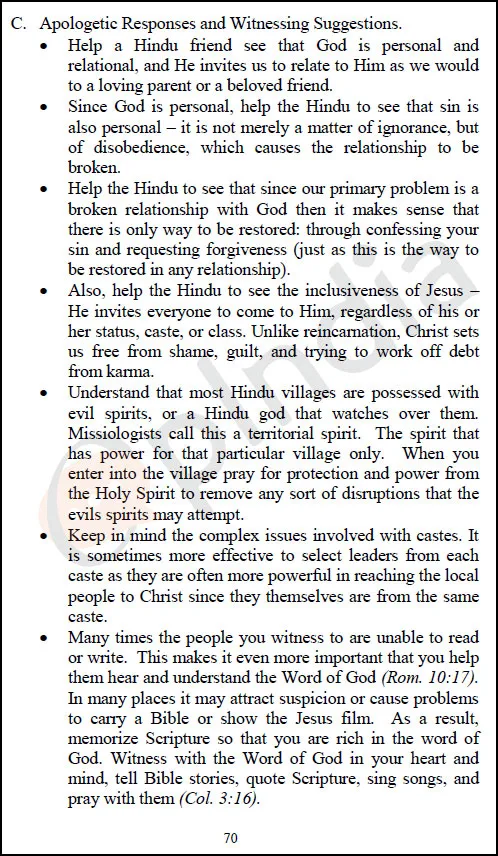
This is not incidental argumentation. It is structured persuasion, designed to gradually shift foundational beliefs.
Demonisation framing: ‘Pray before entering villages’
Perhaps the most controversial element of the manual is the language used to describe Hindu belief systems.
The text reportedly advises missionaries to view villages as being under the influence of “evil spirits” or “territorial powers.” In this framework, local deities are not seen as alternative expressions of faith but as entities that must be spiritually confronted.
Missionaries are instructed to pray for protection and strength before entering such villages, reinforcing the idea that these spaces are spiritually hostile.
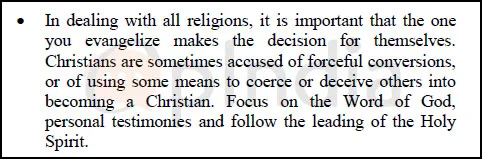
This framing goes beyond theological disagreement. It introduces a narrative where indigenous belief systems are not merely different but dangerous or corrupted.
Such characterisations risk deepening social divides and fostering cultural alienation.
Strategy over visibility
The manual also reveals a clear awareness of resistance within Hindu-majority areas. It acknowledges that overt missionary activity, such as carrying Bibles or screening religious films, can attract suspicion and opposition.
However, rather than reconsidering the outreach model, the response suggested is a tactical adaptation.
Missionaries are encouraged to memorise scriptures and rely on oral communication instead of visible religious tools. This allows them to continue engagement without drawing attention.
The shift is subtle but significant. The concern is not whether entry into resistant communities is appropriate, but how it can be achieved more effectively.
Soft tactics, deep penetration
A key component of this strategy is the use of “soft” outreach methods. Missionaries are advised to engage through storytelling, songs, prayers, and informal interactions.
These methods are presented as culturally sensitive, but the context suggests they are also strategically chosen to reduce resistance.
By embedding themselves within the social fabric of a community, missionaries can build trust and familiarity. This gradual integration makes the eventual introduction of religious ideas less abrupt and more acceptable.
This represents a shift from direct evangelism to embedded influence, where the process is softened, but the objective remains unchanged.
Organised structure
The revelations also highlight the organisational depth of TTI. Founded in 2007 by David Nelms, the organisation has grown into a global network. It is currently led by Jared Nelms.
The existence of structured manuals, standardised training, and uniform messaging indicates that this is not a decentralised or spontaneous effort. It is a coordinated system with defined methodologies and goals.
Such organisation raises questions about scale, reach, and long-term impact, particularly in culturally sensitive regions.
The controversy has reignited a long-standing debate around religious freedom and ethical boundaries.
While the right to propagate one’s faith is constitutionally protected, the methods employed in doing so remain a subject of intense debate.
Strategies designed to bypass resistance, reinterpret belief systems, and gradually influence communities cross into ethically questionable territory.
The tension lies in the methods, whether they are transparent and consensual, or strategic and layered.
With the Enforcement Directorate continuing its probe and new details emerging from independent investigations, scrutiny of TTI is expected to deepen further.
Authorities are likely to examine not just financial compliance but also the broader implications of the organisation’s activities in India.
As investigations progress, the TTI controversy stands at the intersection of law, faith, and strategy, raising questions that extend far beyond a single organisation.