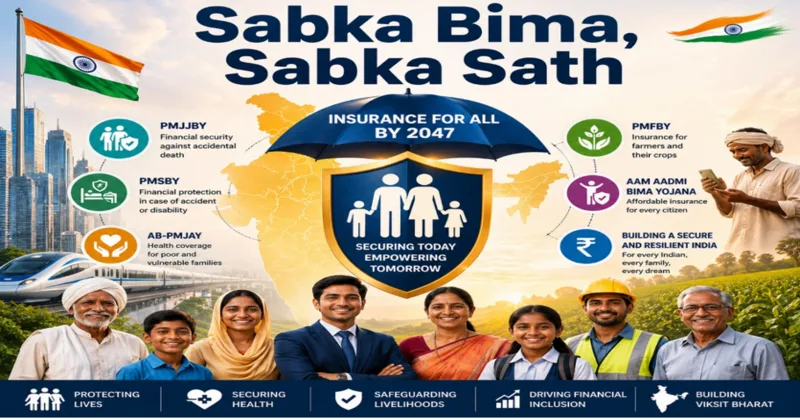
A country wellness and prosperity is not measured only by the size of its economy but by the depth of its social safety net. When citizens are shielded from life uncertainties through well-designed, affordable and accessible insurance. Everyone is free to invest, innovate and contribute to national prosperity without having fear of financial ruin. This fundamental truth has guided Indian evolving insurance ecosystem, anchored firmly in the landmark vision of Insurance for All by 2047.
Under the leadership of the Prime minister Narendra Modi and in close collaboration with the Insurance Regulatory and Development Authority of India (IRDAI), the country has embarked on one of the most ambitious insurance transformations journey, the world has seen in recent decades. The goal is clear and inspiring to ensure that every Indian citizen of metropolitan city or remote village has adequate life, health and property insurance coverage, that every enterprise can access suitable risk protection.
The Indian insurance progress is not just one of numbers and regulations. It is a welfare of 1.4 billion citizens of Viksit Bharat 2047 and to a future where no family is left behind in the hour of need.
India Insurance Sector: A path of remarkable growth
Before examining the landmark reforms, it is important to appreciate the sheer scale and momentum of India’s insurance sector in recent years. India has consolidated its position as the 10th largest insurance market globally by nominal premium volumes, commanding a market share of 1.8 per cent a significant achievement for an emerging economy with a vast informal sector and diverse demographic profile.
The numbers tells the growth and deepening reach of schemes. During FY 2024-25, the sector issued an extraordinary 41.84 crore policies, collected premiums of ₹11.93 lakh crore and paid claims amounting to ₹8.36 lakh crore. Total assets under management stood at ₹74.44 lakh crore as on 31 March 2025 which reflects the trust millions of Indians are placing in insurance as a cornerstone of financial planning.
Premium income has grown by 43.37 per cent from FY 2020-21 to FY 2024-25, rising from ₹8.30 lakh crore to ₹11.90 lakh crore. Non-life insurance premiums surged by an impressive 53.46% over the same period with health insurance emerging as the single largest line of business in the non-life segment, contributing 41% of gross domestic premium.
Insurance and pension funds now represent 29.6 per cent of household financial assets up from 28.6 per cent in FY 2018-19 signalling a growing culture of financial awareness and preparedness among Indian households. The distribution network has expanded from approximately 48 lakh intermediaries in FY 2020-21 to nearly 83 lakh in FY 2024-25, dramatically improving accessibility in rural areas and among socio-economically weaker sections.
Sabka Bima, Sabki Raksha: Legislative transformation for every Indian
The legislative cornerstone of India’s new insurance era is the Sabka Bima, Sabki Raksha (Amendment of Insurance Laws) Act 2025, a path-breaking law that amends the Insurance Act 1938, the Life Insurance Corporation Act 1956 and the Insurance Regulatory and Development Authority Act 1999. The very name of the Act is a declaration of insurance protection for everyone. These Act has introduced several transformative provisions that collectively aim to expand coverage, attract investment, simplify compliance and above all protect the policyholder.
One of the provisions is the increase of the FDI limit in Indian insurance companies from 74 per cent to 100 per cent. This bold move is expected to attract stable, long-term foreign investment into the sector, facilitate the transfer of cutting-edge technology and create the capital base necessary for deeper insurance penetration. Countries like the United Kingdom and Germany have long allowed 100 per cent foreign ownership in insurance, India has now joined this progressive club while maintaining strong regulatory oversight.
The Act also eases the regulatory burden on insurers and intermediaries. One-time registration for insurance intermediaries ensures seamless operations. The IRDAI approval threshold for share transfers has been raised from 1 per cent to 5 per cent, reducing bureaucratic friction. The Net Owned Fund requirement for foreign reinsurers has been reduced from ₹5,000 crore to ₹1,000 crore, opening India’s reinsurance market to greater global participation. These reforms collectively position India as one of the most business-friendly insurance environments in Asia.
This act empowers IRDAI to order disgorgement of wrongful gains made by insurers or intermediaries and enhances the maximum penalty for non-compliance from ₹1 crore to ₹10 crore. This demonstrates the Government unwavering commitment to consumer protection a principle that distinguishes India’s regulatory philosophy from many global peers.
GST Exemption: Making insurance affordable
A transformative step towards affordability came with the GST exemption granted on all individual life insurance policies and health insurance policies including family floater plans effective September 22, 2025. The removal of the 18 per cent GST on insurance premiums is a direct benefit to every policyholder, immediately reducing the cost of life and health coverage.
This policy intervention is particularly significant for middle-income and lower-income households, for whom the GST burden had long been a deterrent to purchasing adequate insurance. By removing this financial barrier, the Government has taken a concrete step towards achieving the Insurance for All vision one that will resonate strongly in smaller towns and rural areas where price sensitivity is highest.
Compared to countries like Australia, where insurance products attract a 10 per cent GST with limited exemptions or Canada, where provincial sales taxes add to premium costs in several provinces. India decision to fully exempt life and health insurance from GST is a world-class policy choice that puts citizens first.
Health Insurance Reforms: Stronger rights and greater trust
The regulatory reforms introduced by IRDAI in the health insurance sector represent a comprehensive consumer rights revolution. In a domain where complexity and opacity have historically disadvantaged policyholders, Indian new framework sets a global benchmark for clarity, fairness and inclusivity.
The moratorium period the timeframe after which insurers cannot deny claims on grounds of non-disclosure has been reduced from 8 years to 60 months (5 years), strengthening policyholder protection and reducing the period of uncertainty that policyholders had to endure. A standardised 30-day free look period has been introduced for all policies with a term of one year or more, giving citizens ample time to review and assess their coverage before committing.
IRDAI has mandated insurers to offer products across all ages, regions and occupational categories to cover a wide range of medical conditions, disabilities and medicine, it includes AYUSH alongside allopathy. This commitment to inclusive insurance design is a direct response to Indian diverse healthcare landscape and reflects a regulatory philosophy that is distinctly human-centred.
Other landmark consumer protections include guaranteed policy renewal (insurers cannot deny renewal based on previous claims, except in cases of fraud), a No Claim Bonus to reward claim-free policyholders with enhanced coverage or premium discounts. Full portability provisions are allowed to policyholders switch insurers while retaining accrued benefits. These reforms create a health insurance ecosystem that is fair, transparent and genuinely protective qualities that many mature insurance markets have taken decades to achieve.
Government Schemes: Insurance reaching every corner of India
The true measure of Indian insurance ambition lies in its flagship government schemes and programmes have extended meaningful financial protection to hundreds of millions of citizens who were previously unprotected.
1. Pradhan Mantri Jeevan Jyoti Bima Yojana (PMJJBY)
Launched in May 2015, PMJJBY provides life cover of ₹2 lakh to citizens aged 18-50 years at an annual premium of just ₹436 ,auto-debited for convenience. With 26.88 crore gross enrolments and over 10.45 lakh claims disbursed as of February 2026, PMJJBY has become one of the most successful mass life insurance programmes in the world. The simplicity and affordability of this scheme costs less than ₹1.20 per day, it show2 how smart policy design can democratise access to life insurance.
2. Pradhan Mantri Suraksha Bima Yojana (PMSBY)
PMSBY offers accidental insurance coverage at an annual premium of just ₹20, providing risk coverage of ₹2 lakh for accidental death or full disability and ₹1 lakh for partial disability. With 57.11 crore enrolments making it one of the largest accidental insurance programmes globally. PMSBY provides a critical financial cushion for low-income workers and informal sector employees. The programme’s scale reflects the Government’s determination to ensure that no citizen is left without basic risk protection.
3. Ayushman Bharat Pradhan Mantri Jan Arogya Yojana (AB-PMJAY)
AB-PMJAY is perhaps the most ambitious government-funded health insurance programme in the world. Launched in September 2018, it provides free health insurance coverage of up to ₹5 lakh per family per year for secondary and tertiary healthcare services, with no restriction on family size, age or gender and nationwide portability across empanelled hospitals. In September 2024, coverage was expanded to all senior citizens aged 70 and above irrespective of their income. As of February 2026, 43.52 crore Ayushman cards have been created, thus making AB-PMJAY the largest health assurance scheme in the world by coverage.
India AB-PMJAY covers a beneficiary population that exceeds the entire population of the United States, the United Kingdom, Germany and France combined. The UK National Health Service, often cited as the gold standard of universal healthcare covers approximately 67 million people. Canada provincial healthcare systems cover around 38 million. AB-PMJAY alone has issued over 43.52 crore card and continues to expand a level of governance and social protection that is unparalleled in scale.
4. Pradhan Mantri Fasal Bima Yojana (PMFBY)
India agricultural economy employs hundreds of millions of citizens, farmers have historically been among the most financially vulnerable segments of society. PMFBY addresses this with a comprehensive crop insurance programme that covers non-preventable natural risks. The entire crop cycle from pre-sowing to post-harvest is insured at minimal premium rates (2% for Kharif crops, 1.5% for Rabi crops). As of March 2026, 93.98 crore applications have been received and claims of ₹1,94,505.9 crore paid to farmers, a figure that represents one of the largest financial safety net transfers to the agricultural community in history.
India vs World: A new benchmark in universal coverage
Universal healthcare and insurance coverage have long been aspirational goals for nations across the world. Germany pioneered statutory health insurance in 1883. The UK established the NHS in 1948. Canada introduced universal healthcare in 1966. These systems were built over generations in countries with far smaller and more homogeneous populations, higher per capita incomes and well-established administrative infrastructure.
India’s achievement extending meaningful insurance coverage across life, health, accident and agriculture to a population of 1.4 billion. It includes hundreds of millions in remote and underserved regions. Unlike purely tax-funded systems such as the NHS, which are entirely dependent on fiscal capacity and often face funding constraints. India has developed a multi-layered model that combines government-funded schemes for the most vulnerable, regulatory reforms to expand private sector participation and strong consumer protection measures to ensure trust and uptake.
Germany health insurance system covers 90 per cent of the population through approximately 97 competing non-profit funds. India AB-PMJAY alone now covers the bottom 60% of the population with a ₹5 lakh annual health cover and this is supplemented by ESI coverage for formal sector workers, CGHS for government employees and a rapidly growing private health insurance market.
Japan universal health insurance system, often cited as among the best in the world, achieves near-universal coverage through a combination of employer-based and community-based schemes. India’s approach with PMJJBY, PMSBY, AB-PMJAY, PMFBY and ESI working in a similar principle of layered, scheme-based universalism. The GST exemption on insurance premiums, a step few developed nations have taken in recent years, which underscores India’s pro-citizen policy stance.
China universal health insurance drive, launched in the early 2000 achieved broad coverage through the New Rural Cooperative Medical Scheme and Urban Resident Basic Medical Insurance. India AB-PMJAY offers higher per-family coverage (₹5 lakh per year) and includes portability across states a federalism friendly feature that makes Indian model especially suited to its diverse geography. India extension of AB-PMJAY to all senior citizens aged 70 and above irrespective of income goes further than most universal healthcare systems in providing age-based entitlement without means testing.
Thailand Universal Coverage Scheme, launched in 2002 is widely praised for achieving near-universal coverage. It covers a population of just 72 million. India Insurance for All vision aims to protect 20 times that number and is well on its way to doing so through a combination of regulatory innovation, legislative reform and programmatic expansion.
Building a secure and Aatmanirbhar Bharat
India journey towards Insurance for All by 2047 is not simply a policy programme. It reflects a ethos of Government that believes deeply in the power of social protection. It links financial security and human dignity.
From the Sabka Bima Sabki Raksha Act that opened India insurance sector to the world, to the GST exemption that made premiums affordable for ordinary citizens, to the 43.52 crore Ayushman cards that represent real protection for real families to builds a stronger and more resilient India. The expansion of the distribution network to over 83 lakh intermediaries, the consumer-centric health insurance reforms and the schemes like PMJJBY, PMSBY and PMFBY together paint a picture of a nation on the move.
Compared to the gradual, often resource-intensive paths taken by developed nations to achieve universal coverage, India is charting a faster, smarter and more inclusive route. It leverages digital infrastructure, innovative regulation and the energy of a young, aspirational population. The Insurance for All vision is not a distant dream it is an unfolding reality, shaped by strong policy will, compassionate governance and the belief that every Indian life deserves protection.
As India marches towards Viksit Bharat 2047, insurance will stand as one of the most powerful pillars of national security not just financial security, but human security. A secure citizen is a productive citizen. A protected family is a resilient family.