Pakistan has etched the role of a mediator and peacemaker in the US-Israel and Iran war. It is expected to act as a neutral mediator and seek a lasting resolution to the geopolitical conflict of West Asia. However, the latest action of Islamabad doesn’t align with the fundamentals of a mediator. Most importantly, the Trump administration in the United States has embarked on Pakistan to play the role of a mediator and has rendered it a prime geopolitical attention across the landscape. However, the latest action of Islamabad, seems to be a betrayal against the USA.
The Trump administration has espoused a strong naval blockade in the Strait of Hormuz and has been posing significant gridlock to the maritime trade traversing through the critical chokepoint. With this move, Washington DC aims to impose a strategic pressure on Iran, thereby compelling it to accept the terms of the ceasefire. By blocking the Strait of Hormuz, the United States is aiming to cut the lifeline of the Iranian economy which is energy trade. In contrary to this, Pakistan has unlocked the land trade routes that connect to Iran and aims to unleash trade with the neighbouring Tehran.
This raises serious apprehensions as these are not the acts that a mediator in a war has to do. It also raises questions on whether Pakistan has betrayed the USA to accomplish its strategic and selfish goals. This is clearly a strategic move by Pakistan to overcome the gridlock prevailing at the Strait of Hormuz and fulfill its trade goals and other deeds.
This also reflects the alternate strategy and trade route etched by Pakistan to fuel trade ambitions and a significant sign to vanquish the Hormuz blockade. When the US President Donald Trump designated Pakistan as a mediator, this is how a neutral actor in the war behaves? Does a mediator embark with one stakeholder in the war and accelerate trade interests against the demands of another stakeholder? Thus, geopolitical analysts deem this is a clear betrayal by Pakistan against the US.
Six new land routes to trade with Iran: Puncturing the US maritime blockade
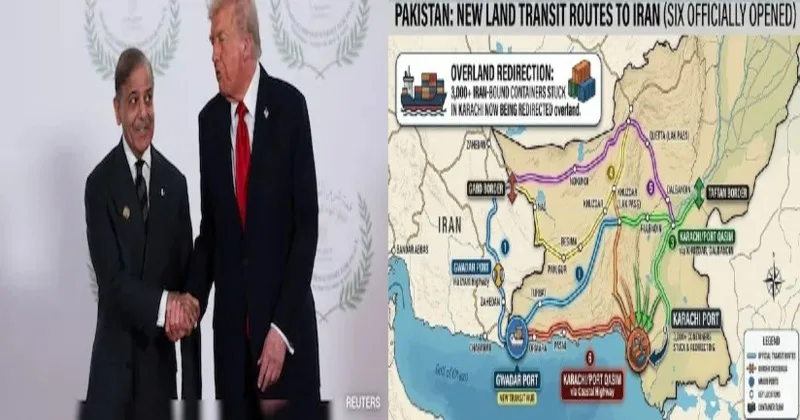
Pakistan has notified six new land routes to trade with Iran and accelerate swift or unhindered goods transportation. Currently, due to the blockade of the Strait of Hormuz, thousands of containers destined to Iran are stranded at Karachi ports. Thus, the alternate land routes unlocked by Pakistan, will help Tehran to get its shipments, which will aid its economy. As per the new notification released by Pakistan, the new land routes include both existing infrastructure and the newly prioritised coastal corridors. The new routes notified by Pakistan are:
- Gwadar to Gabd: It is a vital link identified as the primary corridor due to its proximity to the border of Iran
- Karachi/Port Qasim to Gabd: Utilising the coastal highway via Lyari, Ormara and Pasni
- Karachi to Taftan: The traditional inland route through Khuzdar and Dalbandin
- Gwadar to Taftan (Inland): Linking the deep-sea port to the Taftan border via Turbat and Quetta
- Gwadar to Taftan (Coastal-Inland Hybrid): Utilising Lyari and Khuzdar
- Karachi to Gabd (Direct): A streamlined commercial transit route
As per the reports, more than 3,000 containers bound for Iran are stuck at the Karachi port in Pakistan. This move of Pakistan to reopen the land borders to connect with Iran is deemed as major recalibration in the regional trade and economic architecture. This will indeed boost the trade and transit between Pakistan and Iran. As per the estimation, the Gwadar-Gabd trade route which Pakistan has opened lately, will reduce the transit time by 87 per cent, when compared to the conventional trade routes used earlier between Karachi and Iran. Goods that earlier took 18 hours to reach the Iranian border will now take just three hours. This will also reduce the cost of trade to a drastic extent.
Pakistan has unleashed this new trade mechanism with Iran based on the 2008 bilateral trade agreement between Pakistan and Iran on international road transport. This revamped trade network carved by Pakistan that connects its deep sea ports to Iranian borders is seen as a strategic leverage sealed by Islamabad to fulfill its regional goals. Meanwhile, how will the United States react to this economic bonhomie between Pakistan and Iran is awaited. It is also analysed that by unlocking alternate trade routes to Iran, Pakistan has indeed punched a hole in the maritime blockade of the US across the Strait of Hormuz.
Pakistan has evidently derailed the momentum of the strategic pressure tactic of the USA on Iran. On the one hand, the US is mounting a burden on Iran by puncturing its economic lifelines. On the other hand, Pakistan is facilitating an alternate economic lifeline to Iran. Isn’t this move a clear violation of the rules underlying a mediator? Thus, how will this balancing act of Islamabad redefine the regional trade apparatus? Will it give a boost to the Iranian economy and indirectly strengthen its strategic resistance against the US and what will be counter stroke by the US? The answers are awaited as the conflict escalates, ceasefire collapses and multiple peace talks apparently facilitated by Pakistan repeatedly fails.