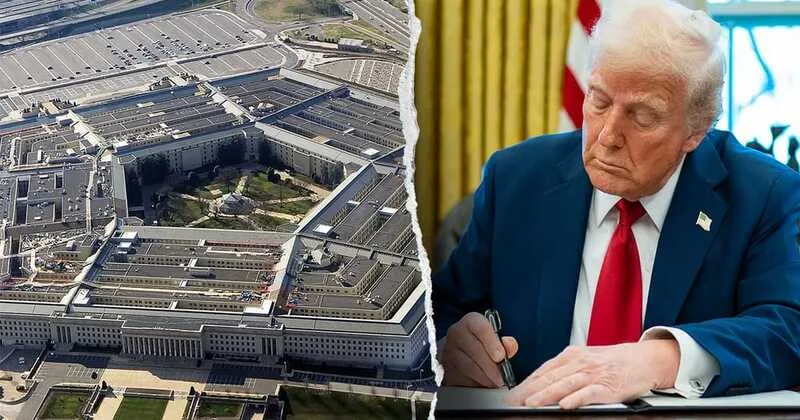
Washington: As the Iran war intensifies, the Pentagon has revealed that current American defence systems are inadequate against the sophisticated missile technology possessed by adversaries. In a candid report, the Defense Department acknowledged that the United States is presently unable to effectively defend against advanced weapons, including hypersonic missiles. The admission has triggered serious concern among American officials amid the expanding conflict in West Asia, with the war with Iran exposing critical vulnerabilities in US defence capabilities.
“We have a very limited, ground-based single-layer homeland defence system that was specifically designed against a small-scale rogue attack,” US Assistant Secretary of Defence for Space Policy Marc J Berkowitz told a Senate panel. “We have very limited capability against any other attack with ballistic missiles, and we have no defence against hypersonic weapons or cruise missiles today,” he added.
Growing threat from advanced missile systems
The report highlights that many of the sophisticated missiles used by Iran are capable of bypassing existing US missile defence systems. Current radar systems and interceptor technologies are unable to reliably detect or neutralise hypersonic missiles, which travel at speeds exceeding 5,000 miles per hour. This limitation poses a direct threat to the security of US military bases and naval assets deployed across West Asia.
Officials have warned that if the Iran war continues for an extended period, the United States could face a depletion of its missile stockpile along with increasing technological gaps. The Pentagon is also assessing whether Iran is benefiting from advanced missile technologies developed by countries such as Russia and China. Defence experts emphasise that countering this evolving threat will require the rapid development of space-based sensors and faster, more advanced defensive missile systems.
Urgent push for ‘Golden Dome’ missile shield
It is highly unusual for the Pentagon to publicly acknowledge such weaknesses in America’s defence posture. The report calls for urgent action to address major shortages and technological bottlenecks in the US arsenal, particularly eight weeks into the ongoing Iran war. It also indicates that the administration of President Donald Trump is considering increased funding for missile defence in the upcoming fiscal year.
A key component of this response is the accelerated development of the ‘Golden Dome’ missile shield, a massive project estimated to cost around $185 billion. The system is designed as a next-generation defence architecture integrating artificial intelligence and space-based sensors to counter a wide spectrum of aerial threats, from drones to hypersonic missiles. The project is targeted to become operational by 2028.
The warning comes as Missile Defense Agency Director Lt. Gen. Heath A. Collins cautioned that the United States is facing a “capacity debt” due to years of underinvestment in the defence sector. He noted that existing supply chains are insufficient to sustain the production of defensive missiles required during a prolonged conflict. Members of the Senate committee observed that the current strategic environment is more complex than during the Cold War era. They stressed the need for the United States to draw lessons from recent conflicts, particularly the use of drones to dismantle air defence systems in the Ukraine war and ongoing Middle East hostilities. The Pentagon has concluded that relying solely on nuclear deterrence is no longer sufficient. Instead, a robust and modern missile defence system is now seen as essential to safeguarding national security in an era of rapidly advancing military technologies.