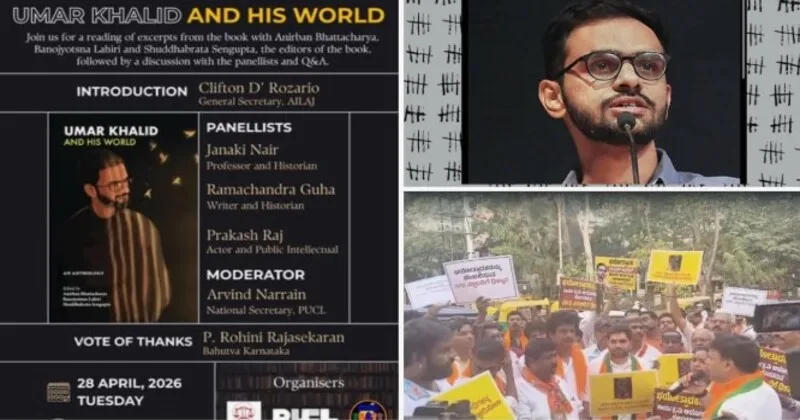
BENGALURU: A book discussion centred on Umar Khalid turned into a major political flashpoint in the city, as protests by the Bharatiya Janata Party (BJP) and heightened security measures marked the event held at the Bangalore International Centre in Domlur.
The programme, titled “Umar Khalid and His World”, was conducted under tight police protection, reflecting the sensitivity surrounding the event. More than 100 police personnel, including senior officers, were deployed at and around the venue to ensure law and order. Authorities had anticipated unrest following calls for protest by BJP workers, who opposed the event citing Khalid’s status as an accused in the 2020 Delhi riots case under the Unlawful Activities (Prevention) Act (UAPA).
Graffiti sparks controversy
The row began days before the event when pro-Khalid slogans such as “Free Umar Khalid” and “Justice for Umar Khalid” appeared on walls in several parts of Bengaluru, including Gandhinagar. The graffiti quickly gained traction on social media, drawing criticism from BJP leaders and supporters, who alleged that such messaging glorified an accused individual.
Party workers responded by blacking out the slogans and demanding that authorities deny permission for the programme. Police described the wall writings as “large-scale” and said they took preventive steps to avoid any escalation.
Tight security measures
On the day of the event, the area around the venue was effectively turned into a high-security zone. Barricades were placed on approach roads, and police regulated movement in the vicinity. Entry into the venue was restricted strictly to those who had pre-registered for the event.
Security checks were thorough, with police verifying identities and recording details such as names and mobile numbers of attendees. Senior officers supervised the arrangements to ensure that the programme could proceed without disruption.
A police official said, “We had credible inputs about possible protests. Adequate security arrangements were made, and necessary precautions were taken to maintain peace.”
Protests and detentions
As expected, BJP and Yuva Morcha workers gathered near the venue and staged protests against the event. Holding placards and raising slogans, they demanded that the programme be cancelled.
However, police intervened before the situation could escalate. Several protesters were taken into preventive custody and moved away from the venue. Officials said the protest did not have prior permission and could have led to law and order issues.
The swift action by police ensured that there were no clashes between protesters and participants.
Prominent attendees add to spotlight
The event drew participation from several well-known figures, including actor Prakash Raj, historian Ramachandra Guha, and academic Janaki Nair. Their presence further amplified the attention surrounding the programme.
While organisers described the event as a literary discussion, critics viewed it through a political lens, intensifying the debate.
Political reactions intensify
The BJP strongly criticised the event, questioning the decision to allow a programme linked to a controversial figure. Party leaders argued that providing a platform for such discussions could send the wrong message and undermine public sentiment.
On the other hand, organisers and attendees defended the programme, maintaining that it was a discussion on a book and part of democratic engagement. They emphasised that debating ideas and perspectives is fundamental to a healthy democracy.
Event concludes peacefully
Despite the tension and political heat, the event concluded without any major incident. Police maintained a tight vigil throughout, ensuring that both the protest and the programme remained under control.
A senior officer said, “The situation was closely monitored. Preventive measures helped avoid any untoward incident, and the event concluded peacefully.”
The episode highlights the growing friction between political groups over issues of glorifying anti nationals. . It also reflects the challenges faced by law enforcement in balancing the right to protest for country with the need to maintain public order.
The controversy comes at a time when political competition in Karnataka remains intense, with both ruling and opposition parties actively shaping narratives around governance, law and order, and ideological positioning.