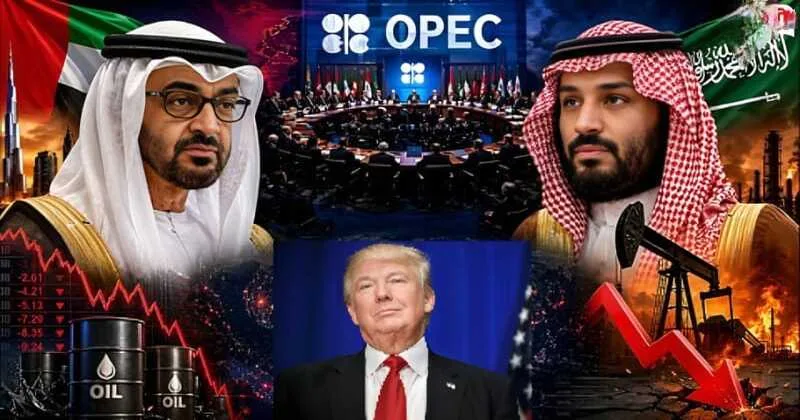
Dubai: The United Arab Emirates has announced its decision to exit OPEC and the wider OPEC+ grouping, marking a significant shift in global energy politics at a time when conflict involving Iran has triggered a sharp and prolonged disruption in global oil supply. The UAE will formally leave the bloc effective May 1, according to an official confirmation issued on Tuesday.
The move represents a major setback to the oil-producing alliance and its de facto leader, Saudi Arabia. The UAE has long been regarded as one of the most stable and reliable members of the grouping, and its departure now risks weakening internal coordination within Gulf countries and OPEC+ at a moment when global oil markets remain volatile and supply routes are under increasing strain. In a statement posted on X, UAE Energy Minister Suhail Al Mazrouei said the decision reflects long-term policy considerations. “The UAE’s decision to exit OPEC aligns with sector policy-driven developments and is consistent with long-term market fundamentals,” he stated. He also expressed appreciation for decades of cooperation with OPEC and its member states, adding that the UAE remains committed to energy security by ensuring reliable, responsible, and low-emission supplies to support global market stability.
Speaking separately to Media, Al Mazrouei clarified that the decision provides the UAE with greater flexibility, as it will no longer be bound by production quotas and other obligations imposed by the group. He emphasised that the move was taken independently, without direct consultations with other members, including Saudi Arabia.
Strategic timing amid regional conflict
The UAE’s departure comes against the backdrop of an ongoing conflict in the West Asia that has severely disrupted oil flows and shaken investor confidence. One of the most pressing concerns has been the security of the Strait of Hormuz, a narrow but crucial waterway through which roughly one-fifth of the world’s oil and liquefied natural gas supplies typically pass. Rising tensions linked to Iran have heightened fears of supply bottlenecks and maritime insecurity, contributing to price volatility in global energy markets. The UAE’s exit from OPEC+ at such a critical juncture is therefore being viewed not only as an economic decision but also as a geopolitical signal reflecting shifting regional dynamics.
Political fallout and Trump’s response
The development has also been framed by some observers as a political victory for Donald Trump, who has consistently criticised OPEC for its influence over global oil prices. Trump has repeatedly accused the organisation of “ripping off the rest of the world” by artificially keeping prices high. He has also linked U.S. security commitments in the Gulf to oil pricing policies, arguing that while United States provides military protection to Gulf nations, those same countries exploit the arrangement by maintaining elevated oil prices. The UAE’s move, in this context, is being interpreted by some analysts as aligning with long-standing American concerns over OPEC’s market control.
At the same time, the decision reflects growing frustration within the UAE, a key regional hub and close U.S. ally, over what it perceives as insufficient support from fellow Arab nations during periods of heightened security threats, particularly amid repeated Iranian attacks during the ongoing conflict.
Gulf disunity and Gargash’s warning
Speaking at the Gulf Influencers’ Forum in Dubai, Anwar Gargash, diplomatic adviser to the UAE President, openly criticised the lack of strong political and military backing from regional partners. He noted that while countries within the Gulf Cooperation Council had provided logistical support, their collective political and military stance had been historically weak. “I expect this weak stance from the Arab League and I am not surprised by it,” Gargash said. “But I haven’t expected it from the (Gulf) Cooperation Council and I am surprised by it.”
Gargash further warned that the current crisis represents one of the most critical moments in Gulf history, drawing comparisons to the Iraq’s invasion of Kuwait in 1990. He stated that trust between regional actors has been deeply eroded and may take decades to rebuild.
Although he acknowledged that relations with Iran could eventually be restored, Gargash stressed that rebuilding trust would be extremely difficult given the scale of recent hostilities. He also alleged that attacks on neighbouring countries were carried out despite prior understandings that Gulf territories would not be used against Iran.
Rethinking alliances and regional security
Gargash argued that longstanding strategies aimed at containing Iran through negotiations and economic engagement have failed. He described Iran as behaving like a superpower without nuclear weapons and warned that it poses a long-term strategic threat to the region. He emphasised the critical role of the United States in maintaining regional security, noting that during recent missile attacks, it was American defence systems that provided effective protection. At the same time, he acknowledged that the level of political and military coordination among Gulf countries during the crisis fell short of expectations.
According to Gargash, the current situation offers three key lessons for the region that the need to rely more on internal capabilities, the importance of restoring unity among Gulf nations, and the necessity of making independent strategic decisions without yielding to external pressures. He stressed that national interests and sovereignty must take precedence over ideological or religious considerations. While reaffirming that the UAE does not seek war, Gargash underscored the importance of pursuing a political solution that safeguards the interests of all parties and ensures long-term regional stability.
Implications for OPEC and global Oil markets
The UAE’s withdrawal could complicate efforts to stabilise oil prices, as OPEC and its allies lose one of their major producers at a time of heightened uncertainty. The move may also encourage other member states to reassess their positions, particularly if internal disagreements continue to intensify. Founded in 1960, OPEC was established to enable oil-producing nations to coordinate production policies and exert greater control over global oil prices. The organisation has long played a central role in managing supply to maintain market stability, especially during periods of geopolitical and economic turbulence.
Following the UAE’s exit on May 1, OPEC will be left with 11 active members, Algeria, Republic of Congo, Equatorial Guinea, Gabon, Libya, Nigeria, Iran, Iraq, Kuwait, Saudi Arabia, and Venezuela.
However, with shifting alliances, rising geopolitical tensions, and increasing pressure on supply chains, the UAE’s decision marks a turning point that could reshape both the internal dynamics of OPEC and the broader architecture of global energy governance.