The historical trajectory of the Indian National Congress has often been sanitised by historians as a linear, inevitable march toward liberation and democratic maturity. However, as we stand in the pivotal year of 2026, a more clinical, honest and rigorous assessment reveals a terminal regression. What the nation is witnessing today is not a temporary political slump or a mere crisis of leadership; it is a century-old institution returning to its primordial, colonial-era function. Founded in 1885 by Allan Octavian Hume, a retired British civil servant, the Congress was explicitly engineered to serve as a “safety valve”. Hume’s intent was candidly imperial. Following the tectonic shocks of the 1857 War of Independence, the British Raj lived in perpetual fear of another spontaneous, grassroots explosion of nationalistic fervour. Hume’s solution was to create a platform where the “educated Indian” could vent his grievances in a controlled, non-violent environment.
The Congress was designed to be the lid on the boiling pot of Indian discontent, ensuring that the energy of the masses was channelled into petitions and polite debates rather than revolutionary action. It was a body intended to stabilise the Empire, not dismantle it. Today, that Humeian safety valve has been reactivated with a vengeance. But the hands turning the valve are no longer in London’s White Hall; they are part of a decentralised, global network of anti-Bharat forces, comprising hostile foreign intelligence frameworks, radical left-wing foundations and globalist entities that view our nation’s civilizational and economic resurgence with visceral, existential hostility. This is the new colonial order and the Congress has once again accepted its role as the primary domestic conduit for foreign interests.
The Tilak Interruption: When Congress found its civilizational soul
The historical aberration in the long, often compromised history of the Congress was the period when it actually functioned as a nationalistic powerhouse. This transformation was spearheaded by the “Lal-Bal-Pal” triumvirate, most notably the indomitable Lokmanya Bal Gangadhar Tilak. Tilak did something that Hume and the early “moderates” never intended: he infused the party with the spirit of the soil, the sanctity of the Dharma and the unapologetic pride of a thousand-year-old civilisation. By declaring that “Swaraj is my birth right”, Tilak moved the Congress from the sterile, wood-panelled drawing rooms of the English-educated elite to the Ganpati Mandaps, the Shivaji Jayanti festivals and the dusty streets of the common man. He understood that a political movement without a cultural and spiritual spine was merely a colonial appendage. He transformed a petition-writing society into a nationalist force rooted in the Prana of Bharat.
The Surat Split of 1907 was perhaps the most significant moment of this era. It was a battle for the soul of the party, between the “Moderates” who were content with Hume’s safety-valve status and the “Extremists” or Nationalists led by Tilak, who demanded absolute sovereignty. For a brief few decades, Tilak’s vision won. The Congress became a vehicle for the national will, seeking to dismantle foreign influence rather than invite it. It was a party that looked inward for strength and upward for inspiration. However, as we observe the party’s conduct in 2026, it is clear that the Tilakian soul has been systematically exorcised. The party has been hollowed out, replaced by a narcissistic leadership that has returned Congress to the Hume model, acting as a domestic proxy for external interests that seek to contain Bharat’s rise.
The Narcissistic Shift: The cult of ‘Self’ over ‘Rashtra’
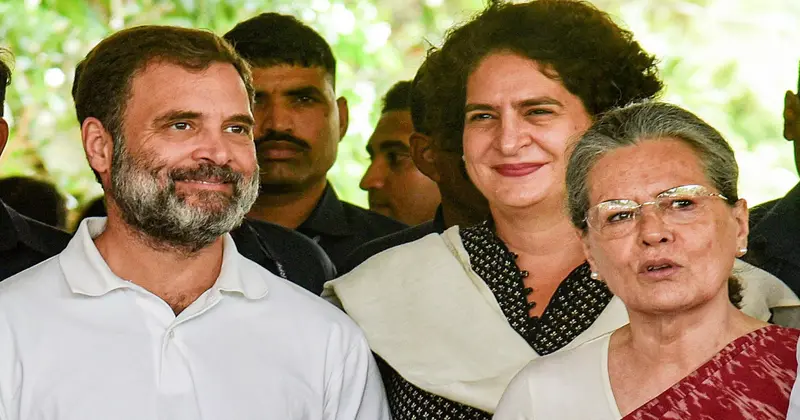
The modern Congress has undergone a fundamental, pathological transition from being “nationalistic” to being “narcissistic”. In its current incarnation, the party exists solely as a vehicle to sustain the relevance of a single dynasty and its shrinking circle of sycophants. This narcissism is the root cause of its current anti-national tilt. In their blind obsession with reclaiming a lost fiefdom, the leadership has conflated their personal political failures with the “failure” of the nation itself. To the narcissistic mind of the current Congress leadership, if they are not the ones ruling Bharat, then Bharat must be described as a “failed state”, a “dying democracy”, or a “repressive regime”. This shift has created a dangerous vacuum where national interest used to reside.
Because the party can no longer connect with the aspirational, nationalist grassroots of Bharat, who have moved on to a vision of self-reliance and cultural pride, the Congress has sought validation and support from the “Break India” ecosystem abroad. They would rather see Bharat weakened and destabilised if it means they can rule over the ruins, than see Bharat prosper under a leadership that respects its civilizational roots. This is the hallmark of a narcissist political entity: the “Self” is placed above the “Rashtra” or Nation. Every policy, every speech, and every protest are designed not to help the citizen, but to massage the ego of a leadership that feels entitled to power. They have traded the welfare of the many for the vanity of the few.
The Reactivated Safety Valve: Serving the global anti-Bharat nexus
In 2026, the evidence of this colonial regression is undeniable. The Congress has reclaimed its role as a “safety valve” for global anti-Bharat sentiments. The recent revelations regarding the party’s formal integration into the Global Progressive Alliance(GPA), a network known for its interference in the domestic policies of sovereign nations, have exposed a deep-rooted connection with a “nefarious nexus” of international forces. By having its top leadership sit on the praesidium of such global bodies, the Congress is no longer an independent Indian political party; it is a branch office for a globalist agenda that seeks to impose a neo-colonial order on the Global South.
This role as a global proxy was most glaring during the controversy surrounding the March 2026 USCIRF report. When a foreign commission, notorious for its biased and Hinduphobic stance, recommended sanctions on Bharat’s premier security agencies like Research and Analysis Wing and cultural organisations like the Rashtriya Swayamsevak Sangh, the Congress did not stand with the nation. Instead, its official communication channels effectively endorsed the report’s fabricated narratives, using them as a “toolkit” to attack the government. This is the ultimate “safety valve” action: taking external pressure from hostile agencies and legitimising it domestically to create a perception of internal collapse. When a party stands with a foreign commission against its own intelligence agencies during a period of heightened regional tension, it has moved from being an “Opposition” to being an Occupational Proxy.
Information Warfare: The Cambridge and GPA toolkits
The Congress’s descent is further accelerated by its deep reliance on “Civil Society” proxies, NGOs and think-tanks funded by foreign interests that have a vested interest in a weak Bharat. These entities provide the “toolkits” that the Congress leadership then amplifies in Parliament and on social media. In early 2026, we saw the deployment of the “Democratic Backsliding Toolkit,” a coordinated narrative produced by European foundations and echoed verbatim by the Congress leadership. They use sophisticated information warfare tactics to paint a picture of an India in turmoil, hoping to trigger international sanctions or investor flight.
Every time a leader goes to Cambridge or Washington and describes Bharat as a “union of states” rather than a civilizational nation, they are not engaged in an academic debate; they are providing the intellectual framework for secessionism. They are inviting foreign intervention to “save” a democracy that they themselves are trying to sabotage. This is the 21st-century version of Hume’s petitions; instead of asking the British Queen for favours, they are asking globalist elites and shadowy foundations for regime change. Their rhetoric serves to release the pressure for foreign meddling, exactly as a safety valve should.
Sabotaging the National Image: The anarchy at the AI Impact Summit
The transition from a nationalist force to an anti-national mouthpiece is visible in the physical sabotage of national pride. The India AI Impact Summit 2026 was a landmark moment, a showcase of Bharat’s technological leadership and its role as a mentor for the Global South. It was a time for the country to stand united and present its genius to the world. Yet, the Congress-led INDI Alliance chose that very moment to stage “shirtless,” chaotic and violent protests in the heart of the national capital. These protests were not about policy; they were about visual sabotage.
They were aimed at creating a backdrop of instability for the international press, providing global media houses like the BBC and New York Times with the perfect “counter-narrative” to Bharat’s success. Union Ministers rightly identified this as a “shameful crime against the nation”. When a political party intentionally tries to belittle a national success story to satisfy its own narcissistic grievance, it proves that its allegiance is no longer to the people of Bharat. The Congress today acts as the primary ventriloquist for those who want to see Bharat’s progress stalled, ensuring that every national achievement is met with a manufactured domestic crisis to deflate the national spirit.
Economic Sabotage: The proxy war on wealth creators
The mouthpiece role extends with surgical precision into the economic sphere. For the past two years, every time a foreign short-seller or a biased international ratings agency releases a report targeting Bharat’s industrial giants or its financial transparency, the Congress is the first to lead the charge. Instead of defending the nation’s economic sovereignty, the party leadership uses these external “hit-jobs” as a toolkit to create panic in the markets and stall vital infrastructure projects. They treat Bharat’s home-grown entrepreneurs as enemies, while treating foreign “economic hitmen” as prophets of truth.
Their reaction to the 2026 Union Budget followed this exact template. While the government sought to secure a deal that protected Bharat’s digital sovereignty and domestic manufacturing, the Congress branded it a “wholesale surrender.” This is the classic behaviour of a “pressure valve”: they take external economic pressure and channel it inward to create friction, hoping to derail the very policies that are making Bharat Atmanirbhar or Self-Reliant. By attacking the wealth creators of the nation, they are essentially attacking the economic backbone of the New Bharat, acting as proxies for global competitors who want to see the Indian economy crippled.
Institutional Erosion: The assault on the judiciary and ECI
A nationalistic party, even in opposition, respects the sanctity of the state’s institutions because it recognises them as the pillars of the Republic. However, the narcissistic Congress has launched a relentless campaign to delegitimise the Election Commission of India (ECI) and the Judiciary. By consistently questioning the EVMs, despite repeated judicial and technical clearances and by attacking judges whose rulings do not favour the Dynasty, the Congress is attempting to hollow out the Republic from within. This is a calculated strategy to create a sense of institutional failure.
By eroding public trust in institutions, they create the “anarchy” they need to invite external mediation. This is exactly what Hume’s “safety valve” was meant to avoid, but the modern Congress has inverted the logic: they are now using the valve to *increase* the pressure until the system breaks. They are no longer participants in the democratic process; they are saboteurs of it. Their goal is not to win an election, but to invalidate the very idea of an election unless they are the winners. This institutional assault is the hallmark of a group that has abandoned the nation for the cult of the leader.
Echoing anti-national verses: The ‘tukde-tukde’ alliance
Perhaps most disturbing is the way Congress leaders now consistently echo anti-national verses that were once confined to radical separatist fringes. We see a party that questions the professional integrity of our armed forces during surgical operations and border standoffs. We see a party that defends elements that openly call for the balkanization of the country under the guise of “freedom of speech.” We see a party that partners with radical outfits in state elections, who have open links to banned extremist organisations.
They have become the domestic megaphone for the Breaking India forces. Tilak used the Ganpati festivals to unify the diverse strands of Bharat into a single nationalist cord. In stark contrast, the modern Congress uses every opportunity, from regional linguistic divides to manufactured North-South” narratives, to fray that cord. Their leadership speaks the language of secessionism, not because they believe in decentralisation, but because they believe that fracturing the national consensus is their only path back to power. They are playing with fire, willing to burn the house down if they cannot be its masters.
The resolve of a New Bharat
The modern Congress has undergone a terminal transformation, devolving from a nationalist powerhouse into a colonial-style “safety valve” that prioritises external agendas over the sovereign pulse of Bharat. By surrendering its ideological autonomy to the radical fringes of the INDI alliance, the party has traded Tilak’s “Swaraj” for a project of national subversion. This alliance, rooted in resentment rather than vision, serves only to provide cover for those mocking Sanatana Dharma and destabilising Bharat’s administrative integrity.
However, the aspirational citizens of 2026 are no longer colonial subjects; they are a sovereign people who value civilizational honour above digital optics. By acting as a mouthpiece for anti-Bharat forces, Congress has forfeited its moral right to leadership. The “safety valve” has been identified and will be shut down by a nation that refuses to be governed by neo-colonial puppets. Bharat has moved toward its destiny as a global superpower, leaving behind those who chose betrayal over the flame of self-reliance.