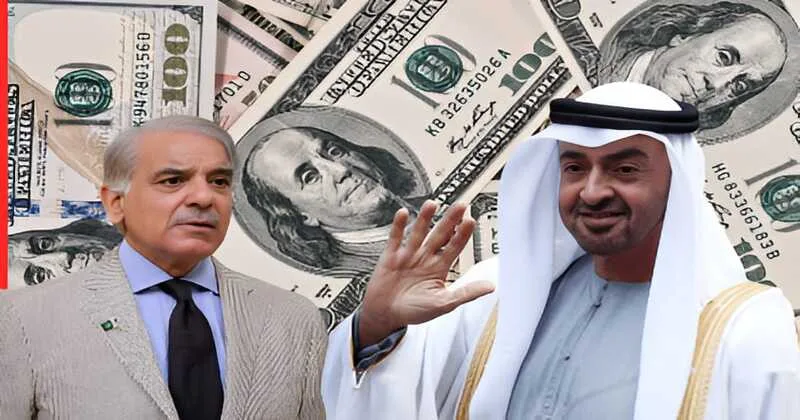
Abu Dhabi/Islamabad : Pakistan’s repayment of a $3.45 billion loan to the United Arab Emirates (UAE) has exposed emerging strains in a relationship long considered stable, with the sudden demand for funds reportedly catching Islamabad off guard and hinting at deeper geopolitical tensions.
Last week, the State Bank of Pakistan confirmed that it had repaid a $1 billion deposit to the Abu Dhabi Fund for Development (ADFD) on April 23. This payment followed the earlier return of $2.45 billion, bringing the total repayment to $3.45 billion.
According to the reports, the UAE’s decision to call back the funds came as a surprise to both Pakistani authorities and the International Monetary Fund (IMF). This was particularly notable because Abu Dhabi had previously assured that it would not seek repayment before the conclusion of Pakistan’s IMF programme in 2027.
While Pakistan’s foreign ministry described the repayment as a “routine financial transaction,” officials in Islamabad privately conveyed frustration over the abrupt nature of the demand. At the same time, some policymakers viewed the episode as an opportunity to reduce dependence on Abu Dhabi, especially given the UAE’s expanding strategic and economic engagement with India.
Geopolitical undercurrents and Gulf rivalries
The reports link the UAE’s move to growing dissatisfaction with Pakistan’s recent foreign policy positioning. Neil Quilliam, an associate fellow at Chatham House, noted that Abu Dhabi has been uneasy about Islamabad’s attempt to maintain a neutral stance amid rising tensions involving Iran. Quilliam observed that Pakistan’s role as a mediator in the United States’ conflict with Iran did not sit well with the UAE, particularly at a time when regional alignments are becoming increasingly polarised. He suggested that Abu Dhabi views the situation in “black and white,” and therefore perceives Pakistan’s “middle ground” approach as lacking neutrality.
The UAE is also believed to be concerned about Pakistan’s deepening ties with Saudi Arabia. Earlier this month, the State Bank of Pakistan received $2 billion from Saudi Arabia’s Ministry of Finance, part of a broader financial assistance package aimed at stabilising Pakistan’s foreign exchange reserves. This support played a crucial role in enabling Islamabad to meet its repayment obligations to the UAE.
Complicating matters further are the growing tensions between the UAE and Saudi Arabia themselves. Differences over the civil war in Yemen, where the two countries support rival factions, have contributed to a widening rift, creating additional pressure points in the region’s diplomatic landscape.
Strategic realignments and future uncertainty
Quilliam also highlighted that the UAE’s increasingly strong ties with India could be influencing its approach towards Pakistan. He noted that Abu Dhabi is “much more invested in India,” and may view the strengthening Saudi Arabia–Pakistan relationship as a potential conflict of interest. Pakistani advisers quoted in the report indicated that the UAE had communicated its expectation for Islamabad to adopt a firmer stance against Iran. This sentiment was echoed by Abdulkhaleq Abdulla, an Emirati academic and commentator, who acknowledged frustration in Abu Dhabi. He pointed out that Pakistan’s attempt to position itself as a mediator “didn’t go down well,” though he cautioned that dissatisfaction alone may not fundamentally alter long-term bilateral ties.
The repayment has increased Pakistan’s reliance on Saudi Arabia, whose financial support now accounts for roughly half of the country’s central bank reserves. Yet, there are signs that Riyadh may not be willing to extend this support beyond immediate financial assistance. Two Pakistani advisers indicated that Saudi Arabia has shown limited enthusiasm for translating a recently discussed defence pact into broader investment commitments. Overall, the episode underscores shifting dynamics in the Gulf region and highlights how Pakistan’s balancing act between competing allies is becoming increasingly complex. While the repayment itself may be framed as routine, the circumstances surrounding it reveal deeper geopolitical frictions that could shape the future of Pakistan’s relations with both the UAE and Saudi Arabia.