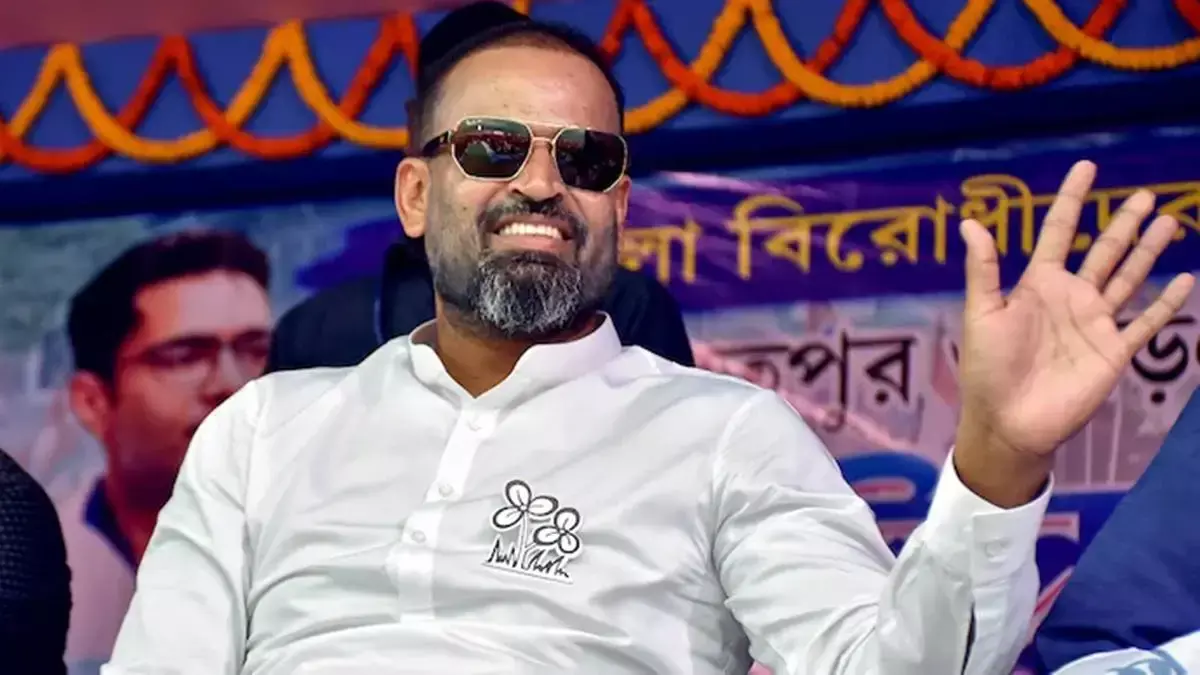
TMC MP Yusuf Pathan praises BJP Gujarat
Vadodara, April 26: Trinamool Congress (TMC) MP Yusuf Pathan on Sunday (April 26) said that the Bharatiya Janata Party (BJP) is likely to remain in power in Gujarat for the next 40 to 50 years, citing continued public support and a development-focused governance model.
Pathan made the remarks after casting his vote along with family members during the ongoing local body elections in Vadodara. The polling forms part of a large-scale electoral exercise across urban and rural institutions in the state.
Speaking to mediapersons, Pathan said, “The BJP cannot be removed from power in Gujarat for the next 40–50 years. The reality is that the party which is strong, works for the people, and is liked by them continues to stay in power.” He emphasised that electoral success ultimately depends on public trust and performance on the ground.
Highlighting Gujarat’s voting patterns, Pathan added that development continues to be a decisive factor for voters in the state. “People here like the BJP and vote for it based on development, so the party will continue to remain in power,” he said.
At the same time, he drew a comparison with West Bengal, where his party, the Trinamool Congress, remains politically dominant. “Similarly, in West Bengal, people prefer the TMC because it raises their voices and works among them,” he stated.
Pathan also addressed concerns related to voter turnout, particularly referring to figures from West Bengal. He argued that turnout percentages can sometimes appear lower due to the exclusion of voters from electoral rolls. “If those voters are included, turnout would still remain around 80 to 81 per cent. It is simply a matter of calculation,” he noted, dismissing speculation about any unusual variation in participation.
It is pertinent to mention here that, political competition in West Bengal has sharpened in recent years, with the ruling Trinamool Congress facing sustained challenges from the Bharatiya Janata Party, which has expanded its footprint across districts and voter segments. Electoral trends since 2019 show a more competitive landscape, with the BJP significantly increasing its vote share and presence in the state assembly. Political rhetoric from both sides has also intensified in this backdrop, reflecting a high-stakes contest rather than a one-sided outcome.
His remarks came as Gujarat witnessed polling across multiple tiers of local governance, including municipal corporations, municipalities, district panchayats, and taluka panchayats. The elections cover nearly 10,000 seats and involve an electorate of over 4 crore registered voters.
Voting is being conducted using Electronic Voting Machines (EVMs) between 7 a.m. and 6 p.m., with counting scheduled for April 28. Key urban centres such as Ahmedabad, Surat, Rajkot and Vadodara are witnessing significant voter participation, alongside rural districts.
Election authorities have put in place extensive arrangements to ensure smooth conduct of polling. Multi-tier security deployments, including large contingents of police personnel, quick response teams, and digital surveillance systems, have been activated across thousands of polling stations.
Meanwhile, Gujarat Chief Minister Bhupendra Patel appealed to voters to participate actively in the democratic process. He described voting as a “sacred civic duty” and encouraged citizens to ensure maximum turnout.
“Every vote contributes to the development of villages, talukas, districts, and cities. People should come forward and make this a festival of democracy,” Patel said, urging citizens to aim for 100 per cent participation.
In another instance, BJP MLA and Minister Sanjaysinh Mahida cast his vote in Nadiad and called upon citizens to exercise their franchise responsibly. “I request everyone to come forward and vote,” he said.
The local body elections are seen as a significant indicator of political trends at the grassroots level in Gujarat, where the BJP has maintained a strong electoral presence for decades. Pathan’s remarks, coming from a leader of an opposition party, have added an additional layer of political interest to the ongoing electoral process.
With counting scheduled in two days, the results are expected to offer insights into voter preferences across both urban and rural constituencies in the state.
