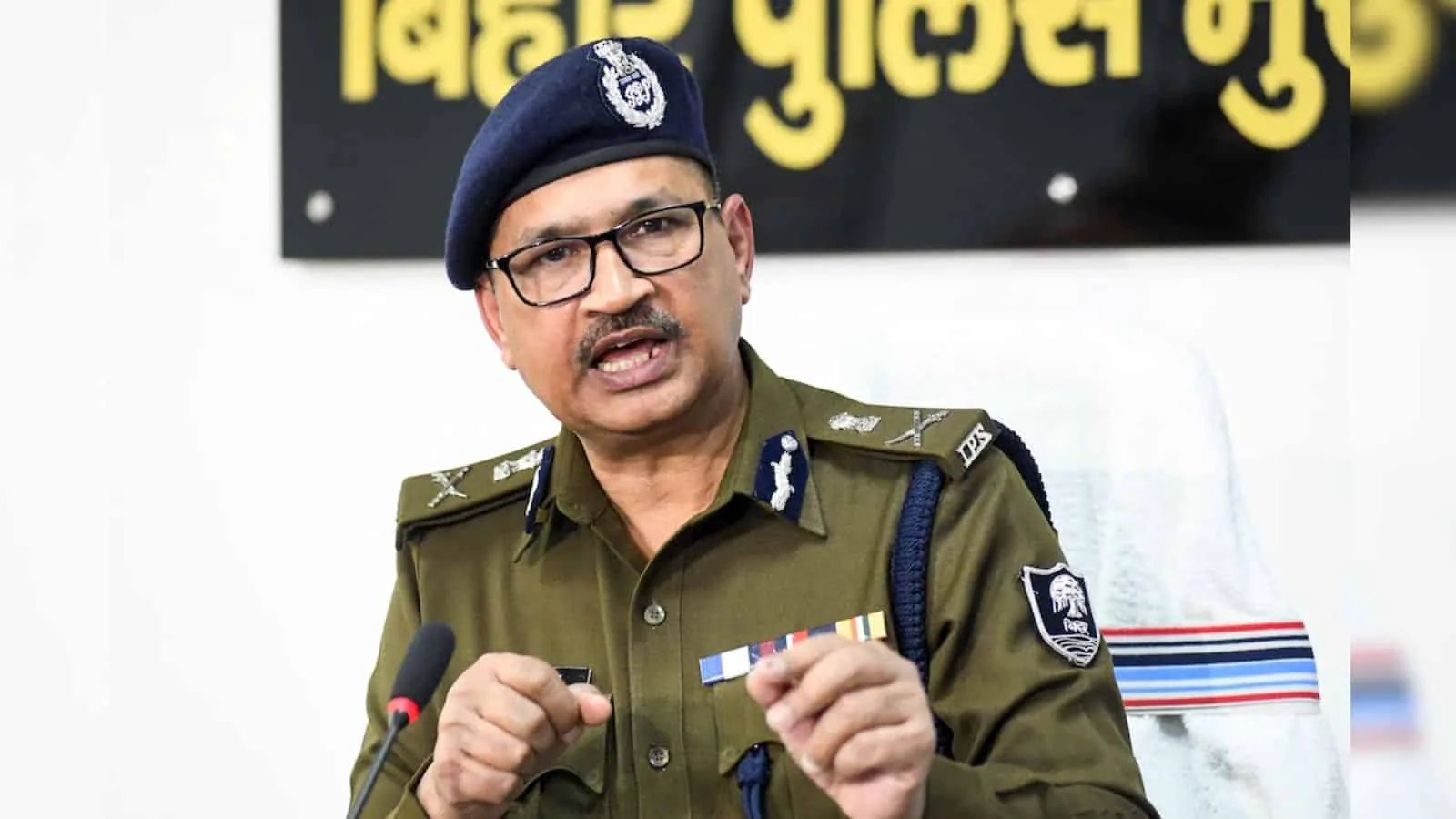
At a time when questions of identity and institutional neutrality are becoming increasingly intertwined, a recent directive issued by Bihar’s police leadership has brought the conversation into sharp public focus. On April 26, Bihar Director General of Police Vinay Kumar directed police personnel to refrain from displaying visible religious markers while in uniform. The order, framed in the language of discipline and professional conduct, has since sparked widespread debate across social and political circles.
The directive reportedly bars police personnel from wearing or displaying symbols such as tilak, chandan, and other visible religious identifiers while on duty. It also extends to female personnel, advising against wearing jewellery such as bangles, mangalsutra, nose rings, and other accessories that are visible over the uniform. The underlying rationale, as cited in reports, is to maintain uniformity, simplicity, and a standardised professional appearance within the force.
While the emphasis on discipline and uniformity is not new within police services, the current directive has drawn attention because of the nature of the restrictions and the questions they raise about the place of personal identity within institutional frameworks. For many observers, the issue is not merely about dress code, but about the balance between professional expectations and individual freedoms.
The Idea of uniformity in uniform
Uniformed services across the world operate on principles of discipline, cohesion, and visual uniformity. The idea is simple: the uniform represents the institution, not the individual. From this perspective, regulations around appearance are often framed as necessary tools to maintain order and clarity in command structures.
In India too, police manuals and service codes have long emphasised neatness, restraint, and standardisation. Restrictions on excessive jewellery, flamboyant appearance, or non-regulation attire are common across departments. These are generally seen as functional guidelines rather than ideological positions.
However, the Bihar directive has brought into question how these principles are applied and interpreted. While limiting heavy jewellery or makeup aligns with standard policing norms, extending such restrictions to small, non-obstructive religious symbols has introduced a more layered debate.
A pattern of similar directives
The current order is not an isolated instance. Over the years, there have been several occasions where questions around religious symbols in workplaces, particularly government institutions, have surfaced.
In 2025, a circular issued by Additional Director General (Law and Order) Pankaj Darad placed similar restrictions on visible accessories and symbols, citing the need for discipline and dignity within the police force. The directive included guidelines for female personnel and emphasised simplicity in appearance.
Earlier, in 2007, a case from Bihar’s Agriculture Department had drawn attention when a senior official reportedly faced disciplinary action for refusing to remove a tilak at the workplace. The incident led to protests by employees, highlighting the sensitivity surrounding personal religious practices in professional settings.
Another episode in 2009 saw internal tensions within the Bihar Police itself when then DGP Anand Shankar faced criticism from sections of the police association over wearing a tilak while in uniform. The issue, at the time, reflected internal disagreements over how service rules should be interpreted.
Taken together, these instances indicate that the question of religious expression within institutional spaces has been evolving over time, often resurfacing in different forms.
Beyond Government offices, A wider trend
The conversation is not limited to government departments. In recent years, similar discussions have emerged in the private sector as well, where companies have introduced grooming policies aimed at maintaining a uniform corporate image.
Instances involving companies such as Lenskart have highlighted how employee appearance guidelines can sometimes intersect with questions of cultural and religious expression. Debates around such policies often revolve around the extent to which organisations can regulate personal identity in the name of professionalism.
Similarly, airline and hospitality sectors, which traditionally maintain strict grooming standards, have also seen discussions around inclusivity and neutrality in appearance guidelines.
India’s constitutional framework guarantees the right to freedom of religion under Article 25, subject to public order, morality, and health. At the same time, institutions, especially those in uniformed services, operate under specific service rules that may impose certain restrictions in the interest of discipline and operational efficiency.
Courts in India have, on multiple occasions, been called upon to interpret this balance. For instance, the Madras High Court in 2024 allowed Muslim police personnel to maintain beards in accordance with their religious beliefs, observing that such practices could be accommodated within service norms.
These legal precedents highlight that the question is not one of absolute rights or absolute restrictions, but of context, proportionality, and consistency.
The Lenskart controversy
A similar debate had unfolded in the private sector when eyewear major Lenskart came under scrutiny after its internal employee grooming policy surfaced online and quickly went viral. The document outlined strict appearance guidelines, stating that employees should avoid wearing visible religious markers such as kalava, bindis, or prominent tilak while at work, particularly in customer-facing roles. It also reportedly advised that if sindoor was worn, it should be applied in a minimal and non-prominent manner.
These restrictions were presented as part of maintaining a standardised, professional appearance across stores.
However, what drew significant attention was that the same policy appeared to permit the wearing of hijabs and Sikh turbans, which are also visible expressions of religious identity. This perceived inconsistency led to sharp reactions on social media, with many questioning whether the policy was selectively restrictive rather than uniformly applied.
Many argued that while companies have the right to define dress codes, differential treatment of religious symbols raises concerns about fairness, inclusivity, and the broader interpretation of neutrality in workplace environments. The episode soon expanded beyond a corporate policy issue into a larger public conversation on how institutions, both private and public, navigate the balance between professional standards and individual expressions of faith.
The changing nature of workplace identity
As India’s institutions evolve, so too does the understanding of identity within professional spaces. The modern workplace is no longer seen as a space entirely detached from personal identity. Instead, there is a growing recognition that individuals carry their cultural and religious identities with them, even in formal roles.
At the same time, institutions continue to emphasise the need for neutrality, particularly in roles that involve public interaction, law enforcement, and governance. The challenge lies in defining what neutrality looks like in practice.
Is neutrality the absence of all visible identity markers, or is it the equal accommodation of diverse identities? This question sits at the core of the ongoing debate.
The Bihar directive has elicited a range of responses. Some have supported the move as a step towards reinforcing discipline and ensuring that the police force presents a neutral and unified image. Others have questioned whether such measures disproportionately affect certain forms of expression.
One of the central questions emerging from the debate is whether visible religious symbols, particularly those that are small and non-intrusive, interfere with the discharge of duty. While large or conspicuous displays may raise practical concerns, smaller markers often fall into a grey area.
Supporters of stricter guidelines argue that even minor deviations can lead to inconsistencies and make enforcement of rules more complex. Critics, however, contend that a blanket approach may overlook the nuances of individual expression.
This tension between discipline and expression is not unique to Bihar or even to India. Across the world, institutions continue to grapple with similar questions, particularly in multicultural societies.
The Bihar Police directive has, in many ways, become a lens through which larger questions about identity, secularism, and institutional authority are being examined. It is a reminder that policies governing appearance are rarely just about appearance; they often reflect deeper ideas about how institutions see themselves and the individuals within them.
As discussions continue, what remains clear is that the conversation is far from settled. The balance between uniformity and individuality, between institutional discipline and personal belief, will likely continue to evolve.
For now, the directive stands as an example of how even seemingly administrative decisions can resonate far beyond their immediate context, opening up wider debates about the nature of public institutions and the place of identity within them.