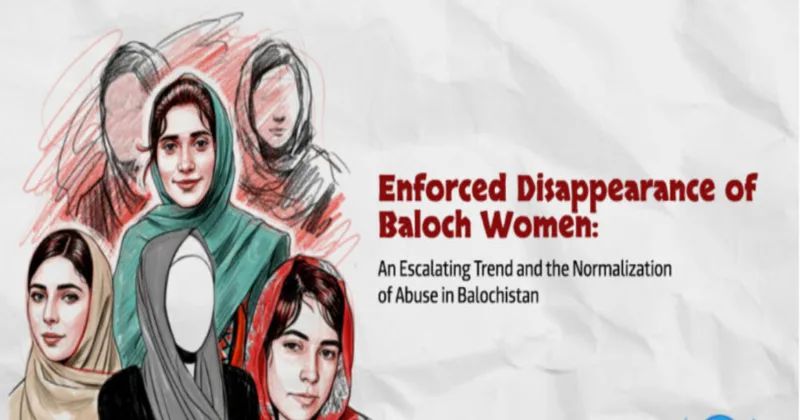
Two Baloch women have been forcibly disappeared in separate raids in Balochistan’s Khuzdar and Kech districts, family members and rights groups said, in the latest cases involving Baloch women. According to reports, Pakistani forces entered a residence in the Istakhli area of Naal in Khuzdar on April 22, assaulted family members and took Sameena, daughter of Dost Muhammad and a resident of Ornach, into custody. Her cousin, Qambar, son of Latif, was also detained during the operation. Both were transferred to an undisclosed location and have not been produced before a court.
The Human Rights Council of Balochistan (HRCB) confirmed the incident, stating that Sameena and Qambar were forcibly disappeared and that their whereabouts remain unknown, describing the rise in cases involving women as “deeply concerning”, according to a report of The Balochistan Post.
In a separate case, the Baloch Yakjehti Committee (BYC) said 22-year-old Gul Banuk, daughter of Taj Muhammad, was taken into custody during a late-night raid in the Singabad area of Kech district on April 14, 2026. According to the group, her whereabouts remain unknown. Her case has come to light only now, almost 10 days later.
BYC leader Dr Sabiha Baloch said the case raised serious concerns regarding due process and lawful detention, adding that the disappearance of Baloch women reflects what she described as an expanding pattern of state repression. “Women are taken to pressure families and to deter public dissent,” she said, adding that detainees are often later presented after periods of incommunicado detention in circumstances that raise concerns of “coercion”.
She said practices including secret detention and denial of legal safeguards undermine legal norms and require independent scrutiny, and called for the immediate disclosure of Gul Banuk’s whereabouts and her safe release. The latest incidents follow a series of reported detentions involving Baloch women in recent days.
Earlier this week, Khadija Baloch, a nursing student, was allegedly taken during a raid on the Bolan Medical College hostel in Quetta. On April 16, Haseena Baloch, a resident of Awaran, was reportedly detained during a raid in Karachi’s Naval Colony area and moved to an undisclosed location. Rights groups say five Baloch women have been subjected to enforced disappearance in April alone, while approximately 15 women have been reported missing in recent months across Balochistan and Karachi.
Meanwhile, the Baloch Students Organisation Azad (BSO-Azad) has accused the Pakistani state of pursuing what it described as a “systematic effort” to normalize the enforced disappearance of Baloch women, calling it a deliberate attempt to weaken Baloch society. Central spokesperson Sholan Baloch said Baloch society is rooted in moral and ethical principles shaped by resistance against injustice, justice and equality, and respect for women. These traditions, he said, have historically defined its identity and preserved what he described as its dignity.
He said that after what he described as Pakistan’s “occupation” of Balochistan in 1948, the state began exploiting the region while attempting to alter its social structure by suppressing language, culture and traditions in order to maintain control. “Enforced disappearances have already been made routine… efforts are now being made to normalize the disappearance of women,” he said, adding that raids on homes and violations of domestic spaces were taking place and that women were being subjected to “collective punishment.”
He said that in the current year alone, nearly two dozen Baloch women had been forcibly disappeared from Quetta, Karachi, Hub, Khuzdar, Kech, Awaran, Gresha, Dalbandin and Tejaban. He alleged that some of the women were being held in “torture cells” and subjected to “inhumane treatment,” while others faced threats and what he described as “media trials” aimed at weakening the ongoing movement through false narratives.
Referring to historical events, he said the Pakistani state had previously carried out similar actions in Bangladesh, alleging that women were abducted and subjected to violence. He described this as reflecting a pattern of disregard for social morality and human rights. He added that similar practices were now being repeated in Balochistan, where women were being harassed, threatened and forcibly disappeared, calling such actions “serious human crimes” and violations of human ethics and the laws of war.
He said the increasing disappearance of women formed part of what he described as a broader attempt to weaken and desensitize Baloch society and distort its structure, adding that such measures would not succeed, stating that a nation “in which resistance is embedded in its memory cannot be subdued by force.”