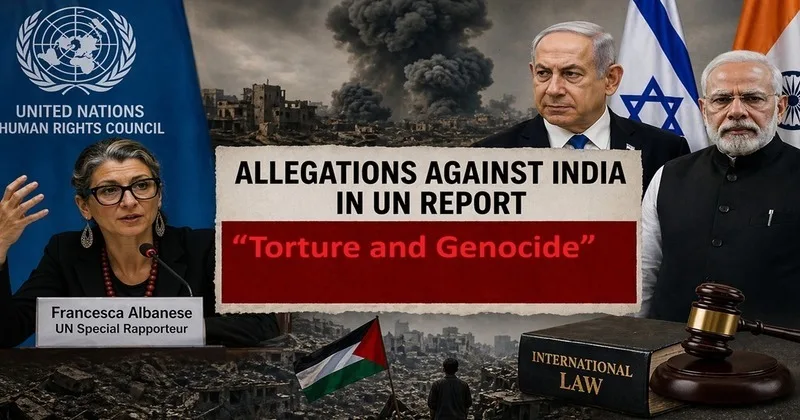
In recent times, a report titled the “Torture and Genocide Report” presented before the United Nations Human Rights Council has sparked a new debate regarding India’s foreign policy, particularly concerning its relations with Israel. This report, presented by Francesca Albanese, suggests that India’s proximity to Israel could place it in a position of violating international law; however, can India’s balanced foreign policy truly be evaluated based on the merits of a single report? Furthermore, even if India has extended assistance to Israel, such actions are entirely pragmatic and logical. Israel has consistently stood by India; it is a matter of policy and indeed, a centuries-old Indian tradition to provide timely assistance to those who step forward to help us.
To truly comprehend the relationship between India and Israel, it is essential to first examine its historical foundations. These ties did not emerge overnight; rather, they are the culmination of decades of shared experiences, mutual trust and cooperation. During the 1971 India-Pakistan War when India was besieged by international pressures and very few nations were willing to openly declare their support, Israel provided assistance covertly. At the time, this cooperation was not made public, as India needed to maintain a delicate balance in its relations with Arab nations; nevertheless, this fact is duly documented in various historical studies. It was a pivotal moment when, amidst the complexities of international politics, one nation recognized the needs of another and extended assistance without any fanfare or publicity.
Subsequently, the “Kargil War” of 1999 proved to be a decisive turning point in this relationship. As the Indian Army battled the enemy across treacherous mountainous terrain and faced an urgent need for state-of-the-art technology, Israel, without any delay supplied drones, laser-guided weaponry and advanced surveillance systems. These technologies significantly augmented the Indian Army’s operational capabilities and played a pivotal role in tilting the outcome of the war in India’s favor. This was, without a doubt, an instance of trust and partnership between India and Israel two nations- that was put to the test during a moment of crisis.
The reality of international relations is that they are not based solely on moral ideals; rather, nations have always guided their interactions with one another based on national interests. Every country makes decisions with its own security, economic and technological interests in mind. India, too, has consistently adhered to this principle. Today, Israel stands as one of the leading nations in the fields of defense technology, cybersecurity, drone systems and intelligence cooperation. For a country like India situated within a complex security environment and constantly grappling with challenges such as terrorism, the significance of such an ally is immense. Therefore, should India and Israel choose to cooperate, it constitutes a pragmatic and rational decision, aligned with both present and future requirements.
Furthermore, one should view India’s policy through the lens of its deep-rooted cultural and ethical traditions; within Indian civilization, the principle of “reciprocity” returning a favor for a favor has long been a cherished value. It is considered a moral imperative to extend cooperation and support to anyone who stands by you during your times of adversity. When Israel extended its assistance to India during challenging periods, it was certainly not merely fulfilling the formalities of diplomatic relations; it was, in fact, forging a bond of trust. Consequently, if India chooses to stand by Israel today, it serves as an extension of that very tradition, one that places immense value on friendship and mutual cooperation.
The question now arises; is this cooperation in violation of international law? In this context, it is essential to understand that while observations made by institutions such as the International Court of Justice, as well as reports issued by the United Nations, carry significant weight, they do not necessarily constitute final and binding verdicts in every conceivable situation. To date, there exists no direct international judicial ruling that has held India culpable for its diplomatic ties with Israel. The arms trade and strategic cooperation are standard and legitimate practices within the international arena- provided they do not contravene any explicit sanctions or prohibitions. Therefore, it would be more appropriate to view India’s stance as a subject of ongoing global debate, rather than as an established transgression. Another significant aspect of India’s foreign policy is its sense of balance. On one hand, it strengthens its ties with Israel; on the other, it has consistently supported the rights of Palestine. India has long been a proponent of the two-state solution, a stance demonstrating that it does not offer blind support to any single party, but rather has adopted a balanced approach right from the outset aimed at fostering peace and stability. It is precisely this balance that lends maturity to India’s diplomacy.
It is also noteworthy that India’s cooperation with Israel today extends beyond the defense sector to encompass fields such as agriculture, water management, cyber security, artificial intelligence, and innovation. Israel’s drip irrigation technology has played a pivotal role in enhancing agricultural productivity across numerous drought-prone regions of India, while its water management techniques have paved the way for the more efficient utilization of resources. Thus, this relationship is multifaceted; to limit it solely to military cooperation would fail to do justice to the reality of the situation.
Everyone here must understand that India’s cooperation with Israel is neither a sudden decision nor the result of a mere political inclination. It represents a balanced confluence of history, strategy and cultural values. It has long been India’s tradition to stand by those who stand with it; this is precisely why India’s cooperation with Israel is logical. Indeed, this decision also serves as a symbol of the maturity and credibility of India’s foreign policy. Consequently, we should treat the report titled ‘Torture and Genocide’, presented to the United Nations Human Rights Council by the UN Special Rapporteur, Francesca Albanese very lightly; there is no need to take this report too seriously. Today, India is doing exactly what serves its own best interests and this shall remain India’s policy going forward.