For all followers of the Sanatan Dharma residing across the globe, the Himalayas serve as a silent proclamation of the cosmic vastness hidden within the human soul. Nestled amidst snow-clad peaks, where even the breeze seems to resonate with the cadence of Vedic chants lies the sacred Kedarnath Dham. It is a pilgrimage site where the spiritual journey transcends mere religious rituals, evolving into an awakening of the inner consciousness. Indeed, a pilgrimage to Kedarnath is less about traversing external trails and more about walking the inner paths of the mind, where one encounters and communes with one’s own true self. Upon reaching this sacred sanctuary, devotees become so deeply immersed in the ‘darshan’ (sacred sight) of their chosen deity that they perceive Shiva’s divine presence enshrined everywhere within the natural world. In essence, they embark upon the profound journey of recognizing the ‘Shiva’ that resides within their own being.
दिव्य आह्वान: आइए चलें, चारधाम यात्रा पर! 🛕
देवभूमि उत्तराखंड बुला रहा है…
जहां हिमालय की गोद में बसता है आस्था, प्रकृति और आध्यात्म का अद्भुत संगम। 🙏गंगोत्री, यमुनोत्री, केदारनाथ और बद्रीनाथ धाम श्रद्धालुओं के स्वागत के लिए तैयार हैं। आइए, स्वच्छता, प्रकृति संरक्षण और… pic.twitter.com/Itvav74iZx
— MyGov Hindi (@MyGovHindi) April 23, 2026
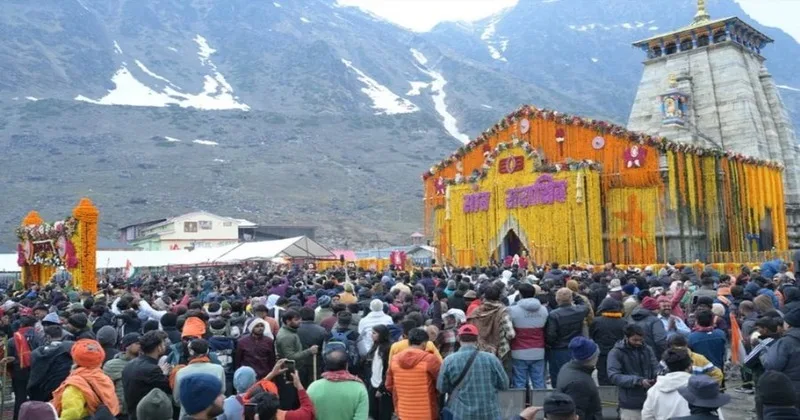
Amidst this divine aura, precisely at 8:00 AM on April 22, Wednesday- during the auspicious ‘muhurat’ (propitious time), the gates of Kedarnath Dham were opened for devotees to offer their prayers and seek ‘darshan’, accompanied by the chanting of Vedic mantras and strict adherence to scriptural rituals. With this sacred moment, the annual Kedarnath pilgrimage officially commenced. Religious ceremonies, which had begun around 4:00 AM, had already suffused the entire shrine complex with a radiant spiritual energy. Following the ceremonial worship of the ‘Panchmukhi Doli’ (the five-faced palanquin), the palanquin bearing Lord Kedarnath was brought into the temple precincts, and the gate-opening ceremony was conducted in accordance with established traditions.
Precisely at 8:00 AM, the moment the gates swung open, the ‘Panchmukhi Doli’ was the first to be ushered into the ‘Garbhagriha’ (sanctum sanctorum); subsequently, after the completion of all religious formalities, Bhagwan Kedarnath was ceremonially enshrined in His divine seat. Uttarakhand Chief Minister Pushkar Singh Dhami was also present to witness this historic occasion. Amidst the presence of thousands of devotees, the entire shrine complex reverberated with the resounding chants of “Har Har Mahadev!” Adding to the divine grandeur of the spiritual festivities, a magnificent shower of flowers was ceremonially released from a helicopter hovering above the temple.
LIVE: श्री केदारनाथ धाम के कपाट खुलने के अवसर पर दर्शन-पूजन
https://t.co/9HRJnzOsVu— Pushkar Singh Dhami (@pushkardhami) April 22, 2026
The spiritual significance of Kedarnath Dham
The religious significance of Kedarnath Dham holds a uniquely exalted position within the Sanatan tradition. This is one of the twelve ‘Jyotirlingas’, where Bhaagwan Shiva is enshrined in the form of ‘Kedar’. The “Shiva Purana” (Kotirudra Samhita, Chapter 35, p. 112) states: “A devotee who worships Shiva with reverence in the sacred realm of Kedar is liberated from the bondage of birth and death.” It must be said that this assertion lies at the very core of Indian spiritual thought- a tradition wherein the path to liberation leads through ‘Atma-gyan’ (self-realization).
Kedarnath has also held an immensely glorious place within the annals of history. It is widely believed that Adi Shankaracharya undertook the renovation of this temple during the 8th century. In his composition, the “Shivananda Lahari” (Verse 23, p. 47), he writes: “The worship of Shiva grants one the realization of the soul’s pristine nature”. Kedarnath stands as a living epicenter of this very realization, a place where the spiritual seeker experiences the non-dual unity (Advaita) of the individual soul (Atma) and the Supreme Soul (Paramatma). In essence, the seeker becomes one- in spirit, in sentiment and in their entire state of being with both their Creator and with Nature itself.
केदारनाथ धाम के कपाट आज आठ बजे खुल गए हैं। कपाट खुलने से पारंपरिक पहले पूजा अर्चना की गई। pic.twitter.com/TLRJOZ6cQ3
— LP Pant (@pantlp) April 22, 2026
From a cultural perspective, Kedarnath Dham constitutes an integral part of Indian folk life. A pilgrimage to this site is not merely a religious journey; it is simultaneously a vibrant cultural festival, a magnificent confluence of folk songs, age-old traditions and collective faith. The renowned historian Dr. Ramesh Chandra Majumdar notes in his book, “Ancient India” (p. 289), “The pilgrimage sites of the Himalayas have served as living centers of Indian culture, where the non-dual nature of religion and society is vividly manifested”.
The spiritual significance of Kedarnath is, in truth, not confined merely to scriptural texts; rather, it is grounded in the realm of direct experience- a space where the human being discovers their true self. Consequently, even Swami Vivekananda could not refrain from articulating his thoughts on this profound subject. During his travels, he remarked: “Seated in the lap of the Himalayas, a human being can recognize the infinite power residing within themselves”. (Complete Works of Swami Vivekananda, p. 214). Kedarnath stands as the very symbol of this inner spiritual power.
केदारनाथ धाम पर कपाट खुलने पर पहुंचे सभी यात्रीयों पर पुष्प वर्षा की गई।
सभी यात्रीयों का स्वागत है। pic.twitter.com/QGjiCOS8wg— Pradeep Maikhuri (@PradeepMaikhur3) April 22, 2026
From a natural perspective, too, Kedarnath is truly unique. Situated at an altitude of approximately 3,583 meters above sea level, this sacred shrine rests upon the banks of the Mandakini River. Surrounded on all sides by snow-capped mountains, pristine streams, and pure air- indeed, all these elements combine to create a divine center of energy. The profound stillness that pervades this place inspires one to look inward. In contemporary times, while the pilgrimage to Kedarnath may outwardly appear to be merely a religious journey, it stands as a symbol not only of religious faith but also of the unity and cultural continuity of Indian society. The ceaseless stream of devotees arriving from both within the country and abroad serves as a testament to the fact that the Sanatan tradition remains just as vibrant today as it was thousands of years ago.
It must be said that the sight of sheer enthusiasm visible in the eyes of the devotees gathered here for the opening of the shrine’s portals marked the very first step on the path toward inner peace. Amidst the showering of flowers, the chanting of mantras, and the resounding peals of bells, it felt as though Nature herself had joined in to participate in this divine celebration. Indeed, anyone who arrives here and lingers for even a short while is bound to experience the infinite depths of this sacred place.
दिव्य केदारनाथ धाम के कपाट आज श्रद्धालुओं के लिए विधि-विधान के साथ खुल गए हैं।
बाबा केदार से प्रार्थना है कि सभी पर उनकी कृपा बनी रहे और हर यात्रा मंगलमय हो।
हर-हर महादेव🙏 pic.twitter.com/LXGpmQdYu3
— Himanta Biswa Sarma (@himantabiswa) April 22, 2026
Kedarnath Dham beckons us all, conveying the message that the true journey of life is not an outward expedition, but rather an inward one. It is only when a human being recognizes the ‘Shiva’ residing within the inner self that they attain true liberation. Nestled in the lap of the Himalayas, this shrine has for centuries inspired us to walk the path of self-illumination, self-awakening and inner consciousness, a path where the answer to every question is found within oneself. Kedarnath embodies that very consciousness which introduces a human being to their true nature. Embedded within every stone, every breeze, and every sound of this place lies a singular message: “Know Thyself, for that is Shiva. What He is, so too are you”. The human soul and the cosmic consciousness (Shiva) are not distinct entities; we are not merely the body, the mind, or the intellect- rather, we are that very same pure, blissful consciousness. ‘Shivo’ham’…’Shivo’ham’…’Shivo’ham’…!