The long-running investigation into the 2006 Malegaon blasts has taken yet another decisive turn, with the Bombay High Court quashing charges against four accused, deepening concerns over how the case was handled during the tenure of the United Progressive Alliance.
A division bench led by Chief Justice Devendra Kumar Upadhyaya (as per the current roster context) set aside the charges framed by a special court against Rajendra Chaudhary, Lokesh Sharma, Dhan Singh and Manohar Narwaria. The detailed order is awaited, but the court’s decision effectively dismantles the prosecution’s case against this second set of accused.
From Initial Arrests to Complete Collapse
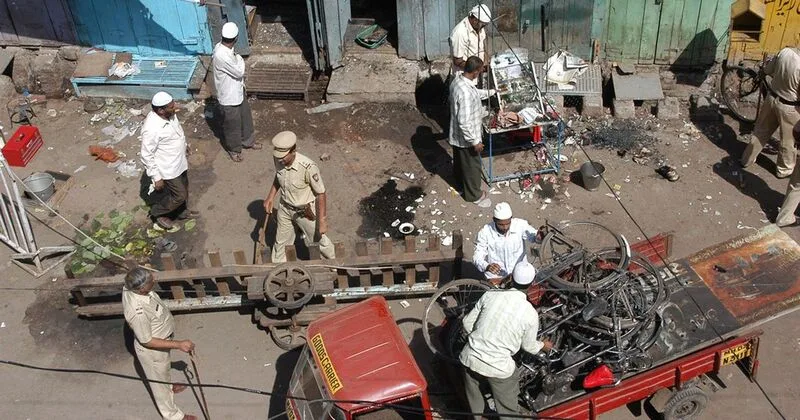
The 2006 blasts near a mosque in Malegaon claimed 37 lives and injured over 300 people. In the immediate aftermath, the Maharashtra ATS arrested nine Muslim men, who spent years in prison before being granted bail and eventually discharged in 2016 due to lack of evidence.
The case then took a controversial turn when the National Investigation Agency pursued a different theory, leading to the arrest of four Hindu men based largely on statements linked to an alleged ‘confession’ statement by Swami Aseemanand.
With the High Court now quashing charges against this second set as well, the case stands in a striking position: two entirely different investigative theories, two sets of accused, and neither sustained in court.
Agenda Politics: A Narrative Built Before Evidence
Gaurav Bhatia, the national spokesperson of the Bharatiya Janata Party (BJP) launched a sharp attack on the Congress party following the Bombay High Court order quashing charges against four accused in the 2006 Malegaon blasts case, pointing out that the Congress-led UPA government had derailed the investigation to push a “saffron terror” narrative.
Addressing a press conference at the BJP headquarters in New Delhi, Bhatia stated how the term was coined to “hide failures and pursue appeasement politics,” and demanded that senior Congress leaders apologise to the nation and the Hindu community in light of the court’s decision.
Responding to the verdict, Gaurav Bhatia highlighted how the investigation was deliberately steered to fit a political narrative. He stated that during the UPA regime, instead of focusing on identifying the real perpetrators, the government sought to “hide its failure” and pursued appeasement politics by coining terms like “saffron terror.” According to him, this narrative was promoted under the leadership of Sonia Gandhi and to politically benefit Rahul Gandhi.
Bhatia argued that the High Court’s decision to quash charges is a “strong rebuttal” to that narrative and demanded an apology from Congress leaders to the nation and the Hindu community.
Allegations of a Botched Probe
The BJP spokesperson further alleged that investigative agencies during the UPA era were pressured to build a case around the idea of “Hindu terror,” leading to a situation where individuals were targeted and a narrative was constructed before evidence could stand scrutiny in court. He claimed this approach not only failed to secure justice for the victims but also allowed the real perpetrators to evade accountability.
In his remarks, Bhatia also named former Union Home Ministers P. Chidambaram and Sushil Kumar Shinde, accusing them of endorsing or enabling this narrative shift.
“Judiciary Has Corrected the Course”
Bhatia emphasised that the verdict reflects the strength of India’s judiciary, stating that despite political interference, the courts have ultimately upheld justice by scrutinising weak or unsustainable cases.
He described the situation as a “sinister conspiracy” aimed at defaming Hindus for short-term political gains, asserting that the concept of “Hindu terrorism” was artificially created and has now been discredited.
Renewed Political Flashpoint
The BJP has demanded that Congress leaders, including Sonia Gandhi, Rahul Gandhi, and party president Mallikarjun Kharge, issue a public apology and take accountability.
The party maintains that the sequence of events in the Malegaon case, from wrongful arrests to collapsed prosecutions, demonstrates how political narratives can distort investigations and delay justice.
The Larger Question
Beyond the political sparring, the case raises a deeper institutional concern: how two radically different investigative tracks, targeting entirely different groups, both failed judicial scrutiny over time.
For the victims and their families, the core issue remains unresolved: who carried out the 2006 Malegaon attack, and why has the system failed to conclusively establish it after nearly two decades?