Alappuzha: What began as outrage over a controversial Vishu advertisement has now expanded into a larger protests, with allegations emerging that such incidents are not isolated but form part of a pattern of organised and provocative messaging targeting Hindus, their festivals, and traditions by a jihadi network in Keralam. The controversy, which initially centred on a single restaurant in Cherthala in Alappuzha district, has widened to include multiple establishments across Keralam, where similar visual themes have appeared in Vishu promotional campaigns.
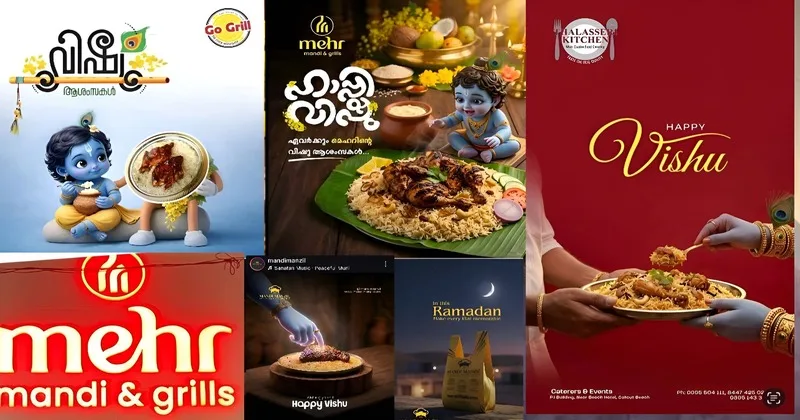
Restaurants now under focus include Meher Mandi & Grills in Alappuzha district, Go Grill Mandi Mahal Hotel in Erattupetta (Kottayam district), Mandi Manzil Hotel Group with outlets in Thiruvananthapuram, Kollam and Alappuzha, and Thalassery Kitchen in Kozhikode district, owned by Shareef and Munawar. Across these establishments, Vishu advertisements have drawn attention for depicting Bhagwan Krishna alongside non-vegetarian dishes in ways that have triggered strong reactions.
A consistent visual pattern has been identified in these campaigns. In several posters, “Bhagwan Krishna is placed directly in front of biryani platters arranged as the central visual,” while in others, “fried chicken pieces are positioned above or around the deity’s image as part of the composition.” Certain designs show “Krishna integrated into a festive food layout dominated by meat dishes,” merging devotional imagery with commercial presentation. The recurrence of such portrayals across different districts has brought focus to the possibility of a wider trend rather than isolated creative choices.
Contrasting approaches to religious occasions
The issue has also drawn attention to the differing styles of festival-based promotions by the same establishments. During Ramadan, campaigns released by these restaurant groups are framed around themes of fasting, prayer, and community gatherings, with visuals that avoid the use of religious figures in potentially sensitive contexts.
In contrast, Vishu-themed campaigns from these establishments prominently feature the image of Bhagwan Krishna in close proximity to non-vegetarian dishes. The visual pairing of a revered deity with meat-based food items stands in contrast to the norms of ritual purity associated with the festival.
Vishu, marking the Malayalam New Year, is a deeply spiritual occasion centred on the Vishukkani ritual, where auspicious items are arranged and viewed at dawn as the first sight of the year. Bhagwan Krishna occupies a central place in many Vishu observances, with households offering prayers in an atmosphere of devotion, discipline, and symbolic continuity. Within this sacred framework, the repeated depiction of Krishna alongside meat dishes has been seen as a departure from established cultural practices.
Initial Trigger: Meher Mandi & Grills Controversy brought wider attention
The issue first gained prominence following a Vishu advertisement released by Meher Mandi & Grills in Cherthala, owned by Mohammed Shemir, son of a leader associated with the Indian Union Muslim League, who is among the nine owners of the restaurant along with Arshad and Shamnad. The advertisement depicted Bhagwan Krishna alongside a non-vegetarian dish, drawing widespread public attention.
The poster presented “Krishna placed before a biryani platter with fried chicken arranged prominently,” released as part of a Vishu greeting. The imagery, circulated during one of the most sacred festivals in Keralam, led to protests and demonstrations. Hindu organisations, including the Vishwa Hindu Parishad, announced protests in front of the establishment, marking an escalation of the issue. As more posters from other restaurants surfaced with similar compositions, including those linked to Go Grill Mandi Mahal Hotel, Mandi Manzil Hotel Group, and Thalassery Kitchen, the focus shifted from a single controversy to a broader pattern spanning multiple districts.
The emergence of similar Vishu advertisements across multiple establishments has intensified attention on how Hindu religious imagery is being used by the Jihadi network in Keralam. The repeated depiction of Bhagwan Krishna in close proximity to non-vegetarian dishes, across different districts and unrelated outlets, has raised questions about whether these are isolated creative decisions or part of a deliberate and patterned approach that targets Hindu festivals.
Bhagwan Krishna remains one of the most revered deities in Hindu tradition, symbolising dharma, devotion, and divine presence. His imagery carries deep cultural and spiritual meaning, particularly during festivals like Vishu, which emphasise ritual purity, sacred symbolism, and continuity of ancestral practices. Within this framework, the recurring visual placement of Krishna alongside meat-based dishes is being viewed as a direct and conscious departure from established norms of reverence. With multiple establishments now linked to similar portrayals, the issue has evolved into a larger debate on intent and pattern. The repetition of such imagery across locations has brought focus to the possibility of coordinated visual messaging aimed at provoking religious sentiment, rather than isolated instances of artistic or promotional expression.