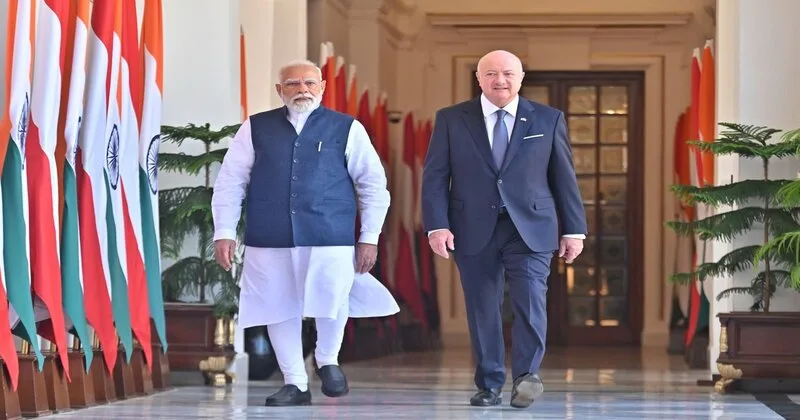
New Delhi: India and Austria on April 16, Thursday concluded 15 outcomes as part of the four-day official visit of Federal Chancellor Christian Stocker to the country, covering key areas including defence, technology, trade, innovation and skills development, with a focus on establishing a Joint Working Group on Counter Terrorism between the two nations. The outcomes were finalised following wide-ranging discussions between Prime Minister Narendra Modi and Chancellor Stocker in New Delhi, marking the first visit by an Austrian Chancellor to India in four decades.
Addressing the joint press meet with Austrian Chancellor Christian Stocker.@_CStocker https://t.co/p3HZhwjbjz
— Narendra Modi (@narendramodi) April 16, 2026
According to official statements by the Ministry of External Affairs, both sides agreed to strengthen cooperation across strategic sectors and reiterated their commitment to combating terrorism in all its forms, including cross-border terrorism. A key highlight was the Letter of Intent to establish a Joint Working Group on Counter-Terrorism, aimed at enhancing strategic cooperation in tackling global terror threats. The leaders also emphasised defence collaboration through a Letter of Intent on Cooperation in Military Matters, which seeks to deepen defence industrial partnerships, policy dialogue, training and capacity building.
Among the major agreements signed was the Agreement on Audiovisual Co-production, which will promote collaboration between the film industries of both countries, facilitating joint productions and cultural exchange. To boost business ties, both countries announced a Fast Track Mechanism for Indian and Austrian companies, aimed at addressing investor concerns and improving ease of doing business. In the area of food safety, a Memorandum of Understanding between AGES Austria and FSSAI India was signed to enhance cooperation in standards, scientific exchange and regulatory practices.
Held very productive discussions with Chancellor Stocker of Austria. We in India are glad that he selected our nation as his first destination to visit outside Europe after he assumed office. This reflects his vision and commitment to India-Austria relations. Equally special is… pic.twitter.com/6tzORXGs7H
— Narendra Modi (@narendramodi) April 16, 2026
A Joint Letter of Intent on vocational education and skills development was also agreed upon, focusing on apprenticeship systems, knowledge sharing and mutual recognition of vocational qualifications. In addition to these agreements, several key announcements were made, including the renewal of cooperation in road infrastructure, the expansion of the India-Austria Startup Bridge and the launch of an Institutional Cybersecurity Dialogue. Both sides also agreed to collaborate in emerging sectors, including high-technology domains such as quantum technology, machine learning, material sciences and wastewater management, which were identified as central pillars of the enhanced partnership.
Further initiatives include a bilateral space industry seminar in Vienna in 2026, operationalisation of a Working Holiday Programme, and a structured dialogue on education cooperation aimed at strengthening higher education and skill ecosystems. Following his meeting, Prime Minister Modi, in a post on X, described the discussions as “very productive” and said the visit reflects a strong commitment to deepening bilateral ties. He highlighted sectors such as defence, semiconductors, startups and futuristic technologies as areas with immense potential.
Our talks today covered ways to deepen cooperation in areas such as innovation, infrastructure and sustainability. We are committed to adding new energy in trade and investment linkages. Sectors like defence, semiconductors, futuristic technologies and StartUps present immense… pic.twitter.com/dqWGGu466e
— Narendra Modi (@narendramodi) April 16, 2026
“Held very productive discussions with Chancellor Stocker of Austria. We in India are glad that he selected our nation as his first destination to visit outside Europe after he assumed office. This reflects his vision and commitment to India-Austria relations. Equally special is the fact that this is the first visit by an Austrian Chancellor in four decades,” the PM stated in his post. “We are committed to adding new energy in trade and investment linkages. Sectors like defence, semiconductors, futuristic technologies and StartUps present immense potential for closer relations. I am confident that the India-Austria partnership will get even more innovation-centric and future-ready”, the post added.
The Ministry of External Affairs also took to X, stating that both leaders reviewed the full spectrum of bilateral relations, including trade, investment, innovation, green technologies, education and people-to-people ties, while also exchanging views on regional and global issues. The visit comes at a significant time, following the India-EU Free Trade Agreement, which both sides noted would create new opportunities for trade, manufacturing, investment and job creation. With the conclusion of these 15 outcomes, India and Austria have set the stage for a more innovation-driven and future-ready partnership.
PM Modi and Chancellor Stocker condemn Pahalgam & Red Fort terror attack
India and Austria called for decisive and concerted international efforts to combat terrorism during the visit of Austrian Chancellor Christian Stocker to India. The two sides condemned the heinous Pahalgam terror attack and the Red Fort terror incident, which took place in the national capital and underlined the need for cooperation to counter violent radicalisation and extremism.
The details were shared by MEA Secretary(West) Sibi George while addressing a special media briefing on the official visit of the Austrian Chancellor to India. Ambassador George said that the leaders also welcomed the signing of a Letter of Intent for enhancing cooperation between India and the EU in areas of counter-terrorism and counter-radicalisation. He said, “Both sides categorically and unequivocally condemned terrorism in all its forms and manifestations, including cross-border terrorism. The leaders welcomed the signing of the ‘Letter of Intent’ (LoI) to set up a joint working group on counter terrorism, which will serve as a platform to enhance bilateral cooperation in counter-terrorism and also counter radicalisation through information, knowledge sharing and capacity building within the appropriate multilateral fora in the framework of the respective collaboration between India and the European Union”.
He added, “The leaders condemned in the strongest terms the terrorist attacks in Pahalgam last year and the terror incident near Red Fort in November 2025. They also called for decisive and concerted international efforts to combat terrorism in a comprehensive and sustained manner”. The Ambassador said that the leaders underscored the need for cooperation to counter violent radicalisation and extremism, and specifically the financing of terrorism, including by promoting internationally agreed anti- money laundering standards, as well as to prevent exploitation of new and emerging technologies for terrorist purposes and to tackle terrorist recruitment.
He further noted, “The leaders also reaffirmed a strong commitment to continue taking active measures to disrupt the terror financing linkages and channels, including at the United Nations and the Financial Action Task Force”.
(With Inputs from ANI)