Since ancient times, charity has held unparalleled importance in Bharat. The Atharvaveda states:
“Shatahasta samahara, sahasrahasta sankira”
This means, “Earn with a hundred hands and distribute with a thousand.” Here, the objective is not merely expenditure, but also the spirit of considering the wealth earned through one’s effort as a social responsibility and donating it for the welfare of society.
This very spirit of the tradition of charity has today taken a modern form in Corporate Social Responsibility (CSR). CSR is a meaningful initiative that connects industry and business with social responsibilities, ensuring direct participation of society in development activities. Keeping in mind the goal of inclusive and sustainable development, Section 135 of the Companies Act mandates that eligible companies must spend at least 2 per cent of their average net profits on social causes.
At present, CSR funds are being utilized in important sectors such as education, health, environment, sanitation, women empowerment, rural development and others. Along with all these sectors, various initiatives in the field of art are also eligible to receive CSR funding. As per Schedule VII (v) of Section 135 of the Companies Act, CSR provisions include the protection of national heritage, art and culture including restoration of buildings and sites of historical importance and works of art; setting up public libraries; promotion and development of traditional arts and handicrafts. Under these provisions, numerous classical and folk-art festivals, workshops and projects are being continuously organized across the country.
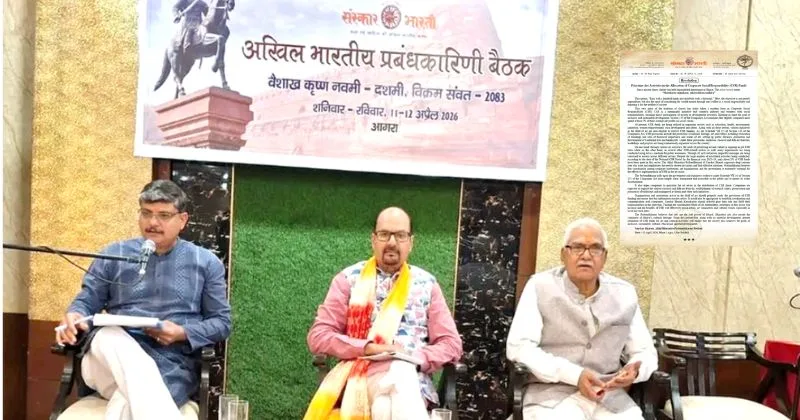
On one hand, through various art activities, the work of preserving art and culture is ongoing as per CSR rules while on the other hand, in several other CSR-related sectors as well, many experiments are being conducted using art as a medium for public awareness. Through all such initiatives, impactful messages are being conveyed to society across different sectors. Despite the large number of art-related activities being conducted, according to the data of the National CSR Portal for the financial year 2023–24, only about 2 per cent of CSR funds have been spent in this sector. The Akhil Bharatiya Prabandhkarini of Sanskar Bharati expresses deep concern over this issue and emphasizes the need to review its causes and find effective solutions. Prabandhkarini believes that coordination among corporate institutions, art organizations and the government is extremely essential for the effective implementation of CSR in the art sector.
The Prabandhkarini calls upon the government and regulatory bodies to make Schedule VII (v) of Section 135 of the Companies Act more simple, clear, transparent and accessible to the public and to ensure its wider dissemination.
It also urges companies to prioritize the art sector in the distribution of CSR funds. Companies are expected to support the various classical and folk-art festivals, establishment of research chairs, preservation and promotion of traditional and endangered art forms and other such initiatives.
Organisations and institutions active in the field of art should properly study the provisions of CSR funding and ensure that this information reaches artists. It would also be appropriate to establish coordination and communication with companies. Sanskar Bharati Karyakartas should actively play their role and fulfil their responsibilities in this direction. Through the coordinated efforts of all stakeholders, awareness in this sector will increase and the benefits of CSR will effectively reach artists, art committees and cultural events, especially in local and rural areas.
The Prabandhkarini believes that arts are the soft power of Bharat. Bharatiya arts also ensure the continuity of Bharat’s cultural heritage. From this perspective, along with its material development, greater utilization of CSR funds for art and cultural activities will ensure that the society also achieves the goals of inclusive, sustainable, cultural, ethical and spiritual development.