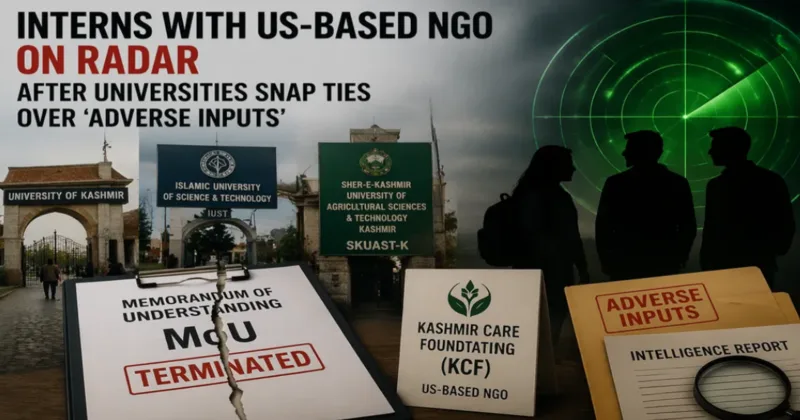
JAMMU: Three universities of Kashmir have terminated their academic agreements with a United States-based organisation, Kashmir Care Foundation (KCF), on the instructions of the government of the Union Territory (UT) of Jammu and Kashmir. The KCF is a very new not-for-profit Non-Government Organisation (NGO) that emerged in the US barely a year ago.
The KCF is headquartered in Atlanta in the US and registered as a not-for-profit, non-religious and a political organisation. It was founded by Dr Altaf Lal of Kashmiri origin. However, he is not known to have done any significant work in Kashmir and his work in the US or elsewhere is also not known.
The NGO had signed MoUs with the universities in 2025, barely a year after the NGO was founded. According to officials, the cancellation was triggered after adverse reports from intelligence agencies. The agencies suspect that these platforms can be used as soft channels to disseminate a specific ideological agenda.
At one time, there were several NGOs active in the US who spread anti-India, separatist and secessionist ideologies. These NGOs, particularly one headed by Ghulam Nabi Fai, was known for paddling pro-Pakistan agenda, gathering Indian scholars and holding seminars and conferences abroad.
The involvement of US-based actors has further intensified scrutiny with fears of coordinated influence efforts across borders. The official said that these universities had signed the MoUs without seeking security clearance, functioning as “autonomous entities.
The SKUAST-K, the University of Kashmir, and the Islamic University of Science and Technology (IUST) cancelled Memorandums of Understanding (MoUs) or Letters of Agreement previously signed with the foundation a year ago. According to a memo, dated March 25, 2026, issued by the Director of Research at SKUAST-K, Prof. Haroon R Naik, the Letter of Agreement signed with Kashmir Care Foundation on April 15, 2025, has been cancelled with immediate effect.
The University of Kashmir, in a communication signed by Registrar Prof. Nasser Iqbal, stated that the MoU executed on December 15, 2025, had been reviewed by competent authorities and found not to be in the larger institutional interest. “The university exercised provisions under the agreement to terminate it with immediate effect”. The communication further clarified that no liabilities, financial or otherwise, had accrued to either party and that no funds had been received or disbursed under the agreement.
At Kashmir University, the agreement was intended to further educational initiatives through workshops, seminars, and other academic engagements in STEM, the humanities, and related fields. The Islamic University of Science and Technology (IUST), Awantipora, also announced the termination of its MoU with the foundation. “The decision followed a review by competent authorities and invoked provisions under a force majeure clause to cancel the agreement”.
The IUST communication states that no financial or contractual obligations have arisen from the MoU and describes the notice as a formal termination of the understanding. All three institutions cited internal review processes as the basis for their decisions, though no further details were provided regarding specific concerns or findings. Interestingly, none of them officially disclosed that they had not had the MoUs vetted by the intelligence agencies, particularly the CID wing of the police.
The agreements had been aimed at academic collaboration, including initiatives related to education, research, and knowledge exchange between the institutions and the foundation. The coordinated timing of the decisions across multiple institutions indicates a broader reassessment of such collaborations, though each university issued its own independent communication.
The universities terminated their MoUs with KCF after intelligence agencies flagged the NGO’s activities.