
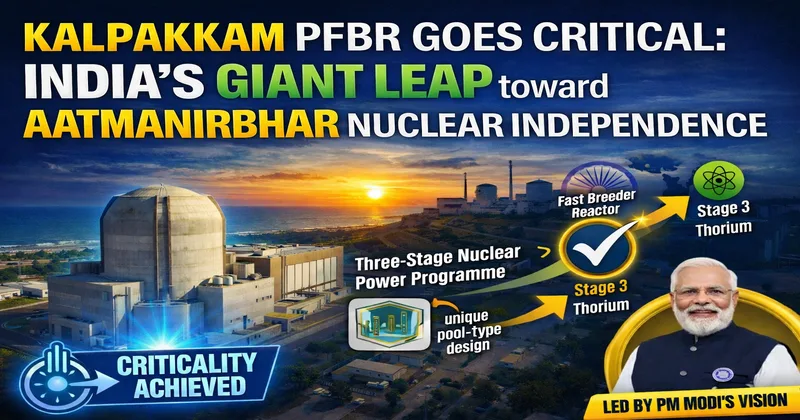
The ongoing confrontation between Israel, America, and Iran has opened eyes wide, particularly for large nations such as Bharat and China. Self-sufficiency in fuel should be a key priority because substantial reliance on other countries might drag the country down in difficult times, such as war, which is why the Modi government has worked relentlessly since 2014 to develop in-house skills. Solar and wind energy, nuclear power, and so on. The 6th of April 2026 is particularly significant for Bharat’s energy program, because Bharat’s scientists showed their skills. The indigenously designed and built Prototype Fast Breeder Reactor (PFBR) at Kalpakkam in Tamil Nadu has reached its first criticality. This PFBR is a 500 MWe (MegaWatt electrical) reactor built by Bharatiya Nabhikiya Vidyut Nigam Limited (BHAVINI) at the Kalpakkam Nuclear Complex. Thorium is important to Bharatiya’s nuclear programme due to its unique position with large thorium and modest uranium resources. Bharat is the second nation after Russia to achieve this incredible feat. America, Japan, France, and Germany spent more than $50 billion but achieved nothing, but Bharat spent less than $900 million and is successful. Bharatiya scientists demonstrate scientific and technological capabilities in all fields.
For a huge nation like Bharat, the long-term strategy for energy supply must be built on indigenous resources and require an optimal balance of energy sources. Aside from the environmental challenges associated with large-scale coal consumption, it is important to note that coal deposits are finite. Solar and other non-conventional renewable energy sources play a vital role and should be utilised to the greatest extent possible. However, multiple high-power base-load power plants are essential to ensure grid stability and meet the demands of industries and metropolitan areas. As a result, nuclear energy plays a significant role in terms of sustainability. In the context of the Bharatiya Nuclear Power Programme (INPP), thorium plays an important role due to its unusual resource profile: large thorium deposits but low uranium stocks. This not only increases the motivation for large-scale thorium use but also necessitates the implementation of thorium-based systems considerably earlier than other countries anticipate. The start of a controlled nuclear fission chain reaction at the Prototype Fast Breeder Reactor moves Bharat into the second stage of a three-stage nuclear program that eventually seeks to complete a closed fuel cycle using the country’s abundant thorium.
With this feat, Bharat has officially reached the second stage of its three-stage nuclear power program, which was first envisioned by Dr Homi Jehangir Bhabha, India’s nuclear programme architect. The milestone has significant worldwide implications. Once fully operational, India will be only the second country in the world, after Russia, to operate a commercial fast-breeder reactor.
“This unique capability significantly enhances the utilisation of nuclear fuel resources and enables the country to extract far greater energy from its limited uranium reserves while also preparing for large-scale use of thorium in the future,” BHAVINI stated. The fast breeder program “strengthens strategic capabilities in nuclear fuel cycle technologies, advanced materials, reactor physics, and large-scale engineering,” and the knowledge and infrastructure developed through the program “will support future reactor designs and next-generation nuclear technologies”.
This achievement is the result of decades of scientific research led by the Department of Atomic Energy. It also represents a key milestone in Bharat’s clean energy journey, reaffirming the country’s commitment to dependable, low-carbon power. Furthermore, it pushes Bharat closer to its objective of reaching net zero emissions by 2070, as announced by Prime Minister Narendra Modi. The PFBR reflects decades of indigenous research, design, and engineering. The Indira Gandhi Centre for Atomic Research (IGCAR), which is part of the Department of Atomic Energy, created the technology.
Advantages of Thorium and the associated three-stage method
Thorium has some physical and chemical advantages over uranium, which may justify its usage as a ‘future nuclear fuel’. Thorium oxide has a greater melting point (3300ᴼC) than uranium oxide (2865ᴼC). It also has better thermal conductivity, a lower rate of fission gas release, and good radiation resistance. Thorium is much more prevalent in the Earth’s crust than uranium, hence the use of thorium in power reactors has been discussed since the beginning of nuclear energy in the 1950s.
Fuel and Design: Unlike conventional thermal reactors, the PFBR uses Uranium-Plutonium Mixed Oxide (MOX) fuel. The fissile material used is recovered from the reprocessing of spent fuel from Pressurised Heavy Water Reactors, closing the loop on Stage 1.
Breeds More Than It Burns: The core of the PFBR is surrounded by a blanket of Uranium-238. Fast neutrons convert this fertile material into fissile Plutonium-239, enabling the reactor to produce more fuel than it consumes.
Bridge to Stage 3: The reactor is designed to eventually use Thorium-232 in the blanket. Through transmutation, Thorium-232 will be converted into Uranium-233, the fuel that will power India’s third stage of nuclear energy based on thorium.
Closed Fuel Cycle: The spent fuel generated by the PFBR will be reprocessed and recycled back into the reactor. This closes the second-stage fuel cycle and paves the way for large-scale use of India’s abundant thorium reserves in Stage 3.
Bharat’s nuclear capability
Bharat presently generates around 7,900 MW of nuclear energy from 24 operational nuclear power plants and is contemplating a significant expansion of its nuclear capacity. According to the government, 17 nuclear power reactors with a combined capacity of 13,100 MW are either under construction (7) or in pre-project activities (10). As part of its Viksit Bharat development strategy, it aims to achieve a nuclear energy capacity of approximately 100 GW by 2047.
The achievement of criticality at the Prototype Fast Breeder Reactor is more than just a technical milestone. It demonstrates the maturity of Bharat’s long-held nuclear goal as well as the strength of its domestic capabilities. From limited uranium resources to a future powered by thorium, Bharat’s three-stage project is progressively progressing from design to delivery. The success of the Kalpakkam Nuclear Complex demonstrates confidence in advanced reactor technologies and highlights the importance of institutions like the Department of Atomic Energy in promoting this transformation. As capacity grows and new technologies emerge, nuclear energy is expected to play an increasingly important role in Bharat’s energy mix. As a result, this moment is both an accomplishment and a watershed moment, cementing the country’s road to energy security, technological self-reliance, and its net zero pledge by 2070.