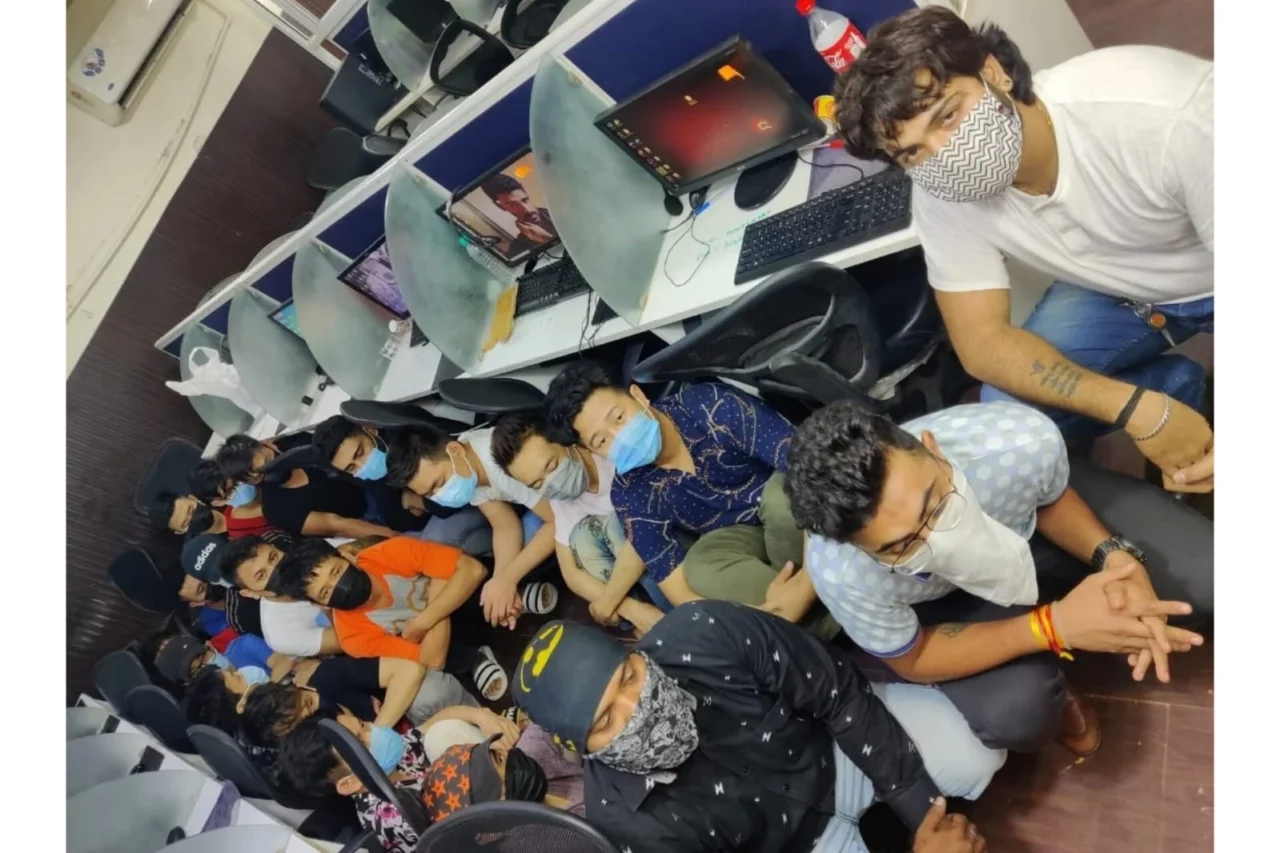
Drones hovered silently over mustard fields, capturing real-time visuals as police teams positioned themselves strategically around a cluster of huts in Reuna village, Ghatampur, Kanpur. What seemed like a quiet rural evening soon transformed into a meticulously choreographed operation reminiscent of a crime thriller.
Leading the operation was ADC Police Sumit Sudhakar Ramteke, who revealed that the plan had been days in the making. “We deployed drones for aerial intelligence and ensured all escape routes were blocked before moving in,” he said. “The sudden strike was essential to prevent any tip-offs or information leaks.”
Earlier in the day, plainclothes police officers had already integrated themselves into the village, observing and confirming suspicions about the cyber fraud activities. Villagers went about their routines, unaware that their fields and huts had become operational hubs for nationwide scams.
The Modus Operandi of the Gang
According to police reports, the gang comprised mostly young men who had completed only basic education, some studying as little as up to class 5, 8, or 11. Yet, despite limited formal schooling, they operated a highly organised scam network targeting citizens across India.
“They posed as police officers, government officials, or bank representatives, luring victims with promises of loans, housing schemes, or other official benefits,” Ramteke explained. “One individual could make 50–60 calls a day. Even if a handful of people fell into the trap, the daily earnings could run into lakhs of rupees.”
During the raid, officers uncovered a network of 20–50 mule bank accounts used to route and withdraw defrauded money. Hundreds of active SIM cards, laptops, mobile phones, and other digital devices were seized, highlighting the scale and sophistication of the operation.
The Sweep of the Raid
As the raid commenced, panic rippled through Reuna village. Local residents recalled seeing suspects scattering in multiple directions. Within minutes, police had stormed all targeted huts, arresting 20 individuals and recovering critical digital evidence.
ACP Ghatampur confirmed that 15 cyber fraudsters managed to escape, likely tipped off in advance. “We are actively tracing them,” he said. “Some villagers appear to have had prior knowledge of the raid and fled before police could intercept them.”
Local shopkeepers and residents expressed shock. “We had no idea such large-scale fraud was being run from these huts,” said one shop owner. “These were young boys from nearby villages, but they were targeting people across the country.”
Villages Emerging as New Fraud Hotspots
Police investigations indicate that Reuna, along with nearby villages like Rathigawan, Lakshmanpur, Samaj Nagar, Badela, and Adigaon, has evolved into a new cybercrime ecosystem. The area has now been branded a “mini Jamtara” due to its structural and operational similarities to the infamous Jharkhand hub known for online fraud.
Cybercrime analyst Rakesh Mishra from Lucknow explained, “Earlier, cyber fraud was associated mainly with urban centres or hubs like Jamtara. Now, rural villages are increasingly becoming operational bases. Cheap internet, easy access to SIM cards, and low visibility make these locations ideal for running scams.”
The Reuna gang’s operations were noted for their simplicity yet efficiency. Youngsters were given daily instructions and carried out fraudulent calls systematically. The operation spanned across states, with victims being targeted in different cities and towns, highlighting the expanding reach of such rural fraud hubs.
The Role of Technology in the Raid
The raid was marked by the strategic use of technology. Drones provided live overhead surveillance, while mobile and network tracking helped pinpoint active locations and coordinate ground teams. Officers noted that this technological edge was critical in the rapid and largely successful execution of the operation.
One arrested youth reportedly told police during questioning, “I just made calls and followed instructions. I never thought the police would reach us like this.”
The recovered devices, ranging from laptops to SIM cards, are now being examined to trace the full extent of the scam network and to identify victims. Police believe the operation is just the beginning, as smaller villages like Reuna are now emerging as new centres for online fraud activity.
Public Awareness and Prevention Plans
Authorities have emphasised that enforcement alone will not stop the trend. Awareness campaigns and educational drives targeting vulnerable youth and potential victims are being planned.
“We need to educate people about cybercrime, including young men who may be drawn into such operations out of financial desperation,” ACP Ghatampur said. “At the same time, citizens must learn to recognise fraudulent calls, messages, and online traps to protect themselves.”
Police officials have also announced increased surveillance in identified hotspots and monitoring through the Pratibimb portal to preemptively detect and prevent similar activities.
The raid has left Reuna villagers both stunned and cautious. For many, the realisation that such organised crime was occurring in their midst has raised questions about local security and youth engagement. Residents expressed concerns about vulnerable youths being lured into cyber fraud due to limited job opportunities and peer influence.
Local authorities are now exploring vocational training, digital literacy, and youth skill development programmes as long-term solutions to reduce susceptibility to cyber fraud activities.
Lessons from Jamtara Replicated
Police and cyber experts agree that the Reuna operation demonstrates the replication of the Jamtara model in smaller villages. While Jamtara in Jharkhand had gained national attention due to its notorious cyber fraud network, Reuna represents a quieter, emerging threat that combines rural invisibility with urban reach.
Experts warn that unless awareness and monitoring increase, more villages could become mini-hubs for scams. “The combination of low oversight, youth unemployment, and mobile technology makes rural areas fertile ground for such crimes,” said Rakesh Mishra.
The Kanpur raid shows the evolving nature of cybercrime in India. With minimal education and simple tools like mobile phones, SIM cards, and laptops, young fraudsters are creating networks capable of defrauding citizens nationwide. Law enforcement, through innovative use of technology like drones and coordinated intelligence, is attempting to counter this trend.
However, a long-term solution requires public awareness, local engagement, and digital literacy. Educating youth about lawful online work opportunities and encouraging community monitoring could prevent future “mini Jamtara” hubs from emerging.
The Reuna operation serves as both a warning and a model. It highlights the ingenuity of rural cybercriminals and the increasing necessity for law enforcement to combine strategy, technology, and community engagement to tackle cybercrime effectively.