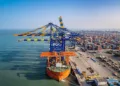
India’s relationship with the sea is not a modern construct. For millennia, the ports were the arteries through which ideas, commodities and civilisations flowed. Today, that relationship is being re-engineered not just for commerce, but for human survival. With a coastline stretching over 11,098 kilometres, 13 major ports, more than 200 non-major ports and a maritime sector contributing approximately 4 per cent to national GDP. India’s blue economy is one of its most consequential, until recently one of its most under-reformed sectors.
Nearly 95 per cent of India’s international trade by volume and about 70 per cent by value moves through its ports. Container turnaround time at major Indian ports, once a sluggish 93 hours in 2014, has been halved to 49 hours in 2025. Inland water cargo movement has grown nearly eightfold from 18 million metric tonnes (MMT) in 2014 to 146 MMT in 2025. Cargo volumes across all ports have grown at a CAGR of 6.2 per cent over the past two decades. These trade metrics have improved, through how cleanly and on what energy from its operating.
Past Challenges: The Weight of Colonial Era Governance
After 70 years of India’s liberation, Indian ports continued to be governed by the Indian Ports Act of 1908, enacted during the colonial era for administrative convenience but not reflecting the developmental vision of an independent country. The environmental considerations were absent from the act, pollution control measures were haphazard, and safety standards did not comply with international conventions. Ship recycling yards like the enormous Alang yard in Gujarat, the world’s largest, operate in an environment that has raised international concerns about worker safety and coastal pollution.
Besides the regulatory shortcomings, the infrastructure bottleneck has made the situation worse. Indian ports lacked inland linkages, cold-chain services, and deepwater facilities capable of accommodating megaships. Private investment was low, and the transhipment business was almost entirely routed through foreign hubs such as Colombo, Singapore and Dubai. The sector’s green credentials were essentially non-existent. The toll of decades of diesel-heavy port operations on coastal air quality and on India’s international environmental standing it was significant.
Policy Interventions: Framework Built for 2047
It starts with one legislative act, i.e. the Indian Ports Act, 2025, introduced by the Rajya Sabha in August 2025, and finally ends the reign of the outdated 1908 law once and for all. The Indian Ports Act ensures that environmental considerations become mandatory requirements of the process rather than just additional aspects, while bringing the regulatory framework of Indian ports into line with the MARPOL and Ballast Water Management Convention standards. For the first time, sustainability is officially a requirement of any Indian port activity.
To begin legislatively, this policy approach has a complex, wide-ranging architecture of initiatives. The Sagarmala Programme, launched in 2015, served as the base for developing India’s strategy of port-driven economic growth. It included 839 individual projects, which were expected to be completed by 2035, with a total investment of Rs 5.8 lakh crore. Sagarmala 2.0 set even higher goals, aiming to attract Rs 12 lakh crore in investments by 2035 and allocate Rs 40,000 crore in direct government investments to shipbuilding, ports, and coastal zone development. With the Maritime India Vision 2030 and the Maritime Amrit Kaal Vision 2047, the initiatives serve two horizons of development.
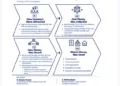
Harit Sagar Green Port Guidelines were released in 2023. These guidelines lay out concrete, measurable targets that ports must achieve. Ports need to cut down carbon emissions per tonne of cargo by 30 per cent by 2030 and by 70 per cent by 2047. At least 60 per cent of port energy use should come from renewable sources by 2030 and this number will rise to 90 per cent by 2047. Electrification of equipment should increase to over 50 per cent by 2030. The green cover in port areas needs to increase by over 20 per cent by 2030. Onboard power supply will be required for ships in a phased manner, and the ports will also be responsible for achieving 100 per cent reuse of wastewater and reducing fresh water consumption by 20 per cent in the coming decade.
Current Scenario & Growth: From Orders to Operations
The Green Tug Transition Programme (GTTP) is perhaps the most vivid symbol of change at work. Tugboats, the essential workhorses of every harbour, have traditionally run on heavy diesel, burning fuel around the clock. Under the GTTP, four major ports have already placed work orders for electric tugs to Deendayal Port in Gujarat, Jawaharlal Nehru Port in Maharashtra, Visakhapatnam Port in Andhra Pradesh and V.O. Chidambaranar Port in Tamil Nadu. The transition from fossil propulsion to electric drive at the harbour’s edge is no longer a pilot it is an active procurement.
Renewable energy deployment across major ports is accelerating. Chennai Port is installing 2 MWp of rooftop solar. Paradip Port Authority is commissioning a 10 MW solar plant. Mormugao Port Authority already generates 3 MW of in-house solar power, meeting 100 per cent of its own consumption and has become India’s first port to introduce Green Ship Incentives through the Environmental Ship Index. With its ‘Harit Shrey’ programme offering discounts on port charges based on the ship’s environmental performance. Mormugao is one of only three ports in Asia, alongside ports in Japan and Oman, to have implemented such incentives. This signals to global shipping operators that Indian ports are preparing to reward clean ships.
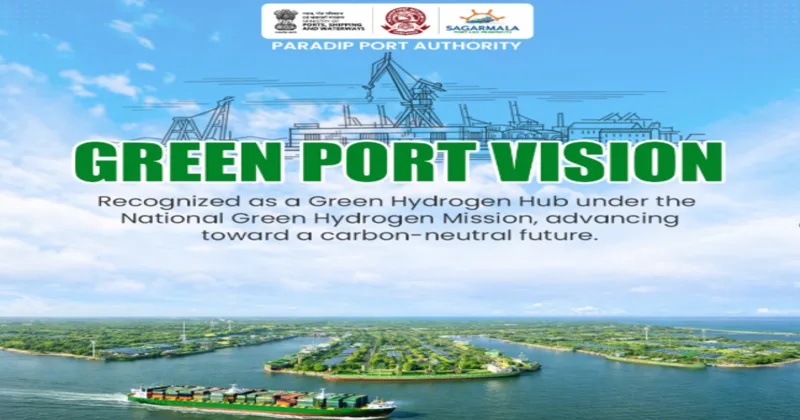
At Deendayal Port, a 1 MW electrolyser-based green hydrogen plant has been commissioned, 3,400 acres have been allotted to developers for green hydrogen and ammonia projects, and the port has achieved Port Readiness Level 6, progressing to 7 for bio-methanol bunkering. A pilot project for green hydrogen was launched at Chidambaranar Port in April 2025, while the Green Methanol Bunkering Facility will have a capacity of two 750-cubic-meter tanks. In Paradip Port, a government green hydrogen and ammonia handling jetty under PPP mode will be established, costing around Rs 797.17 crores with a cargo handling capacity of 4 MMT per year.
PPP Model: A Partnership at Scale
The maritime green transition in India is not an undertaking solely by the public sector, it is a well-crafted PPP framework that aims to mobilize business investments on a large scale. The private sector funding for PPP ventures in large port terminals increased threefold from Rs 1,329 crore in FY23 to Rs 3,986 crore in FY25. 27 MoUs amounting to over Rs 66,000 crore were inked in September 2025 during the ‘Samudra Se Samriddhi’ event at Bhavnagar, spanning across various sectors such as green ports, shipbuilding, inland waterways, maritime finance and logistics. During India Maritime Week 2025 in Mumbai, investments exceeding Rs 12 lakh crore were garnered through over 600 MoUs.
Maritime Development Fund, which is worth of Rs 25,000 crore, has been promoting green investments in the sector. The Vadhavan greenfield port in Maharashtra, which will be developed by the Jawaharlal Nehru Port Authority and Maharashtra Maritime Board, is considered to be the jewel of the PPP model. It will be capable of handling mega ships, to reduce dependence on foreign transhipment facilities and rank among the top 10 ports in the world during this decade. The Union Budget 2025-26 by the government has included the extension of the Shipbuilding Financial Assistance Policy 2.0 worth Rs 18,090 crore, which provides a direct subsidy to Indian shipyards for the construction of next-generation, clean-fuel-ready ships. Green ship recycling policy has been another area of focus, with Rs 53.39 crore subsidies being provided to 109 ship recycling yards through Ferrous Scrap Development Fund till 2026, in conformity with the Hong Kong International Convention for the safe and environmentally sound Recycling of Ships.
Future Potential: The Port that Fuels the World
The shipping sector finds itself at a point of decision-making. The International Maritime Organisation requires that shipping companies adopt a path of decarbonization and that the world’s shipping companies order ships capable of using methanol, ammonia and hydrogen as propulsion fuels. By 2040, ports unable to fuel using these alternatives would become increasingly marginalised. Given that India has abundant solar and wind power, an extensive coastline, and new hydrogen energy infrastructure, it would become one of the key players in the supply chain.
Six new mega ports will soon be operational: Vadhavan in Maharashtra, Enayam in Tamil Nadu, Sagar Island in West Bengal, Paradip Outer Harbour in Odisha, Sirkazhi in Tamil Nadu and Belekeri in Karnataka. The fourteenth major port on Galathea Bay in Great Nicobar Island will be established as a strategically important transhipment port. In its efforts to develop port infrastructure to increase cargo-handling capacity to 10,000 million metric tonnes (MMT), currently at 2,400 MMT, by 2047. The Government of India has proposed an overall investment of Rs 80 lakh crore under the Sagarmala project. Green international collaborations are also witnessing further growth; India and the Netherlands are working together to develop a green digital corridor between India’s ports and the Port of Rotterdam for exporting green hydrogen and carriers.
India has long been a nation that trades with the world. What is changing now is the terms on which it does so and the energy it uses to do it. A port that once ran entirely on diesel, governed by a law written before India was a republic, is today commissioning green hydrogen plants, ordering electric tugboats, installing solar arrays and inking clean-fuel bunkering agreements with the world’s leading shipping lines. The Harit Sagar guidelines, the Indian Ports Act 2025, the Maritime Amrit Kaal Vision 2047, and the Rs 12 lakh crore Sagarmala 2.0 pipeline are the future of Indian Maritime. They are active construction projects with live procurement orders and binding legislative mandates.