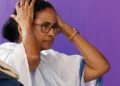
In what could have far-reaching implications for opposition’s so-called unity in Bharat, West Bengal Chief Minister Mamata Banerjee has triggered a major controversy by alleging a “tacit understanding” between the Bharatiya Janata Party, the Indian National Congress, and Tamil Nadu Chief Minister M. K. Stalin.
The remarks, made during a poll rally in Nadia district, come at a politically sensitive time when multiple states are heading into Assembly elections. Banerjee’s allegations stand out because they directly question the integrity and cohesion of the opposition’s INDI Alliance, an alliance formed with the explicit goal of countering the BJP at the national level. Her comments have not only escalated political tensions but have also reignited concerns about whether the opposition alliance is structurally stable or merely a temporary electoral arrangement.
More importantly, the timing of these remarks has raised a deeper political question: if there is indeed no anti-incumbency in West Bengal as repeatedly claimed by the Trinamool Congress leadership, why resort to such sharp and sweeping allegations at the peak of election campaigning.
Core Allegation: ‘Tacit Understanding’ and Administrative Bias
At the heart of Banerjee’s charge lies her claim that there exists an unspoken alignment between rival political forces, an accusation that, if substantiated, would fundamentally undermine the narrative of a united opposition. She alleged that a significant number of IAS and IPS officers from West Bengal had been transferred to Tamil Nadu as election observers following the announcement of polls, and argued that this large-scale administrative reshuffle has adversely affected governance and development work in Bengal.
Banerjee pointed out that while five states are going to polls simultaneously, nearly 500 officers were transferred from West Bengal alone, far more than from other states. This, she implied, was not a routine administrative exercise but a targeted move that raises questions about neutrality. Her statement that there must be some tacit understanding with the Congress and Stalin was a direct political salvo, suggesting coordination across parties that are otherwise publicly positioned as ideological adversaries.
However, such a sweeping claim without concrete evidence reflects more of a political narrative-building exercise than a substantiated institutional critique.
The Tamil Nadu Factor
The controversy becomes more complex when viewed against the electoral backdrop of Tamil Nadu. The state is witnessing a high-stakes contest between the DMK-led Secular Progressive Alliance and the NDA. The alliance led by the DMK includes the Congress and other regional players, while the NDA comprises the AIADMK, BJP, and allied parties. In such a scenario, Banerjee’s allegation that the Congress and DMK could be indirectly aligned with the BJP appears politically contradictory.
This contradiction raises deeper questions about whether Banerjee is hinting at an underlying mistrust within the opposition or making a calculated political statement aimed at strengthening her position in Bengal. The remark places the Congress in an uncomfortable position, caught between its alliance commitments in Tamil Nadu and its broader role within the INDIA bloc. It also exposes the fragile nature of opposition unity, where regional compulsions often override national narratives.
Same Election Commission Rant
Banerjee’s allegations also extended to the functioning of the Election Commission, though she stopped short of directly blaming the institution. She criticised the large-scale transfer of officials and suggested that such moves could influence electoral outcomes, even drawing comparisons with investigative agencies to question institutional neutrality.
While such statements are not uncommon in India’s political landscape, their timing during an ongoing election cycle is significant. Allegations against institutions at the peak of polling often serve a dual purpose: they pre-emptively question the credibility of the electoral process and create a political cushion in case of an unfavorable outcome. This has led to speculation that the narrative is being shaped not just to mobilise voters, but also to frame the legitimacy of the electoral process itself.
Banerjee did not hold back in her attack on the central leadership either. Targeting Prime Minister Narendra Modi, she demanded accountability over alleged irregularities in voter lists and other electoral processes. She claimed that the voter list used during the 2024 general elections was discarded months before the Assembly polls, raising concerns about transparency.
Her call for the resignation of the Prime Minister, the Home Minister, and the entire government marked a significant escalation in rhetoric.
Voter List Controversy
Another major aspect of Banerjee’s speech was her focus on voter list revisions and citizenship issues. She questioned why individuals who had recently entered the country were allegedly granted citizenship, while long-time residents faced deletion from electoral rolls.
She further claimed that around 24 lakh names were restored to voter lists due to her intervention, projecting herself as a protector of voter rights. While such claims are politically potent, they also contribute to a larger narrative that the electoral process is under strain.
Referring to the unrest in Malda’s Mothabari, Banerjee maintained that her party does not support attacks on judicial officers. However, she linked the transfer of a key IPS officer involved in the case to her broader allegation of administrative manipulation. According to her, the officer was sent to Tamil Nadu as an observer after making a critical arrest, suggesting a pattern that could weaken the state’s administrative machinery.
INDI Alliance: Unity Under Question
Perhaps the most significant fallout of Banerjee’s remarks is the renewed spotlight on the internal cohesion of the INDIA alliance. Formed as a counterweight to the BJP, the alliance brings together parties with diverse ideologies, regional interests, and leadership ambitions. While it has managed to present a united front at times, underlying tensions have always existed.
By directly naming the Congress, Banerjee has effectively exposed these tensions in public. This raises serious questions about mutual trust among opposition partners. Her simultaneous assertion that she would travel across the country to strengthen opposition unity adds a layer of contradiction, suggesting both the need for unity and the absence of it in practice.
A key question emerging from this episode is whether Banerjee’s remarks reflect political strategy or electoral anxiety. The intensity and timing of the allegations have led many suggesting that they may indicate a degree of nervousness within the Trinamool Congress leadership.
If the ruling party in West Bengal is confident about the absence of anti-incumbency, as it has repeatedly claimed, the need to level such sweeping allegations against both rivals and allies becomes difficult to reconcile. Political history shows that leaders often escalate rhetoric and question institutions when faced with a tighter-than-expected contest.
This does not necessarily confirm electoral vulnerability, but it does suggest that the political environment may be more competitive than publicly acknowledged. In that sense, the remarks can be seen as an attempt to consolidate voter sentiment, shift the narrative, and create a broader political context that goes beyond local governance issues.
The immediate impact of this controversy is likely to be felt in West Bengal, where the Trinamool Congress is locked in a fierce battle with the BJP. However, the ripple effects could extend beyond the state and influence political dynamics in other regions as well.
In Tamil Nadu, the remarks could strain relations within the DMK-led alliance, particularly with the Congress. At the national level, they complicate efforts to present a unified opposition narrative against the BJP.
Mamata Banerjee’s allegation of a tacit understanding has done more than stir a political controversy. It has reopened fundamental questions about the viability of opposition unity in India and exposed visible cracks within the INDIA alliance.