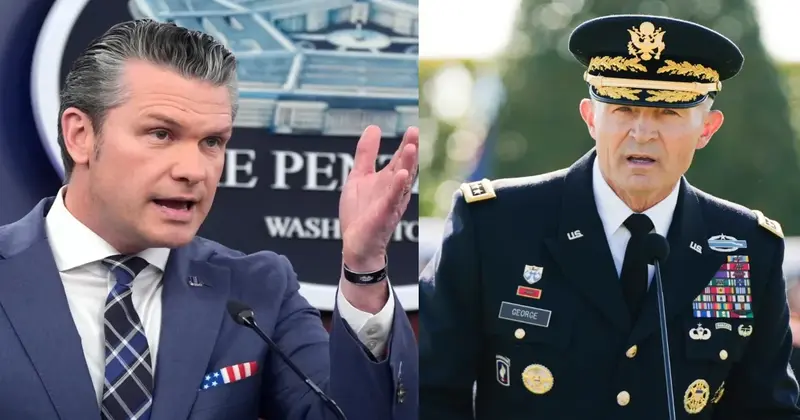
Amidst the ongoing geopolitical conflict in West Asia with the United States at its epicentre, the Trump administration in Washington DC has embarked on an effort to restructure the Pentagon, the US defence Headquarters. Pete Hegseth, the Secretary of War in the Trump rule, has demanded the United States Chief of Army General Randy George to step down immediately. The Pentagon has not reiterated any concrete reason for the sudden firing of the Army Chief. Sources claim that the swift decision was taken by the Defence Secretary(Pete Hegseth) to position “someone who will implement President Donald Trump’s vision for the Army” at the helm of the Pentagon.
Reports claim that General Christopher LaNeve, the current Vice Chief of the US Army will be elevated to the position of Army Chief. A senior War Department official asserted that on April 2, 2026(Thursday) that Hegseth contacted Army Chief Randy George and requested for his immediate retirement. “It was time for a leadership change in the Army”, sources asserted. The reports also mentioned that Hegseth did not give any reason to the Army Chief while demanding to submit immediate resignation. Pentagon spokesperson mentioned that George will be retiring from his position as the 41st Chief of Staff of the Army effective immediately.
“The Department of Defence was grateful for General George’s decades of Service”, Pentagon spokesperson added and wished him well in retirement. The analysts decode the swift reshuffle in the Pentagon as a price paid for not aligning with the policies of President Donald Trump. Reports also claim that the Trump administration is thinking of major administrative reshuffle. FBI Director Kash Patel, Director of National Intelligence Tulsi Gabbard, Army Secretary Daniel Driscoll and Labour Secretary Lori Chavez-De Remer are also quitting the Trump administration. Does these drastic revamp reflect the autocratic nature of Donald Trump is another question posed by the analysts. Those who disagree with the Trump policies are unapologitically fired or made to submit resignation?
Major military reshuffle by Pete Hegseth
Pete Hegseth, as the Secretary of War, has initiated a major military reshuffle in the Pentagon. Hegseth has fired top generals and admirals from the Pentagon, thus reshaping the defence department to suit the priorities of the Trump administration. More than a dozen top officials have been fired by Hegseth, since he took over the office in the previous year. In February, Hegseth fired Admiral Lisa Franchetti, the Navy’s top uniformed officer and General Jim Silfe, the Air Force’s No 2 leader. Meanwhile, President Trump himself dethroned General Charles “CQ” Brown, then Chairman of the Joint Chiefs of Staff.
Trump also suddenly fired then Vice Chief of Staff of the Army General James Mingus and nominated Lt. General Christopher LaNeve for the position. He is now set to replace the Army Chief General Randy George. The Army Chief Randy George was appointed to the top position in 2023, by the Biden administration and the role was for four years. Thus, he has been asked to vacate the office by the Trump rule, before the term could expire. This untimely exit amidst an escalating conflict in West Asia raises questions regarding the intentions of the White House. Is it a wise decision to change the top military brass amidst an ongoing war? Analysts ponder.
The real reason for sudden removal
It is said that the bitter face-off between Pete Hegseth and the Army Chief Randy George led to the resignation of the latter. It was related to the promotions within the Army and other decisions of the army. It is said that Army Chief Randy George refused to block or drop the promotions of the senior army officers as per the suggestion of Hegseth, which apparently irked the Defence Secretary and widening the rift. Hegseth, thus asserted that he wanted an Army Chief who is more closely aligned with the policies of the Trump administration.
As per the recent reports in the New York Times, a few days ago, Army Chief George tried to meet Hegseth to discuss the stalled promotions and raise concerns that the defence secretary was unnecessarily interfering in the decisions pertaining to the Army personnel. However, officials asserted that Hegseth refused to meet the Army Chief, thus further widening the rift. The removal of the Army Chief thus reflects the fractures in the Trump administration amid West Asia conflict. The resignation of the top military official amidst a war scenario is precarious, thus igniting apprehensions about the future course of the Trump administration with respect to the West Asia crisis.