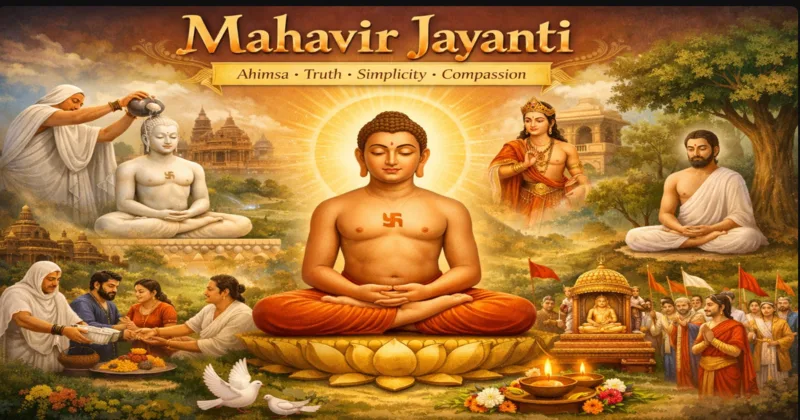
On an auspicious day in 511 BC, Lord Mahavir was born. The birth of a person is a common event. A number of people are born unnoticed on this earth every day, but Mahavir’s birth was marked by an uncanny element. While still growing in his mother’s womb, Mahavir was endowed with clairvoyance (avadhi gyan). An ordinary man is born with indirect knowledge (paroksh), but Mahavir was born with direct knowledge (pratyaksh), as if he had experienced everything already. This was an extraordinary thing about his birth. When he grew up, he was sent to a local school, but on the very first day, his teacher noticed his transcendental wisdom and declared that he didn’t require any schooling.
After Mahavir’s birth, his family began to grow prosperous. Impressed by this phenomenon, his parents gave him the name of Vardhman. Since he was clairvoyant, he became known as Saman. Realising his power of tolerance during spiritual practice, he was named Mahavir. Two sants, Vijay and Sanjay, came. They saw Mahavir, and a mere glimpse of his personality dispelled all their doubts.
In modern times, it is believed that man is free to think and act as he likes. But this is a relative truth. He is not entirely free. He is also bound somewhere by destiny. Mahavir’s destiny was bound with liberation or salvation (moksha). There was a religious environment in his family, and his parents were followers of the 23rd Jain Tirthankara, Parshva. The teachings of Parshva left an indelible impression on his mind. Destiny, environment and the separation from the parents prompted Mahavir to take to the ascetic way of life. When his elder brother, Nandivardhan, came to know of his intention to embrace asceticism, he asked him: Brother, are you thinking of renouncing the household life Yes, Mahavir nodded his head in affirmation. Nandivardhan said: ?Brother, is it the befitting occasion for such a decision? We have not yet recovered from the shock caused by the separation from our parents, and you are thinking of renouncing worldly relations. You must stay at home at least for two years, and thereafter you are free to have your own way.? Mahavir acceded to his elder brother’s request.
From a very young age, Mahavir was keen to leave the family and become a wandering monk, but he stayed for his parents. sake. Many people know that the past influences the present, but few know that the future also influences it. Mahavir’s two-year stay at home was under the shadow of the future, so he lived like a monk. He realised that life is transient and was committed to renunciation. No one had ever imagined that a prince was living the life of a monk in a princely household.
With his brother Nandivardhan’s permission, Mahavir was initiated into ascetic life. Having renounced worldly relationships, he set out with the sole objective of attaining complete samayika (an equanimous state of mind or super-consciousness). His thirty-year-long householder’s life came to an end. He spent his childhood at home, entered his youth and enjoyed the regality of a princely life till he was twenty-eight.
With his initiation into a new way of life, the vigorous practice of Samya Yoga (Yoga of equanimity) began and continued for twelve years. During this period, he went through a number of ordeals which he successfully encountered. His name, Mahavir, or great spiritual warrior, proved true to its meaning. If a coward had come across these ordeals, he would have hardly encountered even one of them. Equanimity (samta) and non-violence (ahimsa) require tremendous bravery.
We know Mahavir as a pioneer of ahimsa. He is not yet widely known as a pioneer of fearlessness (abhaya). He firmly believed that a person afflicted by fear cannot promote ahimsa. This principle became an integral part of his way of life. For this reason, he remained alone during the whole span of his penance (spiritual practice). He wandered alone in the jungles, rivers, valleys, hills, caves and empty houses day and night. Fear did not touch him at all. Fearlessness added lustre to his spiritual practice. Once, he stayed in the temple of Soolpani Yaksha. The priest warned him about the danger at night and asked him not to stay there, for no one survived there until dawn. Even the villagers dissuaded him, but he remained firm. He did stay in the Yaksha’s temple despite warnings and contrary advice, and survived.
Lord Mahavir was going to a hermitage when the cowherds said, ?O, mendicant! Do not go further. There is great danger ahead. There is a snake called Chand Kaushik at a little distance. Its eyes emit venom. Even from a distance the serpent can burn a man to ashes by casting a mere look at him.? Ignoring the advice, Mahavir continued his march. Fear of death and suffering was perhaps unknown to him. He approached the serpent’s hole and stood in a meditative posture. Chand Kaushik must have said to himself. What kind of a man is this? Is he coming to me to embrace death? His defiance infuriated him. The serpent first looked at the sun, then at Mahavir. The waves of venom from the venomous looks spread far and wide, but Mahavir stood motionless in a meditative pose. Now, the serpent was beside itself with the fire of fierce rage. It coiled itself around Mahavir’s body and started stinging him at various points. He began to bleed but remained motionless like Mt. Meru. He countered the effect of the venom emitted from the serpent’s eyes by means of radiations of compassion. Mahavir had no enemy.
Lord Mahavir’s spiritual practice was renunciation. While embracing asceticism he had resolved: ?I surrender this body for the sake of my soul. This body is not mine. With this feeling, I shall use my body. To cross a river, a boat is needed. I shall use my body as a boat to cross the river of life. Shall I bear all the pangs of suffering by being immersed in the soul? After a person has renounced attachment to his body, it is natural for him to renounce matter. After becoming an ascetic, he retained only a wrapping piece of cloth (uttariya). That piece of cloth fell off after it got entangled into a thorny bush. This is what one school of thought believes. The other possibility is that Mahavir deliberately gave it up. It is very easy to say that in the practice of non-possession (aparigraha) Mahavir stands in the first row of such dedicated practitioners.
Enlightened belief (Samyag-darshan) became non-absolutism (anekanta), and the knowledge of the self became enlightened knowledge (samyak gyan). Fearlessness, non-possession and non-violence (aparigraha, ahimsa, abhaya) became enlightened conduct (samyak charitra). This trio led Mahavir to attain omniscience (kevalya). At the sandy bank of the Baluka river, in the farm belonging to a householder named Shyamak, under a tree in Godohika posture, Mahavir attained omniscience.