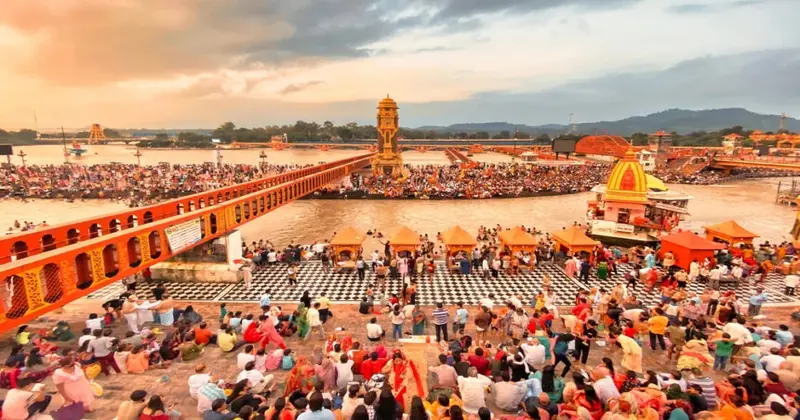
Jammu: Shadipora in Bandipora district of the Union Territory(UT) of Jammu & Kashmir will be hosting devotees from all over India and abroad for a 10-day Kumbh mela from July 15 to 24. The announcement regarding the preparations for the mela, to be held during the Amarnath yatra 2026, was made a couple of days ago by Swami Kalikanand Saraswati. On March 26, Thursday, he said in Srinagar that between three and four lakh pilgrims are expected to take part in these 10 days.
A similar function was organised at the venue in the year 2016, a decade ago, when approximately 35,000 pilgrims had participated in the celebration. Since ancient times, Shadipora is considered as a sacred place by the Hindus as it is here that Sind river merges into Vitasta(commonly known as Jhelum river) after its 108-km journey.
In the ancient Hindu scriptures, the Sind river has been called as the Kashmir Ganga. It flows out from the sacred Gangabal Lake at the Haramukh mountain’s base. The lake and the mountain are regarded as a prominent tirtha(pilgrimage site) symbolizing Shiva’s mukuta(crown or diadem, Haramukuta). In ancient Sanatana texts such as the Nilamata Purana(dating back centuries) and Kalhana’s Rajatarangini(1148–1149 AD), the sacredness and spiritual significance of this river has been highlighted.
The Shadipora confluence is considered a very spiritual place as it is deemed equivalent to the Prayagraj triveni sangam for ritual immersion and purification. Many centuries ago, religious pilgrimages, with annual yatras to Gangabal and Haramukh mountain during Bhadrapada(August–September), were a regular feature. The Kashmiri Hindus conducted shraddha ceremonies here and as is done at Har ki Paudi in Hardwar, the ashes were immersed here in the flowing river.
Some ancient Hindu texts have described rituals conducted here centuries ago by the Kashmiri Pandit community. Hundreds of boats were rowed down the Vitasta(the Jhelum) originating at Verinag in Anantnag district and were anchored at Shadipora. The ashes of the ancestors were kept in earthernware for months together and the annual pilgrimage to Shadipora was when these were immersed at the sangam(confluence).
The expansion of Islam in Kashmir, particularly after 1320 when a Ladakh Buddhist Richen converted to Islam and became the first Islamic ruler of Kashmir, led to erosion of these religious pilgrimages. Over the last few centuries, very few of the ancient Hindu pilgrimages have survived and the mela at Shadipora lost its sheen altogether in 1989-90. The eruption of a Pakistan-sponsored Islamic onslaught had then led to a genocide of Kashmiri Pandits who fled the valley in lakhs.
Since the Sind river becomes visible while tourists travel on Srinagar-Kargil road northwards to Ladakh, it is often mistakenly though to be the Sindhu river(the Indus). In the historical records, the Sind river is clearly distinguished from the Indus(Brhatsindhu or “Great Sind”). Actually, the word Sindhu, in the ancient Vedic hydronomy, at times denoted a major river.
The Sind river originates from the Machoi Glacier at an altitude of 4,800 metres, located east of the Shri Amarnath cave temple (Shri Amreshwar tirtha) south of the Jozila pass. Due to rising global temperature, and climate change, the retreat of Machoi glacier has impacted the water availability in the Sind river.
On June 16, 2016, thousands of displaced Kashmiri Pandits from all over India, and some from abroad, had celebrated ‘Dashar Maha Kumbh’ at the same location where programme will be organised this year. According to some locals, the mela in 2016 was organised after a period of 75 years, after 1941.