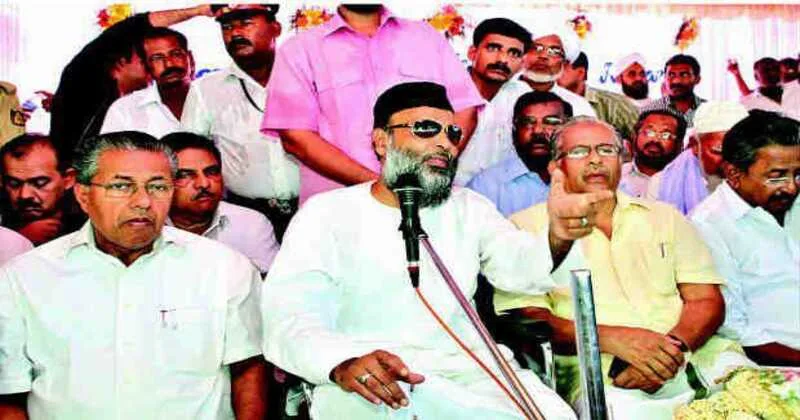
Alappuzha: The CPI(M), which once projected the arrest of Islamic terrorist Abdul Nasser Madani as a major achievement in its fight against religious extremism in Keralam, now finds itself in a politically uncomfortable position. As the state heads into assembly elections, the party is facing criticism for accepting the support of Madani and the People’s Democratic Party (PDP) led by him. PDP leaders have openly stated that their support to the Left is the result of discussions held with senior Left leadership, raising questions about ideological consistency and political expediency.
From crackdown to political alignment
The controversy gains sharper focus when viewed against the backdrop of Madani’s past and the CPI(M)’s earlier stance. In February 1998, a series of coordinated bomb blasts rocked Coimbatore on the day senior BJP leader L.K. Advani was addressing a public meeting. The explosions occurred at thirteen locations, killing 58 people and injuring over 200. Investigations revealed the involvement of the Islamist terror outfit Al Uma. Following these developments, Abdul Nasser Madani was arrested in March 1998 from his residence in Kaloor, Kochi, after Tamil Nadu Police indicated his links to the conspiracy. Several other cases were also registered against him. At the time, the arrest was hailed as a significant success by the Left government in Keralam. Then Chief Minister E. K. Nayanar publicly took pride in the action, portraying it as a firm stand against extremist forces.
However, the present political scenario presents a stark contrast. The same political formation that once celebrated Madani’s arrest is now contesting elections with the backing of his party. This shift has triggered sharp political and ideological criticism, both from within and outside the CPI(M).
Allegations of threats and internal contradictions
The controversy is further compounded by revelations of threats against E. K. Nayanar following Madani’s arrest. According to former IG Sibi Mathews in his book Nirbhayam, there was a plot by Madani’s followers to assassinate Nayanar using a hand grenade in Kannur. The plan, he claims, was foiled due to the alertness of local police officials.
Inspector Unnikrishnan of the Kannur Town Police reportedly grew suspicious of a group posing as toy sellers operating from a rented house on the outskirts of the town. He suspected their involvement in counterfeit currency circulation and alerted higher authorities, including Sibi Mathews. Further intelligence suggested that the group was linked to Madani and was planning an attack on the Chief Minister.
SP Abdul Khader also reportedly conveyed intelligence inputs about individuals seeking revenge for their leader. Some suspects were arrested, though details were kept confidential. Mathews further notes that political responses at the time were dismissive, with certain UDF leaders allegedly mocking the threat as exaggerated. Despite recommendations to form a special team to monitor religious extremism, the proposal was reportedly derailed. These past incidents have resurfaced in the current political climate, intensifying criticism that the CPI(M) is now aligning with forces it once viewed as a serious threat to its leadership and governance.
Political fallout and historical associations
The relationship between the CPI(M) and Madani’s PDP has long been a subject of political debate in Keralam. During a Lok Sabha election campaign in Ponnani constituency, it became controversial when Pinarayi Vijayan, then CPI(M) state secretary, shared a stage with PDP leader Madani at a public meeting supporting an LDF-backed independent candidate. While senior CPI(M) leader V.S. Achuthanandan publicly distanced the party from such associations, sections of the party leadership attempted to justify the engagement.
Subsequently, the CPI(M) Politburo reportedly assessed that the alliance with the PDP had caused political damage. Yet, the recurrence of similar alignments indicates a continuing dilemma within the party regarding electoral strategy versus ideological positioning.
Adding to the controversy, former Chief Minister and CPI(M) ideologue E.M.S. Namboodiripad had once compared Abdul Nasser Madani to Mahatma Gandhi, a statement that drew widespread criticism. Madani had also campaigned for Left candidates in earlier elections, including the 1993 Ottapalam Lok Sabha contest. Interestingly, CPI(M) state committee member P. Jayarajan has himself acknowledged in his writings that Madani and his organisation have been involved in spreading extremist ideas among sections of Muslim youth. This internal acknowledgement contrasts sharply with the party’s present acceptance of PDP support.
As Keralam approaches another crucial election, the CPI(M)’s association with Madani and the PDP has once again brought ideological contradictions and political pragmatism into sharp focus, raising broader questions about the limits of electoral alliances in a complex political landscape.