Kerala’s political direction under question
September 1, 2026
  • Read Ecopy
  • Circulation
  • Advertise
  • Careers
  • About Us
  • Contact Us
Android AppiPhone AppArattai
Organiser
  • ‌
  • Bharat
    • Assam
    • Bihar
    • Chhattisgarh
    • Jharkhand
    • Maharashtra
    • View All States
  • World
    • Asia
    • Europe
    • North America
    • South America
    • Africa
    • Australia
  • Editorial
  • International
  • Opinion
  • RSS @ 100
  • More
    • Op Sindoor
    • Analysis
    • Sports
    • Defence
    • Politics
    • Business
    • Economy
    • Culture
    • Special Report
    • Sci & Tech
    • Entertainment
    • G20
    • Azadi Ka Amrit Mahotsav
    • Vocal4Local
    • Web Stories
    • Education
    • Employment
    • Books
    • Interviews
    • Travel
    • Law
    • Health
    • Obituary
  • Subscribe
    • Subscribe Print Edition
    • Subscribe Ecopy
    • Read Ecopy
  • ‌
  • Bharat
    • Assam
    • Bihar
    • Chhattisgarh
    • Jharkhand
    • Maharashtra
    • View All States
  • World
    • Asia
    • Europe
    • North America
    • South America
    • Africa
    • Australia
  • Editorial
  • International
  • Opinion
  • RSS @ 100
  • More
    • Op Sindoor
    • Analysis
    • Sports
    • Defence
    • Politics
    • Business
    • Economy
    • Culture
    • Special Report
    • Sci & Tech
    • Entertainment
    • G20
    • Azadi Ka Amrit Mahotsav
    • Vocal4Local
    • Web Stories
    • Education
    • Employment
    • Books
    • Interviews
    • Travel
    • Law
    • Health
    • Obituary
  • Subscribe
    • Subscribe Print Edition
    • Subscribe Ecopy
    • Read Ecopy
Organiser
  • Home
  • Bharat
  • World
  • Operation Sindoor
  • Editorial
  • Analysis
  • Opinion
  • Culture
  • Defence
  • International Edition
  • RSS @ 100
  • Magazine
  • Read Ecopy
Home Bharat

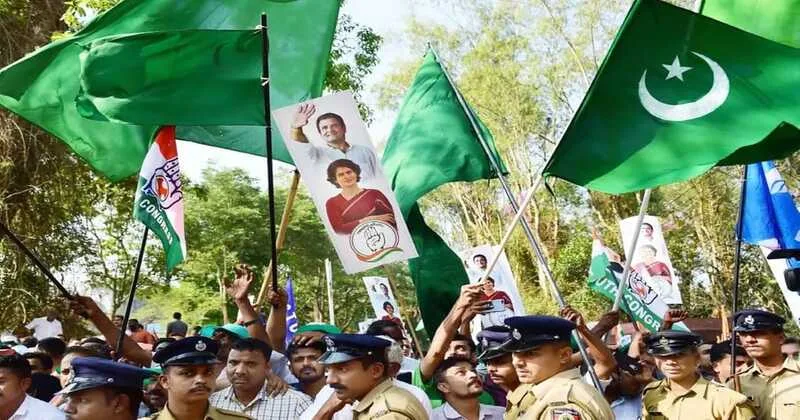
Keralam Next Bangladesh? Congress–League–Jamaat nexus raises questions over state’s political direction ahead

As Kerala heads into a crucial Assembly election, allegations of growing religious influence in governance have sparked intense political debate. The emerging Congress–Muslim League–Jamaat-e-Islami alignment is now being questioned for its long-term impact on the state’s future

Dr Vishnu AravindDr Vishnu Aravind
Mar 23, 2026, 04:30 pm IST
inBharat, Kerala
Follow on Google News
Representational image

Representational image

Facebook
Twitter
WhatsAppTelegramEmail

Kerala appears to be entering a phase where religious influence is increasingly shaping governance, stretching from the appointment of SHOs in police stations to key ministerial and departmental postings, through Jamaat-e-Islami, with the Congress and the Muslim League seen as enabling this trajectory. With the Assembly election nearing, the Jamaat-e-Islami–Congress–Muslim League nexus is increasingly seen as driving the state in that direction. Muslim League leader K. N. A. Khader had, much earlier, asserted that the Deputy Chief Minister’s post rightfully belongs to the League, expressing confidence that the matter would be considered within the alliance based on its performance. Notably, it was not the BJP, but CPI(M) leader A. K. Balan, who remarked that if the UDF comes to power, the Home Department would effectively be governed by Jamaat-e-Islami. Though he later apologised, the statement reinforced a growing perception that Kerala is being pushed towards the dominance of Islamist forces and Sharia-based governance. Adding to this, Minister Saji Cherian observed, “To understand communalism, one only needs to look at the names of those who win elections in Kasaragod and Malappuram districts,” pointing to what he described as an uncomfortable ground reality. Former Chief Minister V. S. Achuthanandan too had warned that organised efforts have long been underway to transform Kerala into a Muslim-majority region. Taken together, these statements raise a pressing  question that are political forces led by the Congress and the Muslim League attempting to steer Kerala towards a Bangladesh-style model of governance?

Bangladesh and Jamaat-e-Islami

In the context of political developments in Kerala, Malayalis must understand the experience of neighbouring Bangladesh. Jamaat-e-Islami came to power in 2001 in alliance with the Bangladesh Nationalist Party (BNP), securing two cabinet minister positions. The organisation, which has been active since 1975 with the support of Pakistan, first extended support to the BNP in 1991. However, between 2013 and 2023, Jamaat was barred from contesting elections by court orders during the tenure of Sheikh Hasina. Following Hasina’s removal, Jamaat returned and emerged as a major opposition force in the 2026 general elections, even contesting against its former ally, BNP. Jamaat also played a role in the disqualification of Hasina’s Awami League from contesting.

Jamaat is considered the South Asian version of the Muslim Brotherhood in Egypt. Inspired by Islamist radicals such as Syed Abul Ala Maududi, Sayyid Qutb, and Hassan al-Banna, the organisation was founded in Lahore during British rule by Maududi. It believes in political Islam and aims to establish an Islamic political system. Jamaat has long pursued the creation of a strong religious-political structure in Bangladesh, with the ultimate objective of establishing an Islamic system of governance that controls all aspects of society. Its ideological and strategic links with Pakistan’s Jamaat-e-Islami and the intelligence agency ISI reflect its broader ambitions. It is also alleged that in 2025, with support from the United States and Pakistan, Jamaat played a role in the unrest that led to Hasina’s removal.

Also Read: Divine Geometry of Bharatanatyam: How every mudra, step & rhythm becomes a sacred dialogue with the cosmos

Similar Developments in Kerala

There is little doubt that similar efforts are unfolding in Kerala, including attempts to influence cultural leaders. The Congress–Jamaat cooperation is seen as parallel to the BNP–Jamaat alliance in Bangladesh. Congress’s Leader of Opposition V. D. Satheesan has publicly justified and defended  Jamaat by claiming that “Jamaat has abandoned religious nationalism.” However, during the January 2026 election campaign in Bangladesh, Jamaat candidate Afzal Hossain urged his supporters: “In a country where nearly eighty percent of the population is Muslim, there should not be ‘unbelievers’ or ‘immoral representatives’ in Parliament. Do you want the Quran or deviations from it?” This reflects the organisation’s position that Hindus, Sikhs, and Christians should not be represented in Parliament.

In Kerala, Jamaat-e-Islami state general secretary and Shura member Shaikh Muhammad Karakkunnu declared that “no true believer can reject an Islamic republic,” and argued that Islamic governance can be established even in non-Muslim-majority regions, citing that when Prophet Muhammad established rule in Medina, Muslims were only about fifteen per cent of the population.

Muslim League leader K. M. Shaji (K. Muhammad Shaji) also declared in Kerala that “religion is the important,” and that Muslims had not held power for the past ten years, and that they seek power to secure their rights.
The banned extremist organisation Popular Front of India (PFI) had also declared its goal of transforming India into an Islamic state by 2047. In this context, it is argued that if the UDF comes to power, Kerala may face governance shaped by religious fundamentalist forces.

Is Kerala becoming another Bangladesh?

Bangladesh, once a rapidly developing country, is now facing decline after falling into the hands of religious extremists. Economic growth has slowed, foreign investment has declined, foreign exchange reserves have weakened, and industrial production has reduced. Unemployment and corruption have increased, while inflation has crossed 8 per cent. According to World Bank estimates, more than three million people fell into poverty in 2025 alone. Under Jamaat’s influence, rising mob violence against Hindus, Sikhs, and Christians has created widespread insecurity, discouraging foreign investment and leading to factory closures. According to police industrial data, between August 2024 and May 2025 alone, around 60,000 workers lost their jobs in factories. Additionally, between July and December 2024, nearly two million people across the country lost employment. Foreign countries also imposed restrictions on employing Bangladeshi workers.
Global trade developments, including US tariff policies, further weakened Bangladesh’s garment industry, which was the backbone of its economy.

Critics argue that similar risks exist in Kerala. The state already has one of the highest unemployment rates in India, nearing 30 per cent. Concerns have also been raised about Muslim youth being drawn towards extremist organisations abroad. In this context, the emerging alliance of the Muslim League, SDPI, Congress, and Jamaat is seen as a foundation that could push Kerala towards radicalisation and instability, while threatening the social and economic security of Hindu and Christian communities. Therefore, it is argued that every vote for the UDF could become a step towards turning Kerala into another Bangladesh.


 

Topics: kerala politicsCongress KeralaUDF allianceBangladesh comparisonJamaat-e-IslamiMuslim League
Dr Vishnu Aravind
Dr Vishnu Aravind
Dr Vishnu Aravind is a researcher, political commentator and writer based in New Delhi, with a PhD from Jawaharlal Nehru University (JNU). His areas of interest include international politics, Indian foreign policy, electoral politics, election analysis, political developments, and cultural affairs. [Read more]
Share
Tweet
SendShareSend
✮ Subscribe Organiser YouTube Channel. ✮
✮ Join Organiser's WhatsApp channel for Nationalist views beyond the news. ✮
Previous News

Tinsukia attack raises questions: Why Did ULFA (I) Target Assam Police Now?

Next News

RSS Centenary ‘Yuva Sammelan’ at IIT Guwahati: Sarkaryavah Hosabale urges youth to work towards nation-building

Related News

Left: C. Divakaran; Right: Pinarayi Vijayan

‘CPI is not bound to obey Pinarayi’: C Divakaran steps up attack over Keralam Deputy Legislature Party Leader issue

Pinarayi Vijayan, Sathyan Mokeri (Left to Right)

“Coalition is not a Master – Servant affair”: CPI mouthpiece hits out at former Keralam CM Pinarayi Vijayan

Maulana Abul Ala Maudidi (1903-1979)

85 Years of Jamaat-e-Islami in the Subcontinent: Maududi and His Organization

Muslim League anchored planned atrocities against Hindus on Direct Action Day in Calcutta

Decoding the horrors of Direct Action Day; Revisiting the forgotten lessons from the streets of Calcutta

Remembrance Day and Partition’s Other Architect: The CPI’s role in dividing India

Kerala General Education Minister N. Shamsudheen (Left) - K.K. Mohammed Ashraff (Right)

Keralam: Jamaat-e-Islami-linked Welfare Party functionary in Education Minister’s staff raises influence concerns

Load More

Latest News

A 21-year-old Hindu nurse, Uke Shirisha, was sexually assaulted and murdered inside her residential quarters in Thukkuguda, Telangana

Telangana Nurse Murder: Islamist Sanaullah arrested for rape and murder of 21-year-old Uke Shirisha in Thukkuguda

A century-old Hindu Mandir in Pakistan’s Narowal was demolished by Islamic zealots over land encroachment claims

Over 100-year-old Hindu Mandir demolished in Pakistan’s Punjab, Narowal, to make way for madrassa

Prime Minister Narendra Modi in Tashkent

PM Modi pushes for Thirukkural translation in Tashkent as India-Uzbekistan ties reach comprehensive strategic level

The Hague based Permanent Court of Arbitration

India rejects Pakistan-favouring Indus Treaty award, calls Hague-based arbitration body ‘illegally constituted’

Augustine Brothers (inset)

Keralam: ED and SIT to probe Augustine Brothers over Rs 126 Cr deal after Nov ’25 Messi tour cancellation

Indianisation does not mean making all people Hindus; unity can be built on common spiritual reality: Guruji Golwalkar

Jharkhand's former Chief Minister Babulal Marandi (Left) and Union Home Minister Amit Shah (Right)

Bangladeshi infiltration in Jharkhand’s Santhal Pargana a national security threat: Babulal Marandi writes to Amit Shah

From left, India's EAM S. Jaishankar, PM Narendra Modi and NSA Ajit Doval during the 16th BRICS Summit in Kazan, Russia, in 2024

BRICS New Delhi Summit 2026: India to push digital currencies for uninterrupted, cheaper cross-border payments

Guru Amar Das Ji, the Third Sikh Guru

Jyoti Jot Day: Remembering Guru Amar Das Ji, the Guru who strengthened the tradition of langar and equality

Congress MLA Ashok Kumar Rai (Left), Chief Minister DK Shivakumar (Right)

Karnataka ‘7 per cent Commission’ Row: Congress MLA’s charge puts Shivakumar govt under scanner

Load More
  • Privacy
  • Terms
  • Cookie Policy
  • Refund and Cancellation
  • Delivery and Shipping

© Bharat Prakashan (Delhi) Limited.
Tech-enabled by Ananthapuri Technologies

  • Home
  • Search Organiser
  • Bharat
    • Assam
    • Bihar
    • Chhattisgarh
    • Jharkhand
    • Maharashtra
    • View All States
  • World
    • Asia
    • Africa
    • North America
    • South America
    • Europe
    • Australia
  • Editorial
  • Operation Sindoor
  • Opinion
  • Analysis
  • Defence
  • Culture
  • Sports
  • Business
  • RSS @ 100
  • Entertainment
  • More ..
    • Sci & Tech
    • Vocal4Local
    • Special Report
    • Education
    • Employment
    • Books
    • Interviews
    • Travel
    • Health
    • Politics
    • Law
    • Economy
    • Obituary
  • Subscribe Magazine
  • Read Ecopy
  • Advertise
  • Circulation
  • Careers
  • About Us
  • Contact Us
  • Policies & Terms
    • Privacy Policy
    • Cookie Policy
    • Refund and Cancellation
    • Terms of Use

© Bharat Prakashan (Delhi) Limited.
Tech-enabled by Ananthapuri Technologies