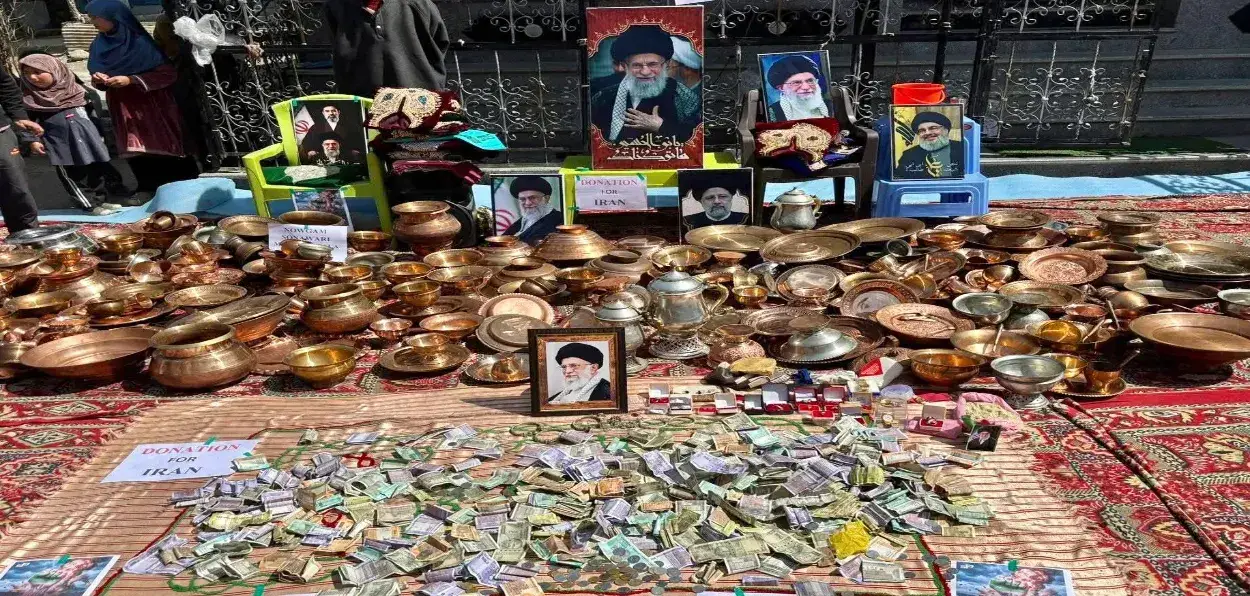
In a development that has sparked intense debate, residents of Budgam in Jammu and Kashmir came together to donate gold, silver, and cash in support of people affected by the ongoing conflict in Iran.
Visuals circulating online show groups of locals assembling in a community setting, placing jewellery and money collectively as part of what appears to be a coordinated effort of solidarity. The initiative comes at a time when tensions in West Asia have escalated sharply, raising global concerns over civilian safety and regional stability.
Adding a political dimension to the development, local MLA Muntazir Mehdi publicly announced that he would donate his one month’s salary towards relief efforts for Iran.
In a statement shared on social media, Mehdi said, “I stand in solidarity with the people of Iran in this difficult time. Humanity must come before everything.” His post, accompanied by hashtags such as #KashmirWithIran and #StandWithIran, further amplified the message.
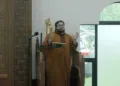
Speaking to ANI, Mohsin Ali from Budgam said a stall has been set up at Masjid Imam Zaman with the sincere purpose of collecting donations.
“At Masjid Imam Zaman, we have set up a stall with the sincere purpose of collecting donations. Our mothers and sisters are contributing jewellery, copper, and cash so that we can support Iran in its current situation,” Mohsin Ali said.
#WATCH | Budgam, Kashmir: Locals in Budgam have donated gold, silver, and cash to support Iran in the wake of the Gulf War crisis, showing their solidarity with Iran. pic.twitter.com/B8CfNMiCLi
— ANI (@ANI) March 22, 2026
While the donations have been described by participants as a humanitarian effort, the development has triggered a larger national conversation.
A respected sister from Kashmir, donated the gold kept as a memento of her husband who passed away 28 years ago with a heart full of love and solidarity for the people of #Iran.
Your tears and pure emotions are the greatest source of comfort for the people of Iran and will never… pic.twitter.com/0zFcJwGhj0— Iran in India (@Iran_in_India) March 22, 2026
Earlier on March 13, thousands of people gathered in Jammu and Kashmir’s Budgam and Leh, Ladakh, on the occasion of ‘Youm-e-Quds’ and participated in a large protest march expressing solidarity with the people of Palestine and Iran.
A large congregation assembled at Markazi Imambara Budgam, following which people took out a peaceful rally and marched towards Main Chowk Budgam.
Reports point out that humanitarian aid is typically routed through official or institutional channels. However, when such efforts emerge at a local level, especially tied to a specific country, it often signals emotional or identity-based connections that go beyond immediate humanitarian need.
India maintains strategic and diplomatic relations with multiple countries in West Asia, including both Iran and Israel. Its foreign policy has long been defined by a careful balancing act, focusing on energy security, trade routes like the Chabahar Port, and geopolitical stability.
However, the Budgam episode raises a pressing question for many Indians: What direct stake do Indian citizens have in Iran’s internal or regional conflicts?
Unlike official humanitarian missions. such as medical aid sent by the Indian government, this instance represents a grassroots mobilisation, which is unusual in the Indian context when it comes to foreign crises.
At the heart of the debate lies the concept of Ummah, the idea of a global Muslim community transcending national boundaries.
Many argue that such public displays of solidarity may indicate that religious identity is being prioritised over national identity. This leads to uncomfortable but important questions:
1. Is the sense of belonging to a global religious community overshadowing national responsibilities?
2. Should domestic resources be mobilised for international religious solidarity?
3. Where should the line be drawn between empathy and political messaging?
India’s position in West Asia is delicate. It has cultivated strong ties with countries across ideological divides, including Iran, Israel, and Gulf nations.
Public actions like the Budgam donations, though unofficial, could be perceived in different ways internationally. While they may not directly influence policy, they can contribute to narratives that complicate India’s carefully maintained neutrality.
Many are also examining whether this is a one-off incident or part of a broader trend where global conflicts increasingly evoke local responses in India.
With the rise of social media and instant global connectivity, international issues often resonate more deeply within local communities. However, when these responses involve financial contributions and organised mobilisation, they begin to take on greater significance.
Ultimately, the Budgam episode sits at the intersection of two competing narratives, humanitarian empathy and national responsibility.
On one hand, the act of donating gold and money reflects a desire to help those suffering in conflict. On the other, it raises critical questions about priorities, identity, and the role of citizens in international issues.