The Bharatiya civilisation was not merely a cultural or spiritual formation; it was also an economically intelligent and refined entity that evolved over centuries. Long before the rise of centralised states or imperial administrations, Bharat developed systems of production and exchange that were decentralised, specialised, and deeply embedded in social life. Economic activity was not episodic or elite-driven but continuous and, more importantly, community-based. This framework allowed complex industries to function without reliance on a centralised authority. The village, rather than the empire, served as the primary unit of economic organisation, regulated through indigenous mechanisms of justice and labour allocation. Such a system, contrary to modern popular belief, did not hinder scale; it enabled sustained productivity, technological refinement, and resilience. It was this decentralised yet integrated economic order that allowed Bharat to emerge as a leading producer of finished goods.
The effectiveness of this civilisational economy was amplified by Bharat’s abundant and diversified geography. Civilisations that mastered rivers and seas mastered the movement of goods, people, and knowledge. Inland waterways connected production centers to markets, while access to the sea integrated local economies into long-distance trade networks. In such environments, industries that required coordination across multiple skills and resources could emerge organically, sustained by ecological familiarity and social cooperation rather than imperial command.
Nowhere were these conditions more fully realised than in the eastern frontier of Bharat. Stretching from the Manas River to the Chindwin River and encompassing present-day North East Bharat along with Bangladesh, this region occupied a unique position at the confluence of land, river, and sea routes. The dense riverine networks of the Brahmaputra-Barak-Surma-Meghna system connected the eastern Himalayas to the Bay of Bengal, creating an environment exceptionally conducive to water-based mobility and economic integration. Equally significant was the region’s location at the confluence of the Ganga and Brahmaputra forming the Padma river which enabled extensive inland connectivity through the Ganga basin, linking regions such as Banaras, Patna, and present-day Uttar Pradesh to the eastern frontier, while simultaneously opening access to sea routes through the Bay of Bengal (Ganga Sagar). As a result, the eastern frontier emerged as one of the most efficient zones in the subcontinent for the integration of inland waterways, land routes, and maritime navigation.
Equally significant, however, was the historical trajectory of this region. While large parts of the subcontinent came under prolonged Islamic dynastic rule, parts of the eastern frontier (that form the North Eastern states of Bharat today) remained largely insulated from Islamic invasions due to its natural defenses and the strength of indigenous polities. This insulation is critical to understanding the region’s economic history. It allowed indigenous systems of governance, production, and social organisation to continue functioning with minimal external disruption up until the colonial advent, preserving civilisational practices that were elsewhere altered or displaced.
It is within this preserved civilisational context that the shipbuilding industry of the eastern frontier must be situated. Shipbuilding here was neither an isolated craft nor a marginal technological activity; it was the natural outcome of a decentralised economic order operating within a geography optimised for water-based mobility. The industry functioned as a large-scale, cluster-based system, integrating multiple communities, specialised skills, and diverse resources into a coherent and sustainable production network.
Shipbuilding, by its very nature, resists centralisation. It demands precision, interdisciplinary knowledge, and long-term coordination across numerous domains. In pre-colonial Bharat, shipbuilding was not confined to isolated workshops or state-controlled dockyards; it was embedded in society itself. Thus, this article discusses shipbuilding in the eastern frontier as a cluster-based industry that demanded mastery over mathematics, geometry, metallurgy, chemistry, carpentry, navigation, and logistics. It required coordination between woodcutters, carpenters, sail-makers, blacksmiths, furnace operators, navigators, and traders, each performing a specialised role within an interdependent whole. Every component from the weight-to-volume ratio of the vessel to the dimensions of the mast and sail had to be exact. Maintenance schedules were unforgiving, and even protective coatings used to prevent rot required chemical precision. Navigation depended on deep empirical knowledge of winds, tides, currents, water depth, coastal vegetation, and wave behaviour. Logistical planning was equally sophisticated, encompassing storage technology, ration estimation, voyage duration, and mid-sea repair capabilities. Such complexity could not have been sustained without a social structure capable of long-term occupational continuity and a governance system that enabled cooperation without central coercion.
The flourishing of shipbuilding in the eastern frontier thus stands as concrete evidence that sophisticated industrial systems in Bharat did not depend on external intervention. They emerged from within a civilisational framework that understood the economy as collective, decentralised, and ecologically grounded long before the arrival of foreign powers. The study of shipbuilding therefore offers critical insight into Bharat’s Abhyudaya under Su-rajya, or good governance.
Evidences of water Navigation
It is not possible to assign a precise chronological origin to water navigation in Bharat, for maritime awareness is embedded in its earliest textual and cultural traditions. Repeated references to the Samudra in the Rigveda point to an early familiarity with oceans, while Bharatiya society’s relationship with nature clearly reflected in worship traditions such as reverence for Varun, the deity of oceans underscores the cultural integration of maritime activity rather than its treatment as a specialised or marginal pursuit.
This civilisational orientation is reinforced by archaeological evidence from the Sindhu-Saraswati period, including the tidal dock at Lothal, terracotta models and seals bearing ship motifs, and the emergence of port cities such as Dholavira and Mohenjo-daro, which facilitated overseas trade extending to Mesopotamia. Subsequent textual and material sources ranging from references to navigational instruments and the use of magnetic compasses to coins engraved with ship imagery demonstrate not only the continuity of waterborne navigation but also the sustained scientific and technological competence that supported it across centuries.
This long-standing maritime tradition found particularly rich expression in the eastern frontier of Bharat, where geography, ecology, and historical continuity converged to sustain large-scale navigation and shipbuilding. The presence of ports and maritime infrastructure in this region is well attested in both foreign and indigenous sources. Greek accounts and the writings of Chinese travelers such as Fa-Xian, Xuanzang, and Yi-Jing refer to Tamralipta (present-day Tamluk) as a major port near the delta of the Hooghly River. Observers remarked upon the extraordinary diversity of watercraft in the eastern frontier. Estimates range from sixty-five to over one hundred and sixty distinct types of boats, including large vessels capable of long-distance maritime travel and the transport of substantial cargo. The scale of this capacity is vividly illustrated by documented instances of transcontinental exchange, such as the transportation of a giraffe from Africa to Bengal and onward to Ming China in the fifteenth century. Accounts by Ibn Battuta, who reached Chittagong in 1346, further confirm the extent of maritime commerce in the region, describing large shipments of precious metals, textiles, agricultural produce, spices, and livestock handled at the port. Stephan Cacella, a seventeenth-century traveller, recorded that large boats travelled regularly between Gaur, Rajmahal, and Patna along the Brahmaputra, and that the journey from Goalpara to Calcutta took approximately twenty-five to thirty-five days.
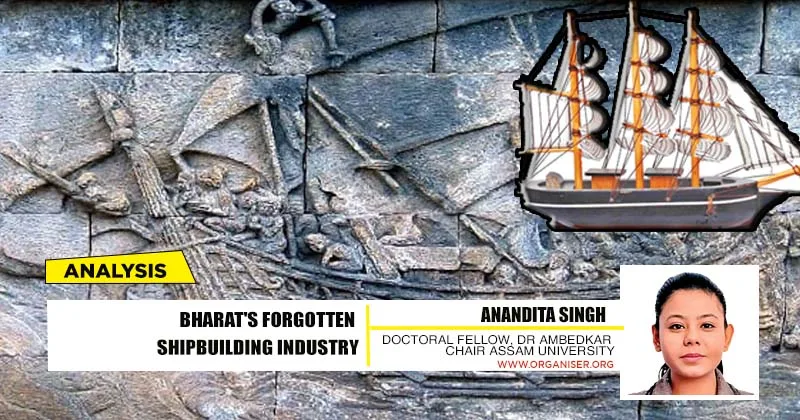
Archaeological and visual evidence reinforces this picture of continuity and scale. Thirteenth-century carvings at the Hayagriva Mahadev temple depict oared vessels in motion, while terracotta sculptures from Bhishmaknagar and later manuscript illustrations record rowing scenes and ship construction. Political and military chronicles indicate that these were not merely commercial capabilities but strategic assets. Regional powers, particularly the Koch and Ahom kingdoms, maintained formidable riverine fleets that played a decisive role in resisting invasions, including the defeat of Mir Jumla in the seventeenth century. Early Ahom chronicles also note the strategic use of waterways by rulers such as Sukapha, highlighting the centrality of rivers to governance and defense.
Copperplate inscriptions from Kalapur, Tipperah, and Mehar identify Samatata near the Meghna river system as a significant hub for both riverine and maritime navigation. River-borne trade between Ahom territory and Kachar via Namdang, the Brahmaputra, Dhansiri and the Kapili River also finds mention in the Tripura Buranji. Literary and historical traditions including the Ahom Buranji, Akbarnama, Baharistan-i-Ghaibi, Tripura Buranji, and related manuscripts further attest to shipbuilding practices and organised naval activity across the region.
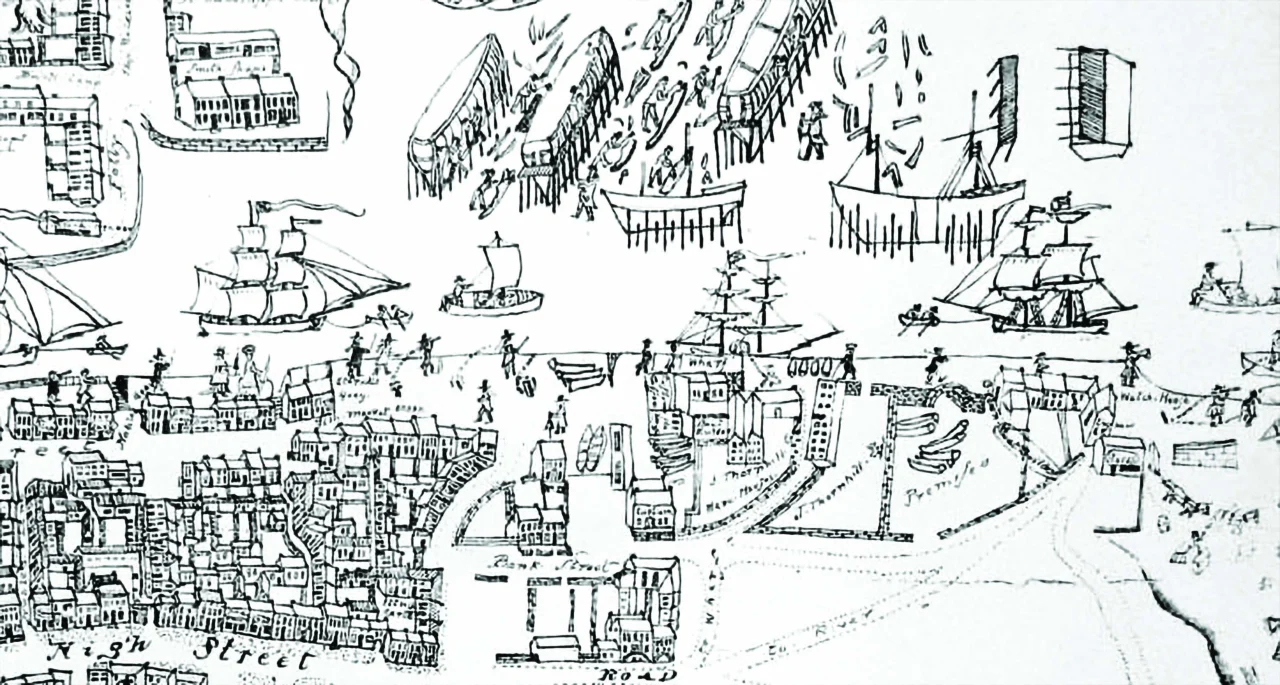
In light of the above, the port city of Chittagong held utmost importance in sea navigation. Moving inland from Chittagong, the riverine network was equally well equipped for trade. The Brahmaputra River itself formed part of the international Silk Route, eventually merging with the Bay of Bengal and facilitating faster and easier transportation of silk. Navigation, trade, and naval activity continued to drive the development of shipbuilding and waterways further inland. The importance of these waterways is further evidenced by the treaty signed on June 12, 1774, in which the British acquired from the Jaintia Raja not land or recurring revenue but permission to navigate the Surma River indicating that river navigation generated greater revenue than agriculture in that region.
Shipbuilding in East
Under Ahom rule, shipbuilding was administered through a clearly defined institutional framework. Officials such as Chola Dhara Phukan, Nowkholia Phukan, and Nobaissa Phukan were appointed to oversee navigation, fleets, and dockyards, which included thousands of ships under Ahom control. A separate department headed by Kath Barua regulated the procurement of wood, the primary raw material for shipbuilding. This ensured coordination between artisans such as the Kundar, suppliers such as the Sutar, ports, and dockyards where ships were constructed and maintained.
The durability and practicality of ships from this region required the use of multiple raw materials. Different varieties of wood were employed, with Chambal wood specifically used for merchant vessels reputed for their load-bearing capacity. Metal procurement constituted another linked industrial activity. Iron sourced from the Khasi Hills of present-day Meghalaya and the Naga Hills of present day Nagaland was transported for shipbuilding purposes, with Col Lister estimating in 1853 that 20,000 mounds of iron were transported annually for this industry. The processing and application of this iron whether for anchors or protective functions connected mining regions, transport networks, and shipyards.
Smaller vessels made from single tree trunks were rendered more durable through the application of mud and furnace baking, giving rise to specialised furnace operators whose work increased the efficiency of inland water transportation. Alongside functional construction, shipbuilding sustained artisan communities engaged in decorative work. The Tezpur Grant of Vanamala records craftsmen adorning ships with carvings and ornaments, indicating a parallel craft industry operating alongside structural fabrication.
Ship production was geographically decentralised. Dockyards and production centers were distributed along river routes and deltas, including Pandu, Guwahati, Kalibar, Biswanath, Dikhoumukh, Rangpur, Gargaon, Barpeta, and Sadiya, with major boatyards such as Barnaosal, Sakabari, and Naosal located in Sibsagar and Gadgaon. Shipbuilding functioned as both royal and private enterprise, with Ahom, Koch, Kachari, and Jaintia rulers encouraging the construction of vessels of varied sizes and purposes. The embeddedness of this industry in social life is reflected even in folk traditions such as the Baramahi geet, which describes the absence of men engaged in voyages.
Thirteenth-century carvings at the Hayagriva Mahadev temple depict oared vessels in motion, while terracotta sculptures from Bhishmaknagar and later manuscript illustrations record rowing scenes and ship construction
Together, these arrangements demonstrate that shipbuilding in the eastern frontier operated as an integrated industrial cluster. Raw material extraction, processing, fabrication, decoration, administration, and navigation functioned as distinct but interdependent activities sustained by specific communities and coordinated through indigenous governance structures rather than centralised command.
The shipbuilding industry of the eastern frontier of Bharat reveals a civilisational economy that was technologically advanced, organisationally sophisticated, and ecologically grounded long before colonial intervention. Rooted in decentralised governance, supported by extensive inland and maritime connectivity, and sustained by specialised communities working in coordinated clusters, shipbuilding in this region stands as a powerful counterpoint to narratives that attribute Bharat’s economic and technological achievements to external rule. The eastern frontier offers a rare historical archive where indigenous systems of production and governance can be observed functioning on their own terms. Throughout the study of shipbuilding, we see that Bharat’s Abhyudaya was neither accidental nor imported, but the product of a long-standing civilisational logic rooted in Su-rajya, decentralisation, and collective economic intelligence.