Some business stories are about profits, scale, and market leadership. But a few stories are really about changing how people think and Zerodha, Bharatiya brokerage and financial services company, is one of them. Its journey is not just about building a successful company. It is about questioning a system, facing doubt, and patiently earning trust in a space where ordinary people once felt they didn’t belong.
Back in 2010, the Indian stock market felt distant and intimidating to most people. Investing wasn’t seen as something the average person could do confidently. High brokerage fees, complicated paperwork, hidden costs, and confusing information made the entire experience overwhelming. For many, the market looked like a closed world — one meant only for the wealthy, the experts, or those with insider knowledge.
Nithin Kamath understood this not as an outsider, but as someone deeply involved in trading himself. He had seen how the system worked from the inside. One thing bothered him in particular — brokers charged investors based on the size of their trades, even though the actual cost of executing those trades through technology was almost the same. The system wasn’t just expensive — it felt unfair and unnecessarily complicated.
But more than the cost, he noticed something else that is fear. People stayed away from investing not just because it was expensive, but because it felt confusing and risky. The barriers were as much psychological as they were financial.
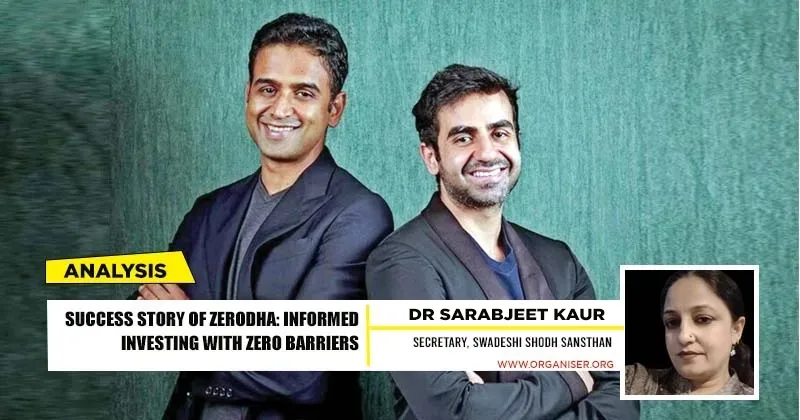
That observation sparked a simple but powerful idea — what if investing could be made easy, affordable, and accessible for everyone? Together with his brother Nikhil Kamath, Nithin decided to act on that idea. In 2010, they launched Zerodha — a name that combines “Zero” and the Sanskrit word “Rodha,” meaning barrier. The goal was straightforward: remove the barriers that kept ordinary people out of financial markets.
But having a good idea and making people believe in it are two very different things. When Zerodha introduced its flat Rs 20 per trade pricing, people didn’t celebrate — they questioned it. Investors wondered how something so cheap could be trustworthy. Many assumed low cost meant poor quality. Traditional brokerage firms and banks dismissed the model as a short-lived experiment. To them, Zerodha was just another “discount broker” that wouldn’t last.
The early days were slow and uncertain. In its first year, Zerodha opened only about 3,000 accounts. Starting a brokerage business during a weak market period was already risky — doing it without any external funding made it even harder. While many startups relied on venture capital to grow quickly, Zerodha chose to grow slowly, using only its own resources.
This meant patience. It meant restraint. And most of all, it meant constantly proving credibility. The real shift came when Zerodha stopped thinking like a traditional financial company and started thinking like a technology company. This mindset led to the creation of Kite, a fast, simple, and clean trading platform that made investing feel far less intimidating. It removed clutter and confusion from the trading experience. But even technology wasn’t enough to solve the biggest problem. Zerodha realised that many people avoided investing simply because they didn’t understand it. Instead of spending money on advertising to attract customers, the company made an unusual decision: it chose to educate them. They created Varsity, a completely free learning platform that teaches people how financial markets work, how to manage risk, and how to invest wisely. Instead of pushing people to trade, they helped people learn.
Education became their marketing. Knowledge became their growth strategy. Slowly, something powerful began to happen. People started trusting the platform not because they were convinced, but because they felt informed. Customers began recommending Zerodha to others. Growth happened naturally, through conversations, communities, and shared experiences.
Still, the journey was never smooth. The company had to adapt to regulatory changes, handle rapid technological shifts, and compete with large, established players. Each stage brought new pressure. Each stage demanded improvement. But Zerodha stayed consistent in what mattered most is transparency, simplicity, and a long-term approach.
Over time, those choices began to pay off. From just a few thousand users, Zerodha grew into a platform used by approx. 12 million. It now handles 15 per cent share of India’s retail trading activity. What makes this even more remarkable is that it achieved this scale without raising venture capital, something extremely rare in the startup world. It grew carefully, profitably, and independently.
But perhaps the most meaningful impact of Zerodha is not its size, it is the shift it triggered. By making investing cheaper and simpler, it forced the entire brokerage industry to rethink its pricing and services. Zerodha didn’t just build a company, it changed the rules of the industry. And it didn’t stop there. Through Rainmatter, they started supporting startups, Zerodha helps other fintech companies grow and innovate. It continues to invest in ideas that improve financial access and understanding.
What makes Zerodha’s journey truly inspiring is not speed, but intention. It never chased growth for the sake of growth. It focused on building something meaningful, something sustainable. It chose trust over hype, education over advertising, and patience over shortcuts. In doing so, it helped millions of Indians see investing differently, not as something intimidating or exclusive, but as something they could understand and participate in. At its heart, Zerodha’s story is about belief, a belief that systems can be simplified, that access can be expanded, and that trust can be built slowly but deeply. It is the story of an idea that many doubted, a model that many dismissed, and two brothers who chose persistence over popularity.