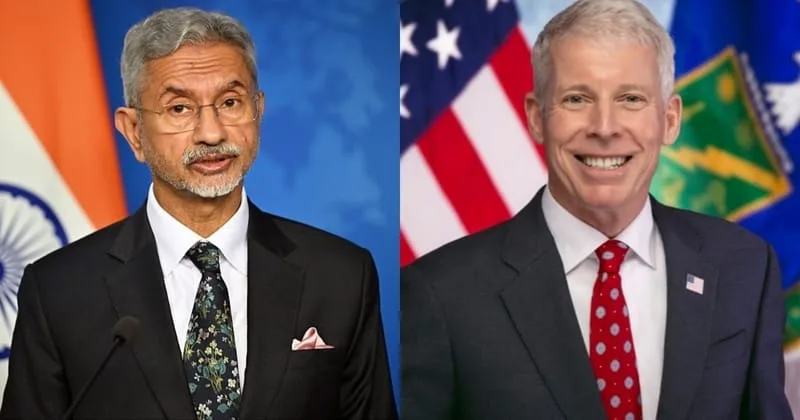
New Delhi: Amid escalating tensions in West Asia, External Affairs Minister S. Jaishankar has said that diplomatic talks between India and Iran are showing positive progress in restoring shipping traffic through the strategically vital Strait of Hormuz. He noted that India’s direct engagement with Tehran has begun to yield results and has already helped facilitate the supply of LPG to India.
In an interview with an English media house, Jaishankar said India is holding discussions with Iran to help reopen the critical maritime route through which nearly one-fifth of the world’s oil trade passes. According to him, the safe passage of two Indian oil tankers through the strait has been viewed as a positive outcome of the ongoing diplomatic engagement.
Diplomatic engagement ensures safe passage
Jaishankar stated that the movement of ships through the Strait is currently being assessed individually, with each vessel’s passage reviewed on a case-by-case basis. He indicated that India’s approach demonstrates how diplomacy can help maintain stability in a tense geopolitical environment and added that other countries could consider a similar diplomatic model if they maintain channels of communication with Iran.
He observed that India’s continued engagement with Iran remains crucial for safeguarding the country’s energy security. Jaishankar noted that discussions with Iranian authorities are ongoing and that the talks are beginning to produce tangible results. According to him, if the negotiations continue to yield favourable outcomes, the diplomatic engagement is expected to proceed further.
The minister also emphasised that India prefers rational engagement and coordinated diplomacy rather than remaining passive in a crisis that could directly affect global energy supply chains. From India’s perspective, he said, it is more effective to think rationally, coordinate diplomatically, and work towards a solution instead of avoiding involvement in a matter with significant international implications.
Jaishankar further remarked that if India’s diplomatic approach helps create a conducive environment for other countries to pursue similar engagement, it could ultimately benefit the international community.
Case-by-case negotiations continue
As an example of the progress achieved through diplomatic engagement, Jaishankar referred to the successful passage of two Indian-flagged liquefied petroleum gas (LPG) carriers through the Strait on Saturday. The ships, Shivalik and Nanda Devi, are transporting approximately 92,712 metric tonnes of LPG to India and are expected to arrive at the ports of Mundra Port and Kandla Port. However, the minister clarified that India has not reached any blanket arrangement with Iran regarding the movement of Indian-flagged ships through the waterway. Instead, he explained that the transit of vessels is being handled on a case-by-case basis while broader diplomatic discussions continue.
Jaishankar also stated that New Delhi’s approach is focused on maintaining dialogue and carefully navigating the complex regional situation. He pointed out that each country’s engagement with Iran would depend on its own geopolitical circumstances and strategic priorities. Responding to a question on whether European countries could follow a similar framework, Jaishankar said that each nation’s interaction with Iran is shaped by its respective political and diplomatic context. At the same time, he indicated that India is prepared to share its approach with European countries that maintain communication channels with Tehran. International observers, including analysts in the United States, are increasingly assessing the possibility of India playing a constructive role in mediating tensions between the US and Iran. While no formal mediation role has been announced, India’s continuing dialogue with Iran is seen as contributing to stability in one of the world’s most critical energy corridors.
US acknowledges India’s diplomatic efforts
The United States has now officially acknowledged the diplomatic initiatives being pursued by countries, including India, to ensure the safe passage of tanker ships through the critical maritime corridor. In an interview with NBC News, US Energy Secretary Chris Wright said that the latest incident in which Tehran did not open fire on a convoy passing through the waterway may have been linked to a diplomatic understanding reached by New Delhi.
Speaking about the evolving situation in the Strait of Hormuz, Wright said that five tanker ships carrying LPG, LNG and crude oil successfully crossed the strategic route on the previous night. “So, we know that the flow through the Strait of Hormuz is possible. The risk is if Iran fires on those ships. A convoy passed through last night and Iran did not fire on them, probably because Iran made a deal with India.”
Chris Wright also hinted on Sunday that India could potentially play a role in helping the United States secure stability in the Strait of Hormuz, underscoring the growing importance of India’s diplomatic engagement with Iran in ensuring the safety of global energy supply routes.