A neighbourhood Indian restaurant in west London has unexpectedly become the centre of a political and cultural storm after confrontations erupted outside the establishment over its refusal to serve halal meat. The restaurant, Rangrez, located on Fulham Palace Road in the Hammersmith area, had already announced it would close after nearly 16 years of operation.
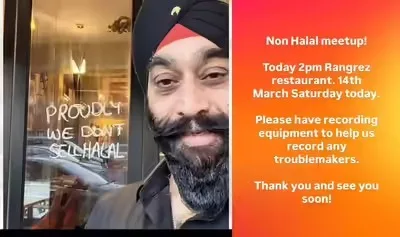
However, tensions escalated in recent weeks when its owner, Harman Singh Kapoor, publicly declared that the restaurant would serve only jhatka meat, a method of slaughter preferred by some Sikhs, and would not offer halal meat.
The announcement sparked protests, online backlash and eventually a confrontation outside the restaurant that required police intervention.
Videos of the incident quickly circulated across social media platforms, transforming what began as a local dispute into a widely discussed issue across international political networks.
The situation reached a flashpoint on March 14, when an Islamist mob gathered outside Rangrez. According to posts circulating online, a large number of individuals surrounded the premises and blocked access to the restaurant while shouting slogans.
Earlier that day, Harman Singh Kapoor had invited supporters to attend what he described on social media as a “Non-Halal meetup” at the restaurant. In his message, he asked supporters to arrive at 2 pm and bring recording equipment so that any confrontations could be documented.
The message quickly spread online, drawing both supporters and critics to the location. As tensions grew, Kapoor posted videos describing the situation as threatening and said he had taken his kirpan, the ceremonial blade traditionally carried by observant Sikhs, to protect his family.
Police later arrived at the scene and Kapoor was arrested while the crowd dispersed. Authorities have not yet clarified the exact circumstances of the arrest or whether formal charges have been filed.
The arrest quickly became the centre of the controversy, with supporters arguing that Kapoor was detained despite defending his family and his religious beliefs.
After videos of the confrontation appeared on social media, the incident quickly spread beyond Britain and became part of a larger international debate.
Several commentators called the episode as an example of “Islamist street pressure”, arguing that businesses refusing to follow halal practices were facing intimidation.
In these narratives, the dispute around Rangrez was portrayed as evidence that certain communities were attempting to impose religious food rules in public spaces.
Posts circulating on social media also claimed that the restaurant had been targeted for months because it openly refused to serve halal meat. Some commentators alleged that authorities failed to protect the Sikh owner while acting against him during the confrontation.
However, many of these claims remain contested, and details regarding the exact sequence of events are still being examined.
Harman Singh Kapoor is known in sections of the Sikh diaspora in the United Kingdom for his activism and outspoken views on community issues.
Over the years, he has positioned himself as a critic of Khalistani extremism and has frequently spoken about what he describes as weak law enforcement responses to threats faced by Sikh activists.
Earlier this year, Kapoor announced that Rangrez would shut down permanently. While he cited rising costs as a factor, he also claimed that harassment and disturbances outside the restaurant had made it increasingly difficult to operate the business.
At the same time, some of Kapoor’s own social media posts have drawn criticism. Certain remarks included strong statements about Muslims and declarations that he would not serve Muslim customers, which critics say contributed to the escalating tensions.
At the heart of the controversy is a long-standing religious distinction between halal and jhatka meat preparation methods.
In Islamic tradition, halal refers to food permitted under Islamic law. Meat must be prepared through a process known as dhabihah, in which the animal’s throat is cut while invoking the name of God and allowing the blood to drain.
For Muslims, halal food forms an important part of religious practice and daily life.
In contrast, jhatka refers to a method in which the animal is killed instantly with a single blow. The word itself means “swift strike”.
Within Sikh tradition, many followers avoid consuming kutha meat, which they interpret as meat prepared through ritualistic slaughter such as halal. The rejection of ritual slaughter is often linked to Sikh ideas of independence from religious authority imposed by others.
This theological distinction has occasionally created friction in regions where Sikh and Muslim communities live side by side.
The controversy surrounding Rangrez also reflects broader dynamics within Britain’s multicultural society.
The United Kingdom is home to large diaspora communities from India, Pakistan, and Bangladesh. Many of these communities trace their migration to the decades following the Partition of India.
That historic event divided the subcontinent along religious lines and left deep scars that still influence political and social relations across South Asia.
The Rangrez episode is not the first instance where diaspora tensions have surfaced on British streets.
In 2022, communal clashes broke out in Leicester after an India–Pakistan cricket match, leading to protests and confrontations between Hindu and Muslim groups.
Social media mobilisation played a major role in spreading the conflict and drawing participants into the streets.
Notably, the Rangrez incident unfolded in a similar digital environment where online narratives can quickly amplify local disputes.
Ultimately, the events surrounding Rangrez demonstrate how quickly a local controversy can become a global ideological flashpoint.
Within hours, videos of the confrontation in London were being shared by political activists and commentators across multiple countries, each interpreting the incident through their own ideological lens.
As investigations continue and more details emerge, the incident remains a striking example of how disputes rooted in local community dynamics can rapidly evolve into international political debates in the age of social media.