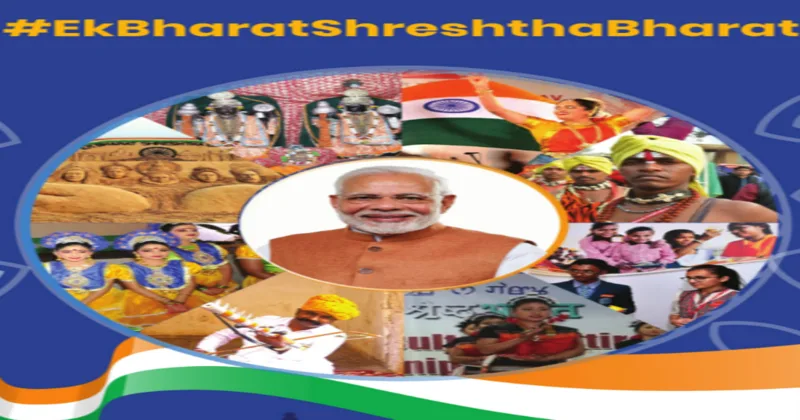
Indian civilisational strength lies in its diversity of languages, traditions, cuisines, art forms and social customs that vary dramatically across regions yet shared by national ethos. Managing and celebrating this diversity has always been central to the idea of India. In this era the initiative Ek Bharat Shreshtha Bharat (EBSB) represents one of the most structured efforts to transform this diversity into a living experience of national unity. Introduced in 2015, this programme has evolved into a nationwide cultural movement that connects states, institutions, artists and citizens in ways that reinforce the spirit of unity in diversity.
This initiative is not a cultural programme, it is an ambitious national integration that attempts to deepen emotional bonds between citizens from different parts of the country. By facilitating the exchanges between states and Union Territories, promoting folk traditions and involving youth through educational institutions. Ek Bharat Shreshtha Bharat has created a structured ecosystem where culture becomes a bridge between communities.
The vision behind the initiative
Ek Bharat Shreshtha Bharat was announced by Prime Minister Narendra Modi in October 31, 2015, marking its 140th birth anniversary of Sardar Vallabhbhai Patel, the architect of Indian political integration after independence. Sardar Patel unified the princely states to create a politically one nation, Ek Bharat seeks to strengthen emotional and cultural integration in the 21st century.
The programme operates on a simple and powerful principle that is pairing states and Union Territories to encourage cultural exchange. These pairings allow citizens, particularly young people, to learn about each other languages, festivals, food traditions and artistic practices. These interactions of the initiative aims to build mutual respect and understanding between regions that socially distant.
The programme integrates multiple sectors education, tourism, culture and community engagement. Schools host language learning activities, universities organising youth exchange programmes and cultural institutions showcasing their regional art forms. The idea is to ensure that cultural interaction which will becomes part of everyday public life rather than an occasional festival event.
Institutional Framework: The role of zonal cultural centres
The strength of Ek Bharat Shreshtha Bharat lies in its institutional backing. The programme is implemented through India seven Zonal Cultural Centres (ZCCs) located in Patiala, Nagpur, Udaipur, Prayagraj, Kolkata, Dimapur and Thanjavur. These centres have long been responsible for preserving and promoting the regional folk traditions but under EBSB their activities have expanded significantly.
ZCCs organise festivals, workshops, craft exhibitions, cultural performances and educational programmes across the country. The ZCC role is not only to showcase culture but also to facilitate the interaction among artists and audiences from different regions. Folk musicians from the Northeast perform in central India, craftsmen from Rajasthan displays their work in southern states and dancers from Uttar Pradesh participate in cultural events organised eastern India.
The decentralised structure ensures that cultural promotion does not remain confined to metropolitan centres only. Events are organised across smaller towns and regional hubs, bringing local communities into direct contact with India wider cultural landscape.
Cultural diplomacy within the nation
Ek Bharat Shreshtha Bharat represents a form of internal cultural diplomacy. Diplomacy usually refers to interactions between countries and EBSB applies similar principles within the nation by promoting states to act as cultural ambassadors to each other.
Festivals are organised under this initiative that features art forms from multiple states on a single stage. Visitors enjoy traditional dance from Arunachal Pradesh with folk songs from Uttar Pradesh and handicrafts from Rajasthan. These events creates a cultural experience while diversity becomes visible and accessible.
Virtual exchanges have also played a role in expanding participation. Cultural performances, folk traditions and language learning sessions are shared online, thus allowing people across the country to participate regardless of physical distance. This digital dimension helped the programme to reach younger audiences who are more comfortable in engaging through online platforms.
Youth engagement as the core strategy
The long-term success of national integration initiative depends on the participation of younger generations. Recognising this Ek Bharat Shreshtha Bharat has integrated youth engagement into its core strategy.
Educational institutions across India host EBSB Clubs, where students learn about the paired state’s language, traditions, cuisine and history. Essay competitions, quizzes, cultural performances and exhibitions are organised regularly. Language-learning initiatives such as Bhasha Sangam encourage students to familiarise themselves with basic phrases from different Indian languages.
Youth exchange programmes deepen this engagement. Exposure tours allow students to travel to partner states, interact with local communities and experience regional traditions firsthand. These experiences go beyond classroom learning, helping young people appreciate the diversity of Indian cultural landscape.
Expanding cultural platforms and festivals
Large scale cultural festivals form Ek Bharat Shreshtha Bharat. Events organised by ZCC attract artists, artisans, performers and audiences from across the country. Craft exhibitions and cultural fairs showcase traditional art forms while also providing livelihood opportunities to artisans. Programmes such as craft melas and folk festivals bring together hundreds of artists and thousands of visitors. These events transform cultural heritage into a living and interactive experience.
Festivals like Bharatiya Kala Mahotsav, Shilpgram Utsav and regional cultural celebrations has become platforms where Indian artistic tradition converges. These programmes not only represent the diversified Indian culture but also the shared values that connect different communities.
Comparing Impact: 2024-25 and 2025-26
Data highlights the growing scale of Ek Bharat Shreshtha Bharat activities. Events organised by Zonal Cultural Centres during 2024-25 and 2025-26 demonstrate a increase in both artist participation and public engagement.
Across selected programmes around 1,500 artists participated in festivals in 2024-25, attracting approximately 150,000 visitors. 2025-26 recorded nearly 2,000 artists and about 250,000 visitors for festival categories.
Craft melas also witnessed good number of participation. In 2024-25, 1,000 artists participated, about 85,000 visitors. In the following year artist participation has increased to 1,200 and footfalls remained at 76,000 which indicates more targeted audiences.
Cultural exchange programmes in both virtual and physical engagement levels. 400 artists participated in 2024-25, compared to 300 in 2025-26, with footfalls remaining around 4,000 participants each year. Major programmes such as Kalagram have highest participation levels with 8,499 artists and about 400,000 visitors, attending events like Udyan Utsav, which had about 251 artists and 40,000 visitors.
Data suggests that artist participation has increased by 40 percent, while public footfalls rose by 50% between the two years. These numbers indicate that the initiative is expanding with public visibility.
Cultural preservation and economic opportunities
Ek Bharat Shreshtha Bharat also helps in the preservation of culture and development of local economies. Folk artists and craftsmen face difficulties in finding a market for their products. These cultural events help them to showcase their talents to a new audience.
Events such as Rashtriya Shilp Mela and regional craft fairs attract thousands of visitors and create direct sales opportunities for artisans. These platforms also help younger generations discover traditional art forms, ensuring that cultural practices are passed down rather than disappearing in the face of urbanisation and globalisation. By integrating culture with tourism and local entrepreneurship, the programme strengthens regional economies while promoting heritage preservation.
Cultural integration in a digital era
One of the problems in modern society is the separation of people into echo chambers in cyberspace, where people only interact with people they already know. Ek Bharat Shreshtha Bharat is trying to reverse this problem in some way.
Technology is being used in a strategic way to increase the scope of this project. The cultural events are being uploaded to cyberspace to increase participation in this project. The use of social media is also being used to raise awareness about regional culture in other regions of India. This hybrid model combines physical events with digital outreach, which in result has allowed the programme to remain relevant in a rapidly changing social environment.
Aligning culture with the vision of Viksit Bharat
The broader significance of Ek Bharat Shreshtha Bharat lies in its association with India’s development agenda. The idea of a Viksit Bharat or a Developed India does not only encompass economic development; it also includes cultural self-assurance and social bonding.
By fostering cultural understanding and respect among citizens, this program will help build a stronger Indian identity. It will also reinforce in people’s minds that diversity is not something that divides Indians; rather, it is something that makes Indians stronger together.
Events such as Ganga Sanskriti Yatra in Varanasi, which featured over 100 artists and more than 1,500 attendees, demonstrate how local cultural traditions can become part of a national narrative. Such programmes encourage communities to celebrate their heritage while simultaneously recognising their place within a larger national story.
Challenges and future possibilities
Despite its achievements, the initiative faces certain challenges. Measuring the long-term impact of cultural programmes on social cohesion can be difficult. Participation numbers and event footfalls provide useful indicators, but emotional integration is harder to quantify.
Ensuring that all regions participate in this program will remain a challenge in the future. Some regions are more actively involved in this program than others. There is a need to improve coordination in this regard. Technology can also play a role in taking this program to greater heights in the future. For instance, virtual reality tours of historical sites or augmented reality cultural exhibitions can allow citizens to engage.
A cultural movement in the making
Nearly a decade after its inception, Ek Bharat Shreshtha Bharat has grown to become one of the most comprehensive cultural integration initiatives in India. It has managed to open multiple doors for citizens to experience the richness of India’s cultural diversity.
The programme has proven that national unity is not just an abstract concept, it’s a feeling that can only be experienced. When students are learning a new language from another state, when artisans from different states are showcasing their crafts together or when people are clapping for performances from distant states, the idea of ‘one nation’ feels like alive.
Ek Bharat Shreshtha Bharat is not just another government programme; it’s a cultural movement that’s constantly evolving. It’s bringing India’s diverse cultural heritage together to narrate a new story that reinforces the idea that India’s strength lies in the harmonious coexistence of its diverse identities. And as this programme continues to grow, it has the potential to become an important force in promoting cultural awareness and harmony and ensuring that India’s incredible diversity remains a unifying force not a divisive one.