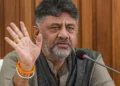
Bengaluru: With political tension rising ahead of the upcoming Rajya Sabha elections, the Congress party has shifted its MLAs from Odisha to Bengaluru amid fears of possible cross-voting. The move has once again placed Karnataka Deputy Chief Minister D. K. Shivakumar at the centre of high-stakes political management within the Congress.
The relocation of legislators is widely seen as a classic example of “resort politics”, a strategy used by parties to keep their MLAs together and prevent attempts by rival parties to lure them away ahead of crucial elections. According to party sources, a group of Congress MLAs and senior leaders from Bhubaneswar arrived in Bengaluru late on Thursday night on a flight operated by IndiGo. The legislators landed around 11 pm at Kempegowda International Airport, where they were received by close aides of D.K. Shivakumar.
From the airport, the MLAs were escorted under tight security to a private resort in Bidadi. They have been accommodated at the Wonder Law Resort, where special arrangements and police bandobast have been made to ensure that the legislators remain together until the Rajya Sabha election process concludes.
Among those who arrived in Bengaluru are Odisha Congress MLAs Mangu Khila, Appala Swamy, Rajan Ekka and Ashok Kumar. In addition to them, around 14 senior party leaders are believed to have travelled to Bengaluru, including former MP Bhakta Charan Das and party spokesperson Durga Prasad Panda. Congress insiders said the decision to move the MLAs out of Odisha was taken after reports of possible cross-voting in the Rajya Sabha elections. Party leaders fear that rival political forces may attempt to influence legislators and disrupt the party’s voting strategy.
In this context, the responsibility of managing the MLAs has reportedly been entrusted to D.K. Shivakumar, who has built a reputation within the Congress as a “troubleshooter” capable of handling delicate political situations. Over the past decade, Shivakumar has played a key role in safeguarding party legislators during political crises in several states.
Political observers say this development once again highlights Shivakumar’s growing influence within the Congress leadership. His ability to manage complex political negotiations and maintain party unity during turbulent times has strengthened his standing in the party. The episode is also being closely watched in Karnataka politics, where Shivakumar is widely seen as a strong contender for the Chief Minister’s post in the future. By successfully handling sensitive political assignments such as protecting MLAs from defections, he continues to project himself as a dependable strategist within the Congress.
Meanwhile, the numbers in the Odisha Assembly make the Rajya Sabha contest particularly intense. In the 147-member Assembly, the Biju Janata Dal holds 50 seats, while the Congress has 14 MLAs. The ruling Bharatiya Janata Party enjoys the support of 79 legislators. The BJD has nominated Dr. Santrapt Mishra as its official candidate and also fielded Dr. Dattatreya Hota as a general candidate for the fourth seat, with support from the Congress. On the other hand, the BJP has fielded two candidates and extended backing to independent candidate Dilip Ray.
Under the Rajya Sabha election system, a candidate needs at least 30 first-preference votes to secure victory. While the BJD appears well placed to ensure the victory of its official candidate, the fate of Dattatreya Hota largely depends on the support of Congress MLAs. Independent candidate Dilip Ray, backed by the BJP, can win only if he manages to secure additional votes from opposition MLAs. This makes cross-voting a decisive factor in the contest. Against this backdrop, the Congress leadership decided to bring its MLAs to Bengaluru and keep them together under the supervision of D.K. Shivakumar until the voting is completed.
As the Rajya Sabha polls draw closer, the presence of Odisha Congress legislators in Bengaluru has added fresh political intrigue — while also highlighting Shivakumar’s continuing rise as a key strategist within the Congress and a prominent leader in Karnataka’s power equations.