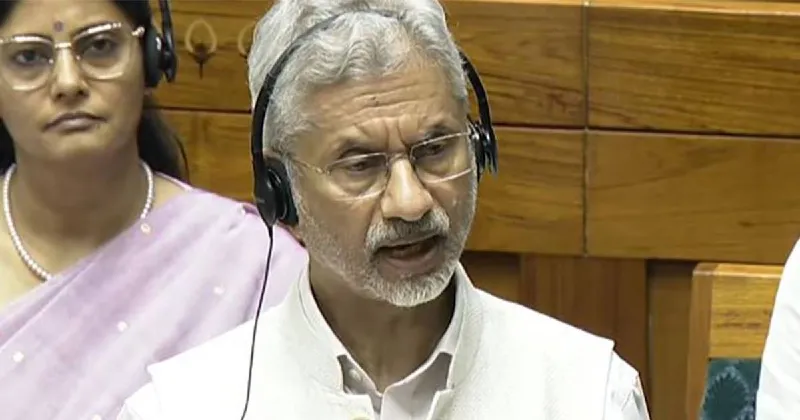
The intense crisis in West Asia triggered by the US-Israel and Iran conflict has been rapidly engulfing the geopolitical landscape of the region as a wildfire that is destructive and beyond control. There is no sign of de-escalation, and the warring parties seem reluctant to remain on the same page to accelerate dialogue and diplomacy. As the conflict spikes and the region boils with a basket of risks spreading across Asia and the Indian Ocean Region (IOR), External Affairs Minister Dr S Jaishankar delivered a suo motu statement in the Rajya Sabha on the West Asian crisis.
India votes for restraint, peace, dialogue & diplomacy
Speaking in the Rajya Sabha, EAM Jaishankar reiterated the importance of dialogue and diplomacy. He urged the warring parties to exercise restraint and return to the negotiating table. Expressing deep concern over the escalating situation in West Asia, the Minister said that the Indian government, since the day the conflict broke out(February 28), has been urging all sides to exercise restraint, avoid escalation and prioritise the safety of the civilians. “We believed and continue to believe that dialogue and diplomacy should be pursued to de-escalate tensions and address underlying issues. It is also imperative that the sovereignty and territorial integrity of all states in the region be respected”, EAM asserted in the Rajya Sabha.
Conflict affecting common people & the Indian diaspora; Measures by MEA
EAM Jaishankar also highlighted how the conflict in the Gulf region has massively affected the lives of the common people and the Indian community in West Asia. In this direction, the External Affairs Minister asserted that during the outbreak of the conflict, the Cabinet Committee on Security(CCS) headed by Prime Minister Modi expressed utmost concerns over the safety and security of the Indian diaspora in the region. The CCS also asserted the adverse impact on the economic and commercial activities due to the spiking conflict. The CCS meeting, in particular, took note of Indian students in the Gulf region who were struggling to travel to write their examinations. There are approximately one crore Indian citizens residing in the Gulf region, and their safety is of utmost priority, EAM Jaishankar noted.
Thus, all concerned ministries and departments of the government are advised to work towards a solution and take adequate measures to address these problems, EAM Jaishankar asserted. “The conflict has continued to intensify and the security situation in the region has deteriorated significantly. We have noted that the conflict spread to other nations with mounting destruction and deaths. Normal life and economic activities in the entire region are visibly affected. We, therefore, reiterated our call for dialogue and diplomacy and spoke up for an early end to the conflict”, EAM further added in his address to the Rajya Sabha.
EAM Jaishankar also asserted that Indian consulates across the Gulf region are constantly in contact with the Indian community to ensure their safety and security. Indian nationals are continuously advised to be cautious and avoid non-essential travel. Indian citizens are asked to keep a close watch on the advisories issued by the Embassies in a timely manner. EAM thus highlighted the measures taken by the Indian government to ensure the safety of the Indian community in the Gulf region. Also, for the safety of the Indians in Iran, 24/7 helplines have been initiated.
“Our diplomats have also worked hard to assist stranded transit passengers in hubs like Dubai, Doha and Abu Dhabi. They have facilitated international border crossings for Indian nationals, including from UAE to Oman and from Qatar, Kuwait and Bahrain to Saudi Arabia. Wherever there has been a partial opening of air space, we have approved and undertaken commercial flights, including non-scheduled flights to enable the return of Indian passengers. Our estimate is that as of yesterday almost 67,000 of our nationals have been safely returned”, EAM presented the data in the Rajya Sabha.
Indian energy & trade stakes in West Asia disrupted
In the latter part of his statement, Dr Jaishankar emphasised that West Asia is key to India’s energy security and other national interests. As a result of the latest conflict, these Indian interests in West Asia are severely affected. “This ongoing conflict is an issue of particular concern for India. We are a neighbouring region and understandably, have obvious stakes that West Asia remain stable and peaceful. The region is key to our energy security and includes many important suppliers of oil and gas”, EAM added.
“The Gulf is also a major trade partner, accounting for almost USD 200 billion annually. There have been significant investments from the region into the Indian economy. Therefore, serious supply chain disruptions and a climate of instability are serious issues. These include attacks on merchant shipping where Indian nationals often constitute a large proportion of the crews”, EAM Jaishankar highlighted how energy, trade and economic interests of India in West Asia are hampered.
“In view of the implications of this conflict for our energy security, the Government remains committed to ensuring that fully, taking into account, costs and risks of the energy markets. For us, the interests of the Indian consumer has and will always be the overriding priority. Where required, Indian diplomacy has supported the endeavours of our energy enterprises in this volatile situation”, the Minister thus reiterated India’s commitment to ensure energy security.
EAM Jaishankar concluded the address in Rajya Sabha by saying how there has been consistent government-to-government level talks to ensure regional peace, security and to fulfill the national interests. In this direction, Prime Minister Modi has held phone conversations with more than 8 counterparts from the gulf nations. With respect to the crisis in West Asia, India’s guiding principles are de-escalation, restraint, dialogue, diplomacy, peace and civilian safety. Beyond the intensity of the conflict, India strives to fulfill national interests in terms of energy security, unhindered trade flows and the security of the Indian community in West Asia, the EAM statement affirmed.