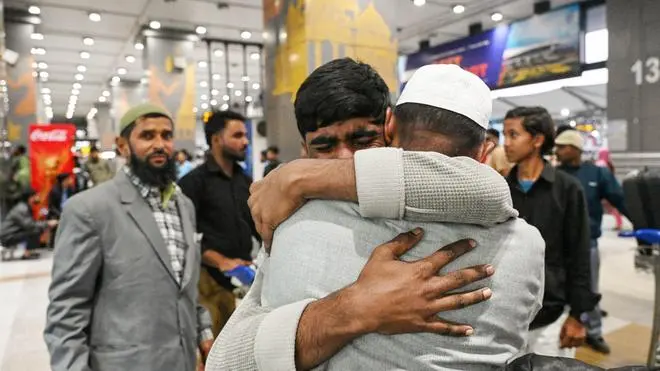
Amid the escalating tensions in West Asia involving the United States, Israel, and Iran, Indian passengers arriving from Dubai at various airports across the country have shared their experiences of living through missile alerts and safety advisories while describing the situation in the United Arab Emirates as largely stable. Many returnees expressed relief at reaching home safely and praised authorities for ensuring the safety of residents and facilitating travel during the uncertain period.
At Indira Gandhi International Airport, passengers arriving from Dubai on Saturday recounted how the atmosphere in the UAE remained relatively normal despite periodic warnings and emergency alerts. One passenger told reporters that while sirens occasionally sounded, the overall environment in Dubai had remained calm.
“The situation is very normal there. Sirens ring and alarms come but still, it’s quite a normal environment. Advisory is to stay inside unless it’s an emergency,” the passenger said, according to the news agency ANI. The returnee explained that authorities in Dubai had issued clear guidelines advising residents to remain indoors during alerts and to follow safety instructions issued through emergency messaging systems.
Another traveller arriving at the Delhi airport described receiving regular alerts on their mobile phones warning residents about possible missile activity in the region. According to the passenger, residents were advised to remain vigilant and keep emergency supplies ready in case the security situation deteriorated.
“The missiles are being intercepted and we used to receive emergency alerts. We were advised to stay safe and stay indoors, and keep one bag packed, ready with all essentials,” the passenger said. The advisory to keep an emergency bag prepared became a common precaution for many residents as authorities encouraged people to stay prepared without creating panic.
Similar accounts emerged from passengers landing at Chhatrapati Shivaji Maharaj International Airport, where travellers spoke about witnessing missile interceptions in the skies while emphasising that civilian life remained largely unaffected. One passenger credited the Dubai government for maintaining calm and order during the tense period.
“The Government of Dubai is handling the situation very well. The state government helped me in arranging the flight,” the passenger said, referring to assistance provided by the Maharashtra government in facilitating travel back to India. The traveller added that authorities coordinated closely with airlines and government agencies to ensure stranded passengers could return safely.
Another returnee in Mumbai described seeing missile activity in the sky but said it did not directly impact civilians on the ground. “The situation in Dubai is controlled. I saw missiles going up and down near me, but nothing of it actually affected the civilians,” the passenger said. The traveller also noted that educational institutions in the UAE had taken precautionary measures to ensure the safety of students during the alerts.
Passengers arriving at Sardar Vallabhbhai Patel International Airport also expressed gratitude after reaching India safely. Many said that while flights were disrupted due to the regional tensions, the overall situation in Dubai remained manageable.
“I am very happy to be back in India and I thank the government,” one passenger said upon arrival in Ahmedabad. Another traveller noted that the main inconvenience faced by passengers had been the rescheduling of flights rather than any direct security threat.
“There is no big problem in Dubai, but the flights are getting rescheduled. I am feeling very happy to be back in India,” the passenger said, reflecting the relief felt by many returnees who had experienced uncertainty due to changing flight schedules.
The accounts shared by passengers collectively indicate that while the conflict in West Asia has created anxiety and logistical challenges, authorities in the UAE have maintained strict safety protocols and provided clear guidance to residents and visitors. Sirens, emergency alerts, and advisories to remain indoors have become part of daily precautionary measures, but many travellers said life in Dubai has largely continued without major disruption.
Meanwhile, Indian airline IndiGo announced that it would operate flights to multiple destinations in West Asia to assist passengers during the ongoing crisis. According to the airline’s travel advisory, services were scheduled to operate to Dubai International Airport, Zayed International Airport, Sharjah International Airport, RAF Akrotiri, and Fujairah International Airport.
The airline also confirmed that return flights from these destinations would operate to Indian cities including Delhi, Mumbai, and Hyderabad in order to facilitate the movement of passengers and assist Indian nationals returning from the region.
“To support customers during this time, subject to prevailing safety conditions and applicable regulatory approvals, IndiGo will be operating flights to five destinations in the Middle East on March 7, 2026,” the airline said in a travel advisory. The company added that ensuring the safety and well-being of passengers and crew remained its top priority as it continued to monitor the evolving security situation.
India’s Ministry of Civil Aviation has also said it is closely monitoring the rapidly changing situation in West Asia as the conflict continues to disrupt regional air travel. Officials have been in contact with airlines and international aviation authorities to assess risks and coordinate flight operations.
Air travel across the region has faced significant disruptions since late February as escalating hostilities between the United States, Israel, and Iran have raised concerns about missile activity and airspace safety. Since February 28, several major Gulf aviation hubs—including airports in Dubai, Qatar, Kuwait, and Bahrain—have experienced flight cancellations and delays, affecting thousands of passengers.
Among them, Dubai International Airport, one of the world’s busiest aviation hubs and ranked second globally after Hartsfield–Jackson Atlanta International Airport, has witnessed disruptions as airlines adjust schedules in response to evolving security concerns.
The ongoing tensions have forced airlines to reschedule or temporarily suspend certain flights while aviation authorities evaluate the safety of air routes passing through the region. Despite these disruptions, both UAE authorities and airlines have continued to reassure travellers that safety protocols are in place and that operations will continue wherever possible under secure conditions.
For many Indian passengers returning home, the journey has been marked by a mix of uncertainty and relief. While the sirens and alerts in Dubai served as reminders of the conflict unfolding across the region, travellers emphasised that coordinated government responses and aviation measures ensured that civilians remained largely safe during the tense period.