The world order has seen a magnetic shift in geopolitical relations economically and militarily. A key factor influencing these equations is the strategic might that nations command over water bodies falling in their Exclusive Economic Zone(EEZ) as well as international boundaries. Hence, a nation’s ability to transport its goods and receive them effectively, ensuring seamless access to commercial vessels in the national waters and maintaining strategic autonomy with to continue building sustained economic relations through the maritime sector become crucial to its economic and military competitiveness in the current geopolitical environment.
In this backdrop this article, aims to examine the importance of this sector, the key components and initiatives undertaken by the Government of India for its development, and the multi-fold impacts of this maritime policy on India’s geopolitical standing.
Importance of the maritime sector in a nation’s development
India has a coastline extending to 7,588 km and 200 nautical miles of water area from its territorial boundaries as its exclusive economic zone. A highly efficient maritime sector unlocks a variety of economic benefits. Firstly, it opens avenues for sale of domestic products in international markets. This is a natural consequence of a country having a large fleet of ships, the requisite port infrastructure, containers, etc. to handle large volumes of goods to be transported. Hence, investment in its development creates a lot of jobs for semi-skilled and skilled workers involved in activities ranging from ship building to port construction, handling capacity, loading and unloading cargo, etc.
Secondly, it reduces the turnaround time for the transportation of goods, with recent reports showing a reduction to 0.9 days which beat global benchmarks of countries like the US and Germany. This reduces operating costs drastically as well incentivising businesses to expand production thereby increasing foreign exchange inflows, competition in the market, research and development and job creation across the board.
This economic competitiveness is dependent on the level of strategic autonomy India can exercise in access and usage of its exclusive economic zone. Hence, while commercial ports and shipping fleets are important, a strong Indian Navy with submarines, warships and naval grade weapons is key to ensure the Indian ocean does not become a battlefield for superior powers like the United States and China at the detriment of Indian interests. The Blue Water Navy Expansion has been initiated with 19 Vessels to be produced this year alone.
The primacy focal point is to ensure unhindered dominance and extraction of huge, rare-earth minerals and petroleum reserves lying in the seabed below and ensuring that indiscriminate fishing is not happening in the Indian Ocean Region to maintain ecological balance. Hence, an all- encompassing maritime policy not only accounts for economic, commercial and civilian convenience, but also the sovereign concerns of a nation over its water resources.
Policy Initiatives to enhance the maritime sector
The Indian government since 2020, has taken proactive measures to enhance development of the Indian Maritime sector. It has set the target for India to emerge as a global maritime leader by 2047, with an investment of Rs. 80 lakh crores, creation of 1.5 crore jobs and a strong push for green shipping under the Maritime Amrit Kaal Vision.
Legislative architecture of the sector
1. The Indian Ports Act, 2025: Replacing the 1908 framework, it promotes efficiency benchmarks and service quality by aligning centre-state roles and project approvals. It mandates establishment of the Maritime State Development Council (MSDC) to craft a National Perspective Plan for integrated development of India’s 12 major and 213 non-major ports. Secondly, it also mandated each state to have its own State Maritime Boards to streamline governance of non-major ports and even introduced ‘Mega Ports’ as a separate classification for high priority hubs. Additionally, it emphasised adoption of digital tools like the Maritime Single Window and advanced vessel traffic systems, transparent tariff policies, public-private partnerships, and formation of Dispute Resolution Committees to eliminate bottlenecks, and enhance last mile connectivity with hinterlands and inland waterways.
2. The Merchant Shipping Act, 2025: The new law aligns India’s position with international conventions like SOLAS, MAPROL, and MLC 2006. It expands the ownership criteria for Indian-flagged vessels to NRIs, OCUs, Co-operative societies, and companies and facilitate bareboat charter-cum-demise vessels to be registered, encouraging leasing and broadening access to ship ownerships. It establishes the National Shipping Board for policy advice and a Maritime Development Fund for acquiring ships, building infrastructure to reach a cargo growth of 230 million tonnes by 2030. Further, it pushes for electronic filings, risk-based vessel inspections, and a centralized database for curbing delays and compliance burdens. Other measures like transparent freight charges in bills of lading, enhanced seafarer welfare, training standards, dispute resolution and decriminalizing minor offences aim to improve operational reliability and attract private investment.
3. Carriage of Goods by Sea Act, 2025: This act modernizes bills of lading by expanding their coverage to outbound cargo, which includes containers and bulk, as well as enhanced due diligence on seaworthiness and accurate shipper details to handle higher volumes reliably. It also emphasised electronic bills of lading recognition to enable paperless trade, accelerating documentation and resucing processing times. It further updated liability limits to 666.67 SDR per package or 2 SDR per kilogram and introduced strict timelines for notice like 3 days for non-apparent damage, and 10yeat suit limits to expedite claims resolution.
Infrastructure and asset development plan
India aims to develop strategic competitiveness in deep-water capacity, transshipment capability, and end-to-end logistics to attract mainline services and keep value onshore. The Central Government has commissioned several projects for development of major ports. These include Rs. 76,000 crores for developing the Vadhavan Deep Water Port with a 20m+ draft and long berths sized for 24000 TEU vessels. It is the flagship mega port project of India with a target capacity of 10,000 MTPA by 2047 and enhance raid-road hinterland links, with shore power, alternative field and low-carbon bunkering integrated into operations.
This is projected to create 12 lakh jobs alone. Kerala is projected to play a major part in maritime expansion through the Vizhinjam International Seaport, which handles 10.6 lakh TEUs and nearly 500 ships. The Galathea Bay Transshipment hub has also been commissioned to harness the strategic position of India on the east-west lanes in the Andamans. With a high crane density, it ensures faster loading/unloading of goods, quick vessel turnaround, and handle large container transshipments. Lastly, the government through Sagarmala and Bharatmala logistic corridors, connects ports to inland demand creating port community systems, while e- workflows cut dwell and paperwork. Under Sagarmala, the government further launched 54 projects worth Rs. 24,000 crores to modernize harbours at Kochi, Kannur and Thrissur.
India aims to enhance its ship building capacity as well. It launched the Shipbuilding Financial Assistance Policy (SBFAP) 2025 to facilitate aims such as reducing turnaround time from 25 hours in 2020 to 20 hours by 2030 and increase average ship daily output to 35,000 GT by 2030. The SBFAP 2.0 provides direct subsidies to offset operational cost disadvantages and enhance competitiveness. The Shipbreaking Credit Note Scheme was also introduced to encourage ship recycling at Indian shipyards, with up to 40 per cent of the scrap value provisioned to shipyards as credit note under this program. These notes could be used by the shipyards to establish a closed-loop system which is environment-friendly and a domestic shipbuilding sector as well.
The policy intends to create certain shipbuilding clusters with high capacity of Gross Tonnage to attract more capital investments. The government also promised composition of a Maritime Development Fund of Rs. 25,000 crores which is to be raised to Rs. 1.5 lakh crores by 2030 for these projects. The government also extended customs duty exemptions on inputs and components used for shipbuilding for another decade, while also extending benefits under the tonnage tac scheme to inland vessels registered under the Indian Vessels Act, 2021.
On December 27, 2025, the Ministry of Ports, Shipping & Waterways (MoPSW), announced the new Shipbuilding Development Scheme (SbDS), with a budgetary outlay of Rs. 19,989 crores. With a focus on developing long-term capacity and capability creation, the scheme provides for development of greenfield shipbuilding clusters, expansion and modernisation of existing brownfield shipyards and establishment of the India Ship Technology Centre under the Indian Maritime University to specifically aid in research, design, innovation and skill development.
The greenfield clusters will be financed through a 50:50 Centre-State special purpose vehicle for common maritime and internal infrastructure. Existing shipyards will be provided the option to avail 25 per cent capital assistance for brownfield expansion of critical infrastructure like docks, shiplifts, fabrication facilities, and automation systems. Lastly, the scheme provides a Credit Risk Coverage Framework, whereby a government-backed insurance for pre-shipment, post-shipment and vendor-default risks are available, improving the project’s financial resilience.
The Union Budget 2026-27 offers opportunities for increasing this momentum by offering long term, low-cost financing for ports and shipbuilding apart from the existing mechanisms. Incentives for port-centric manufacturing and logistics clusters, alignment of the industrial policy with this sector to drive export0oriented growth particularly in heavy manufacturing, energy equipment and bulk cargo industries could be looked at to further private participation. Analysts have also predicted an expansion of the Sagarmala programme to modernize ports, inland waterways, shipbuilding, repairs, and coastal development over the next decase to improve ease of doing business and strengthen supply chains.
Workforce and skill development
At present India supplies about 12 per cent of the world officers for seafaring activities. To develop competence, various training academies have begun expanding intake to meet fleet growth. Focus has also increased on STCW compliance (Standards of Training, Certification, and Watchkeeping for Seafarers), making Indian officers meet international requirements to compete in the global market. Steady investment has been seen in maritime institutes like IMU to scale enrolment in engineering and logistics programs, digital learning modules for port operation and safety and partnerships with global academies to raise standards. The SBFAP 2.0 also allocated substantial funds for establishment of the Shipbuilding Capability Development Centres (SBDC), to provide innovative ship design and engineering solutions. With Rs. 1,200 crores in investment, technological advancements in the sector will become the core objective of the project with an additional Rs. 610 crores for further research and development in ship technology.
To ensure their safety and welfare, enhanced insurance and Employee Assistance Programs (EAPs) have been expanded offering counselling, financial advice, and crisis support per the unique challenges of the maritime work. Adjustments to policy to accommodate more shore leaves for seafarers between voyages, and welfare facilities like rest areas, medical centres, and recreational zones have been emphasised to reduce isolation and improve quality of life. Recognizing the psychological strain and exhaustion possible from long hours at the sea, mental health and fatigue management programs are being designed to help the crew in detecting early signs of stress and exhaustion. Hence, the projects while generating employment and increasing trade, also aim to provide a conducive work environment to balance out the unique problems this sector places on employees at every stage of the manufacturing and service line.
Enhancing naval might through maritime industry
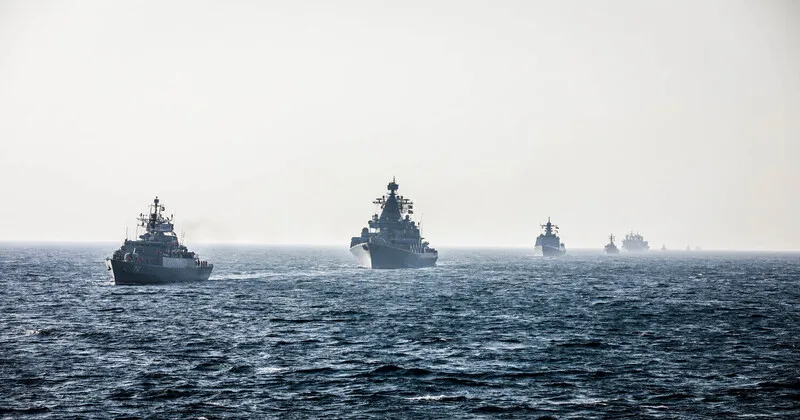
The Indian Navy as previously mentioned, had commissioned 19 warships in 2026 through an integrated construction approach. The strategic objectives of the same include countering Chinese naval expansion, maintaining freedom of navigation across sea lanes, strengthening regional partners in the QUAD and ASEAN and securing its dominance in the Indo-Pacific. In 2025, Swan Energy-promoted Reliance Naval and Engineering Ltd (RNEL) and Cochin Shipyard Ltd looked at construction of two non-nuclear icebreaker ships in a government brokered deal estimated to cost over Rs. 4,000 crores in partnership with the Russian company ROSATOM to support its Northern Sea Route development plan.
The Indian Government has recently discovered potentially vast reserves of crude oil and rare earth minerals in its territorial waters. With increasing geopolitical uncertainty, a strong naval fleet backing the economic boom of the Indian Maritime Sector to ensure extraction and utilisation of these resources and trade routes to promote Indian interests becomes paramount. The opening up of newer trade routes through the International North-South Trade Corridor, Adani Ports’ acquisition and investment in Isreal’s Haifa port among other deals to enhance maritime connectivity for seamless trade makes these policy shifts even more essential.
Impact of shift in maritime policy
The Indian policy for long has been compliance and regulation-heavy with predominantly State-led development. However, the new legal and policy architecture signals a shift towards more private participation. Common themes across these initiatives include bringing the laws in compliance with international standards for shipbuilding, port development, skilling and welfare assurance to workers, cargo handling and transport, etc., focus on digitalization of records, processes, compliance and accountability mechanisms, introduction of liberal economic policies like appropriate tariff adjustments, lowering handling costs for cargo, increased funding options like sovereign funds, green bonds for decarbonization investments, and bank backed long-horizon infrastructure programs among other things.
The new maritime policy hence, is a comprehensive roadmap for addressing key bureaucratic, technical and financial inefficiencies in the sector and harness a dual military and commercial cum civilian development approach to enhance India’s geopolitical standing and strategic control over its territorial waters and shield them from global conflicts and contrary interests.