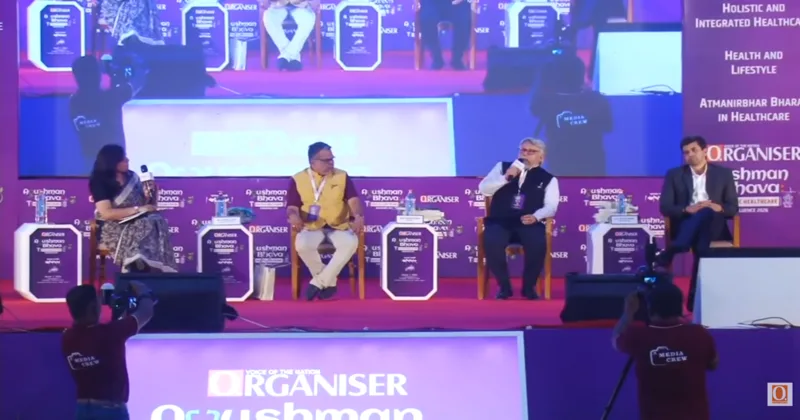
Accessibility to effective healthcare is the fundamental right of every individual. Carving an inclusive society in terms of effective healthcare is the basic attribute of every country. With respect to India, the medical ecosystem of the country is vast and holds huge potential in terms of resources and manpower to craft a healthy society and also to cater it across the globe. To further harness this potential of the Indian medical paradigm and craft pathways to overcome the existing bottlenecks, Organiser Weekly curated a flagship conclave called Ayushman Bhava Holistic Healthcare Confluence 2026.
In the session titled, “Affordable and Accessible Healthcare”, the panel ideated and deliberated a roadmap to script an inclusive healthcare ecosystem in India. They focused on upgrading the medical research ecosystem, integration of technology, furnishing state-of-the-art medical education system, countering the patent gridlocks posed by the western countries and the overarching changes that have to be channelised at the level of curating medical policies etc. The panel also hailed the importance and effectiveness of the traditional Indian medical practices such as Ayurveda and deliberated on ways to harness adoptive Ayurvedic practices aligning with the demands and competitions encountered in the modern era.
Achieving Atmanirbharata in pharmaceutical sector
Speaking at the session, Tarsen K. Ruby, Entrepreneur in the pharmaceutical industry, hailed the incredible progress made by India in the past decade with respect to achieving Atmanirbharata in the pharmaceutical industry. India is gradually and strategically seeking self-reliance in the pharma sector. The out of pocket medical expenditure has drastically reduced in India over the last decade as an impact of flagship initiatives of the government such as Ayushman Bharat.
However, currently, the out of pocket expenditure in India during medical emergencies is around 40 to 45 per cent. The number is high compared to other emerging economies. For example, in China, Sri Lanka and other countries, the out of pocket expenditure is less than 30 per cent. The percentage in India, thus has to come down even more and the work is in progress due to visionary policies of the government, asserted Tarsen K. Ruby.
India is at higher rank in medical accessibility & affordability
Comparing the medical ecosystem in India and the Western countries such as the USA and the UK in terms of medical accessibility and affordability, Dr. Parthiv Mehta, Radiologist suggested that the healthcare dynamics between India and the western countries cannot be compared at all given the scale of population and the intensity of healthcare penetration that has to be accelerated in the country. Despite the challenge of a vast population, the Indian doctors and healthcare system is more accessible and affordable to the needy people in India, Dr. Mehta added.
“I would fly to India for good healthcare”, Dr. Mehta asserted. India is massively progressing in terms of upgrading medical infrastructure, curating indigenous cutting-edge medical devices etc. India is also advancing in terms of sound and solid medical manpower, Dr. Mehta exclaimed by illustrating the overarching advancement accelerated in India in the domain of articulating an inclusive, accessible and affordable healthcare ecosystem.
Countering global competition and the challenge of patent
One of the major challenges encountered by India at the global level, in the path of scripting inclusive and affordable healthcare and Atmanirbharata in medicine, is the challenge of patents posed by the USA and other developed countries. Speaking on overcoming this bottleneck, Dr. Tarsen K. Ruby, stated that India need not worry about the patent challenge, because the country hitherto has access to manufacture more than 95 per cent of all necessary medicines that is prerequisite to craft a healthy Indian society. Thus, beyond countering the challenge of patents at the global level, India should focus more on large-scale manufacturing of the available medicines.
Making the medicines accessible to the grassroots through cost-effective means is vital, Dr. Ruby affirmed. The apex motive should be vast production, inclusive and economical distribution of the medicines, building a strong medical research and development ecosystem, medical education apparatus, strengthening medical infrastructure etc. This is pivotal than the problem of patents, Dr. Ruby thus highlighted the utmost needs of Indian healthcare beyond the problem of patents.
On countering the competition posed by the global pharmaceutical sector, Dr. Prerak Shah, Panchkarma Practitioner reiterated that more than mere large-scale manufacturing or production of generic medicines, India should aim at spreading and rooting the ancient Indian medical philosophy and practices across the globe. For example, ancient medical knowledge of Ayurveda should be spread across the globe. Fundamental Indian medical practices have to be unleashed across continents.
For example, China predominantly focuses on this strategy. Rather than mere production of generic medicines, they spread fundamental medical and health philosophy of China to the world. This makes Chinese medicine popular across the globe. India should adopt a similar strategy so that more than India made medicines, Indian medical philosophy will be popular and adopted across the world, thus global competition can also be effectively countered, Dr. Shah asserted. Also, India should focus more on strengthening the medical R&D architecture, to tackle global challenges, Dr. Shah further added.
Ayurvedic start ups and innovation centres
On the path of crafting unique solutions to popularize adaptive Ayurvedic practices in the country and across the globe, Dr. Mehta said that India has to scale-up the research and development budget for the medical ecosystem. The Indian government is indeed marching in this direction, Dr. Mehta also added. He highlighted how the current government is encouraging the growth of Ayurvedic start ups and innovation centres/labs to meet the modern day medical demands, to make the health practice more accessible to the people. These Ayurvedic start-ups/innovation centres are an incredible leap in the path of achieving Atmanirbharata in the Indian healthcare ecosystem.
AI in healthcare
Speaking about the integration of Artificial Intelligence into the healthcare ecosystem, Dr. Mehta asserted that AI is helping to bridge the gaps in healthcare and seek inclusivity. It is also aiding to restore the precious ancient medical knowledge, which is apparently on the verge of extinction. The lost Ayurvedic texts and practices can be catered to a larger population, to achieve better health and lifestyle practices among the population, with the help of AI. AI also helps to foster personalised medication, Dr. Mehta added. AI can be particularly used to achieve inclusivity in healthcare and reach advanced medical practices to the grassroots.
For example, the Primary Health Care Centres(PHCs) in the remote regions can be integrated with city healthcare practitioners with the help of AI. One example is tele-medication or tele-couseling. The under-operated, under-equipped PHCs can be furnished to its fullest efficiency with the tools of modern technology such as AI, Dr. Mehta asserted. However, the panel warned to be vigilant of the adverse effects of AI such as misuse, misguidance, cyber crime, theft of critical and personal data etc. Ultimately, the merits of AI integration into healthcare is more than the demerits, the panel concluded. Thus, use of AI in health is for the greater good and well-being of mankind.
Nation-first approach: Propelling sound healthcare policy in India
The panel also spoke about articulating a sound healthcare policy in India that will act as the key pillar in crafting a sound healthcare ecosystem in the country. Nation-first approach should be the bedrock of effective health policy of India. Additionally, the health policy should focus on bringing behavioural change among the medical graduates who are resistant to work at PHCs and remote regions. In fact, in this direction, drastic progress has been ensured in the previous decade, the panel opined.
Integrated and multidisciplinary medicine approach should be another pivotal pillar of the healthcare policy of India. Changes in the medical bureaucracy is another vital aspect that has to be implemented in the healthcare policy. This translates to the fact that people who draft healthcare policy in India should be medical experts and longtime professionals, beyond administrative professionals, the panel strongly asserted. Introducing Indian Medical Services will be an exponential initiative in this direction, Dr. Shah reiterated. The medical and healthcare policy should also focus on consolidating institutional changes in the medical educational apparatus. This includes a flexible hiring system for medical professors and ensuring an effective administrative system, the panel at Ayushman Bhava confluence asserted.