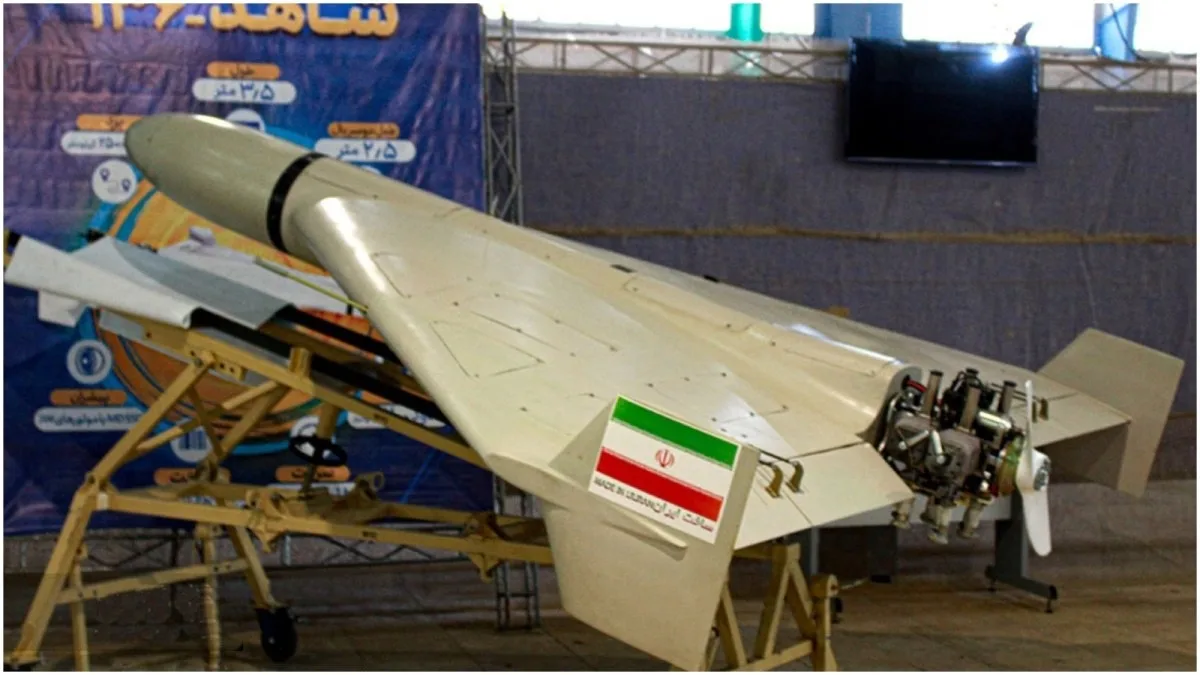
The rapidly escalating military tensions across West Asia have brought an unlikely weapon into global focus, the Shahed-136 drone, developed by Iran Aircraft Manufacturing Industries Corporation (HESA).
The growing attention around this drone is not about celebrating technological brilliance or military superiority. Instead, it highlights a troubling reality of modern warfare: even relatively crude and inexpensive weapons can create serious strategic complications for some of the world’s most sophisticated defence systems.
The Shahed-136 is a loitering munition often described as a “kamikaze drone.” Each unit is estimated to cost between 20,000 and 50,000 dollars, a price comparable to that of a mid-range automobile. Yet intercepting such drones frequently requires missile systems costing millions of dollars per shot.
This imbalance has created what reports describe as a “missile math problem.” When Iran launches large numbers of drones simultaneously, countries such as the United States and Israel are often compelled to deploy extremely expensive interceptor missiles to neutralise targets that are, by comparison, cheap and expendable.
The contrast in costs is stark. A single interceptor fired from the Patriot PAC-3 missile defence system can cost nearly 4 million dollars, while missiles used by the Terminal High Altitude Area Defense (THAAD) system may cost as much as 12 million dollars each.
In purely economic terms, the equation is deeply asymmetrical. Destroying one inexpensive drone may require firing a missile worth dozens or even hundreds of times more than the target itself. Over time, this imbalance can strain even the most advanced air defence networks, not because they lack capability, but because their ammunition is far more expensive and limited in supply.
This does not mean the Shahed-136 represents a technological breakthrough. In fact, the drone is notable precisely because of how unsophisticated its design is compared with high-end military hardware.
The ‘Lawnmower of the Skies’
Often referred to as the “lawnmower of the skies,” the drone gets its nickname from the distinctive buzzing sound produced by its piston engine. The noise resembles the hum of a lawnmower or small motorcycle engine, making it both recognisable and unsettling when heard approaching a target.
Despite the attention it receives, the drone itself is relatively simple. It is a delta-wing aircraft measuring about 3.5 metres in length, with a wingspan of roughly 2.5 metres, and weighing around 200 kilograms.
Unlike advanced Western drones designed with stealth features, encrypted communications, and complex sensors, the Shahed relies on a philosophy centred on simplicity, mass production, and expendability.
The drone is categorised as a loitering munition, meaning it is built for a single-use suicide mission. Once launched, it travels toward a designated target and ultimately crashes into it, detonating its onboard explosive payload.
Because the aircraft is not intended to return, it does not require landing gear, recovery systems, or reusable components. This drastically reduces production costs and allows the drone to be manufactured in large numbers.
Another striking aspect of the Shahed-136 is the ordinariness of many of its components. Instead of relying on specialised military hardware, much of the drone’s technology is derived from commercially available electronics.
This reliance on widely accessible components keeps costs low and also complicates efforts to restrict the drone’s production through international sanctions or export controls.
At the centre of the drone’s propulsion system is the MD-550 piston engine, a four-cylinder, two-stroke engine that Iran is believed to have reverse-engineered from a German civilian design. The engine drives a rear-mounted wooden pusher propeller, further highlighting the drone’s utilitarian and low-cost construction.
Its navigation systems are equally straightforward. The drone typically relies on a combination of satellite navigation signals, such as GPS or GLONASS, along with an inertial navigation system (INS).
Before launch, operators program the drone with pre-set coordinates, allowing it to travel autonomously toward its target without continuous human control.
This form of pre-programmed guidance reduces the need for complex command-and-control infrastructure and allows the drone to operate even in environments where communication signals may be disrupted.
By forcing expensive missile defences to respond to extremely cheap aerial threats, drones like the Shahed have introduced a new kind of challenge for modern militaries, one in which the battlefield is shaped as much by economics and production capacity as by technological superiority.
Launch system and attack method
The Shahed-136 is typically launched using simple rail systems mounted on trucks or mobile platforms.
The launch sequence involves a rocket-assisted take-off (RATO) booster that propels the drone into the air. Once airborne, the booster detaches, and the drone’s piston engine takes over for the remainder of the flight.
After reaching cruising altitude, the drone flies toward its target, often at low altitude to evade radar detection.
As it approaches its destination, the drone performs a terminal dive, crashing directly into the target and detonating its 30-50 kilogram warhead.
This attack profile allows it to strike a wide variety of targets including: Military bases, radar installations, fuel depots, infrastructure, and commercial shipping vessels.
Rapid upgrades between 2024 and 2026
While the basic design remains simple, the Shahed-136 has undergone significant upgrades over the past two years.
Newer variants deployed between 2024 and 2026 reportedly include:
Anti-jamming modules: Iran has integrated the Nasir anti-jamming system, designed to reduce vulnerability to electronic warfare measures.
Improved navigation systems: Enhanced inertial navigation capabilities allow the drone to continue its mission even if satellite signals are disrupted.
4G/LTE connectivity: Some models are believed to use commercial mobile networks to receive mid-flight course corrections, enabling operators to redirect the drone if necessary.
These improvements have increased the drone’s effectiveness against sophisticated air defence networks.
The ‘Missile Math’ crisis
The greatest strategic concern surrounding the Shahed-136 is not its individual destructive power but its ability to overwhelm defensive systems through sheer numbers.
Modern missile defence networks were originally designed to intercept ballistic missiles, which are relatively expensive and used sparingly.
The Shahed drone changes that equation entirely.
Because each unit is inexpensive, Iran can launch dozens or even hundreds simultaneously, forcing defenders to choose between:
1. Firing expensive interceptor missiles
2. Allowing some drones to slip through and strike targets
This scenario creates what military planners describe as “attrition economics.”
If a defender fires a 4 million dollar interceptor to destroy a 20,000 dollars drone, the attacker gains a financial advantage even when the drone is successfully intercepted.
Massive production capacity
According to research organisations such as the Centre for Information Resilience, Iran has developed a substantial production capability for these drones.
Estimates suggest the country may be able to manufacture up to 10,000 drones per month.
Such industrial capacity allows Iran to deploy drone swarms in prolonged conflicts, placing sustained pressure on enemy air defence systems.
This capability has raised concerns among Western strategists that their interceptor stockpiles may not be sufficient in a long war of attrition.
The effectiveness of Shahed drones has been demonstrated in several recent conflicts, particularly across the Middle East and Eastern Europe.
Reports say the drones have proven especially difficult to counter because they fly “low and slow.”
Traditional missile defence systems are optimised to detect fast-moving ballistic threats, but slow-moving drones can sometimes slip through radar coverage.
This challenge was highlighted during a 12-day conflict in June 2025, when the United States and Israel reportedly consumed a quarter of their THAAD interceptor inventory responding to Iranian attacks.
The episode raised serious concerns about the sustainability of current defence strategies.
‘The Strait of Hormuz’
Beyond military installations, Iran’s drone capabilities have significant implications for global energy security.
One of Tehran’s key strategic objectives is believed to be exerting pressure on the Strait of Hormuz, one of the world’s most critical maritime chokepoints.
Nearly 20 percent of global crude oil and liquefied natural gas shipments pass through this narrow waterway connecting the Persian Gulf to the Arabian Sea. Even a small number of successful drones strikes on oil tankers can disrupt shipping and trigger sharp increases in energy prices.
Recent attacks on multiple vessels have already caused: Brent crude prices to jump by 12 percent and European natural gas prices to rise by nearly 50 percent within a week.
The US military response
In response to the growing drone threat, the United States has begun experimenting with alternative strategies.
One approach involves deploying its own low-cost drone systems to counter Iranian capabilities.
Among these is the Low‑cost Unmanned Combat Attack System (LUCAS), which reports describe as a reverse-engineered equivalent of the Shahed-type drone.
This system has reportedly been used during operations targeting Iranian facilities under Operation Epic Fury.
However, US defence officials have acknowledged that the drone threat remains more severe than initially anticipated. The United States reportedly does not possess unlimited interceptor stockpiles, and sustained drone attacks could gradually deplete defensive inventories.
Political debate in Washington
The growing drone threat has sparked debate among US lawmakers regarding the duration and cost of potential conflicts involving Iran.
Some political leaders believe the confrontation could end relatively quickly.
Others fear it may become a prolonged war of attrition.
Several senators have warned that American defence manufacturing capacity may struggle to keep pace with the rate at which interceptors are being used.
The future of warfare
The rise of drones like Shahed-136 represents a broader shift in how wars may be fought in the coming decades. Historically, military superiority depended heavily on advanced technology and expensive weapon systems.
However, drones like the Shahed demonstrate that mass production and affordability can sometimes outweigh technological sophistication.
By combining low cost with large production volumes, Iran has created a weapon capable of:
1. Straining advanced air defence systems
2. Disrupting global trade routes
3. Altering strategic calculations of major powers
As drone technology continues to evolve, the challenge posed by systems such as the Shahed-136 drone is likely to grow more complex. The concern for defence is not that such drones represent unmatched technological sophistication, but that inexpensive and relatively simple weapons are increasingly capable of straining extremely costly military defence systems.
If low-cost drones can repeatedly force billion-dollar defence infrastructures into expensive interception cycles, the economics of warfare itself may begin to shift. Modern air defence architectures were designed primarily to counter ballistic missiles and high-end aircraft, not large swarms of cheap, expendable aerial platforms.
For the United States and its allies, the challenge is now to develop cost-effective countermeasures that can neutralise such threats without exhausting expensive missile inventories. These solutions may include advanced electronic warfare systems, directed-energy weapons such as laser defences, and cheaper interceptor drones designed specifically to counter unmanned aerial threats.
Until such alternatives become widely operational, weapons like the Shahed-136 will continue to highlight an uncomfortable reality of modern warfare: sometimes it is not the most technologically advanced systems that create the biggest strategic problems, but the simplest and most affordable ones.