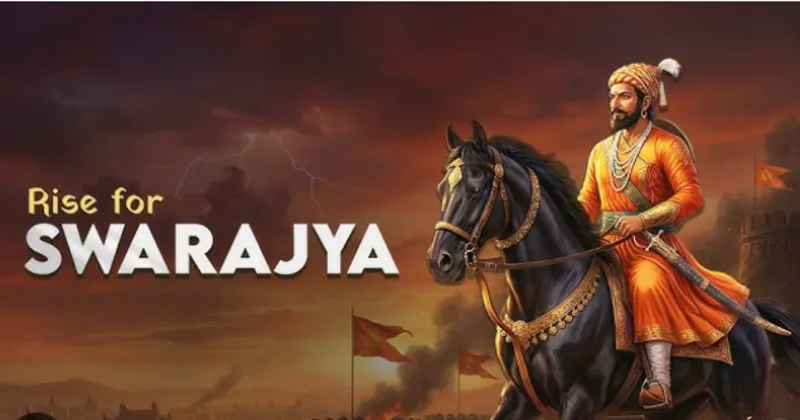
Born in 1630 at the hill fort of Shivneri Fort, Shivaji emerged as a visionary leader who reshaped the political and military landscape of the Indian subcontinent. His mission was not merely territorial expansion but the creation of a self-governing state rooted in justice, cultural pride, and the protection of society.
Historians across generations have examined Shivaji’s rise and his motivations. Many have highlighted his determination to establish “Hindavi Swarajya”—self-rule for the people of the land—at a time when large parts of India were under powerful imperial administrations. Through military brilliance, administrative innovation, and strong cultural conviction, Shivaji built a kingdom that inspired millions and altered the course of Indian history.
Early Life and Influences
Chhatrapati Shivaji Maharaj was born on February 19, 1630, to Shahaji Bhosale and Jijabai. His father was a Maratha general who served various Deccan sultanates, while his mother played a crucial role in shaping Shivaji’s character and worldview.
Raised largely under the guidance of Jijabai, Shivaji grew up hearing stories from the Ramayana, Mahabharata, and heroic accounts of ancient Indian rulers. These narratives instilled in him a deep sense of cultural pride, responsibility, and devotion to his homeland. Jijabai’s strong personality and unwavering belief in dharma profoundly influenced Shivaji’s moral and political outlook.
Around the age of twelve, Shivaji moved to Pune, where he began to observe the political realities of the Deccan region. The area was divided among several powers, including the Mughal Empire and regional sultanates such as the Adilshahi Sultanate and the Nizamshahi Sultanate. These circumstances shaped his early understanding of power, resistance, and governance.
Historical Perspectives on Shivaji’s Vision
Prominent historians have offered insights into Shivaji’s personality and motivations.
Renowned historian G. S. Sardesai noted that Shivaji possessed remarkable oratory skills and the ability to inspire his followers. According to Sardesai, Shivaji often spoke passionately about the injustices faced by society under certain rulers and urged his companions to stand up against oppression and injustice.
Similarly, historian R. C. Majumdar observed that Shivaji quickly won the hearts of people due to his courage, leadership, and constant readiness to face danger. Majumdar wrote that Shivaji and his associates frequently held secret meetings where they discussed strategies to free their homeland and end the suffering faced by ordinary people.
Another distinguished historian, Jadunath Sarkar, emphasised Shivaji’s broader political ideals. According to Sarkar, Shivaji’s governance aimed at ensuring peace among his subjects, promoting welfare, encouraging trade, and establishing an efficient administrative system that served people of all communities.
These assessments illustrate that Shivaji’s vision extended beyond warfare; it was rooted in state-building, justice, and social stability.
The Rise of Hindavi Swarajya
From a young age, Shivaji demonstrated remarkable political ambition and strategic thinking. Historian Gajanan Bhaskar Mehendale notes in his work Shivaji: His Life and Times that even as a teenager, Shivaji behaved like a de facto sovereign. Evidence of this appears in official seals found in documents dated January 28, 1646, when he was only sixteen years old.
Shivaji gradually began capturing strategically located forts across the Western Ghats. These forts served as defensive strongholds and administrative centres for the emerging Maratha state.
Over time, Shivaji’s actions transformed a small regional power into a formidable force capable of challenging major empires. His political ideology emphasised self-rule, protection of local traditions, and a governance system that reflected the needs of the people.
Master of Fort Warfare
One of Shivaji’s greatest military strengths was his mastery of fort-based warfare. Historical accounts suggest that he controlled around 240 forts during his lifetime, many of which were located in the rugged terrain of the Western Ghats.
These forts formed the backbone of his defensive strategy. Their placement along mountain passes allowed Shivaji’s forces to monitor enemy movements and control key trade routes.
Military historian Scott Waring observed that Shivaji’s forts stretched across vast mountain ranges along India’s western coast, effectively controlling crucial passes and defensive routes.
Each fort was administered carefully. Instead of concentrating authority in one person, Shivaji appointed three officials of different backgrounds—a havaldar, a sabnis, and a sarnobat—who collectively managed administration and defence. This system ensured accountability and reduced the risk of betrayal.
Military Organisation and Discipline
Despite facing enemies with far larger armies, Shivaji succeeded through discipline, mobility, and innovative tactics.
His forces relied heavily on guerrilla warfare, rapid cavalry movements, and surprise attacks. Shivaji emphasised strict discipline among soldiers and encouraged them to fight not only with skill but also with a sense of patriotism.
Rather than maintaining large armies, Shivaji focused on quality and strategic deployment. His soldiers were trained to operate in difficult terrain and execute swift operations that neutralised larger enemy forces.
This flexible military strategy enabled Shivaji to challenge powerful adversaries and maintain control over his expanding territories.
Administrative Reforms and Governance
While Shivaji’s military achievements are widely celebrated, historians often highlight his administrative innovations as equally significant.
According to Mahadev Govind Ranade, Shivaji was not only a great warrior but also a remarkable organiser who laid the foundations for strong civil institutions.
His administration was structured around a council known as the Ashta Pradhan, comprising eight ministers responsible for finance, foreign affairs, military matters, and other key functions.
Shivaji also implemented revenue reforms to ensure fair taxation and prevent exploitation of farmers. Trade and commerce were encouraged, and maritime security was strengthened through the development of a naval force along the western coast.
These policies helped create a stable and prosperous kingdom.
Cultural and Religious Vision
Although Shivaji is often remembered for his military struggles, his governance philosophy emphasised social harmony and justice.
Historian Jadunath Sarkar highlighted that Shivaji aimed to establish a welfare-oriented administration that provided equal opportunities to people of different backgrounds.
Temples and cultural institutions received patronage, while trade routes and agricultural systems were protected. The overall goal was to create a secure and prosperous society under a just administration.
Poet Bhushan (poet) famously referred to Shivaji as “Hindupati Patshah,” reflecting the admiration he commanded among contemporaries.
Expansion of the Maratha Power
During Shivaji’s lifetime, the Maratha state emerged as a powerful regional force. His strategic victories laid the foundation for the expansion of Maratha influence across large parts of India.
By the early eighteenth century, the Marathas had become one of the most influential powers on the subcontinent. Within a few decades of the death of Aurangzeb, Maratha armies advanced northwards and began asserting influence over major regions including Malwa, Bundelkhand, and Punjab.
Eventually, Maratha forces marched into Delhi, symbolically demonstrating their rise as a major power in Indian politics.
Influence on Later Generations
Shivaji’s legacy extended far beyond his lifetime. His example inspired numerous leaders, reformers, and freedom fighters in later centuries.
Even during the modern era, many national leaders expressed admiration for Shivaji’s achievements. Mahatma Gandhi once remarked that visiting Maharashtra—the land that produced figures such as Shivaji, Samarth Ramdas, and Sant Tukaram—felt like a pilgrimage.
Shivaji’s life became a symbol of courage, leadership, and resistance against oppression.
Historical Impact on India
The rise of the Maratha power dramatically altered the political structure of India. By challenging dominant empires and creating a decentralised but resilient political system, Shivaji’s legacy reshaped the subcontinent’s history.
Historians argue that the Maratha expansion weakened older imperial structures and changed the balance of power across the region.
Without Shivaji’s leadership and the subsequent Maratha movement, India’s political evolution might have taken a very different path.
The life and legacy of Chhatrapati Shivaji Maharaj remain central to India’s historical consciousness. His achievements as a military commander, state builder, and visionary ruler transformed a fragmented regional landscape into a powerful political force.
More than three centuries later, Shivaji continues to be remembered not only for his battlefield victories but also for his efforts to establish a just and organised state. His ideals of courage, self-rule, administrative efficiency, and cultural pride continue to inspire scholars, leaders, and citizens across generations.