
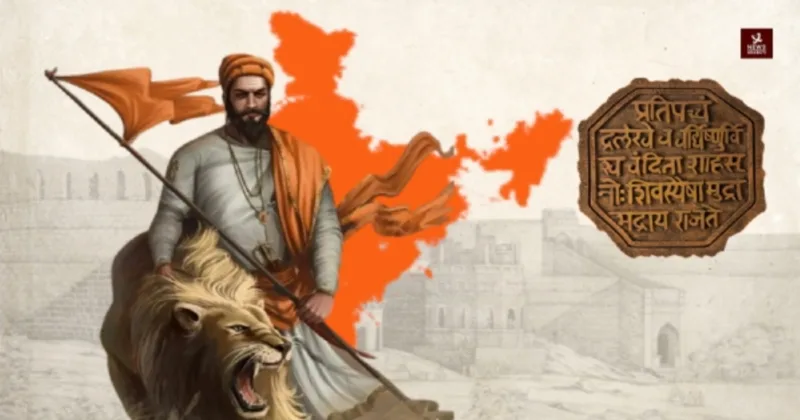
The most extraordinary king that Bharat has seen in the last three hundred years was a true reflection of Siva, whose coming was predicted long before he was born. All the great souls and saints of Maharashtra eagerly anticipated his arrival, believing he would save Hindus from foreign invaders and bring back Dharma, which had been harmed by the Mughal forces, as noted by Swami Vivekanand. Is there anyone more heroic than Shivray—be it a hero, saint, devotee, or king? He was the ideal king for humanity. He embodied the true essence of Bharat and what its future could be—a united group of diverse entities under one powerful leadership.
Chhatrapati Shivaji Maharaj’s identity as a Hindu King was not coincidental; he was a leader whose geopolitical, administrative, and ethical approaches were thoughtfully derived from Sanatan Dharma. His life was a purposeful, organized response to centuries of cultural oppression. In crafting a lasting inspiration for contemporary society and nation-building, his actions offer a clear and pragmatic blueprint for Hindus globally.
Prior to Chhatrapati Shivaji Maharaj, a prolonged period of subjugation had instilled a mentality of defeat among the native Hindu populace. Many Hindu chieftains fought amongst themselves for titles from foreign Sultans. Shivaji Maharaj’s most significant act was breaking this mental bondage. He reframed the struggle: the fight was no longer to serve a master but for Hindavi Swarajya—a self-governed state rooted in its own values.
During the exploitation by Mughal invaders, the country endured immense injustice, physical and mental abuse towards women, plundering of natural resources, and destruction of Hindu Dharmic and cultural sites. This dark time fostered a sense of helplessness that suggested nothing could be changed.
The economic, scientific, technological, and spiritual progress of Bharat was exploited, and during this tumultuous period, Hindu leaders lacked unity, instilling a sense of slavery in the populace, undermining Sanatan culture, and enforcing religious conversions. It was a bleak era for Hindus. They needed a Sanatani figure to courageously combat their enemies to restore the “Hindu Rashtra.” This concept of Hindu Rashtra does not imply the exclusion of other religions; rather, it operates on “Sanatan Dharma” principles to uplift every individual socially, economically, scientifically, and spiritually. Shivaji Raje’s vision included innovation, administration, and reforms. He devised unique military strategies suited to his geography and fortified key castles. Regarded as the founder of the Bharatiya navy, he was the first Bharatiya king to recognize the maritime threats posed by European colonial powers and established a robust naval force for his defense.
A visionary like Shivaji Maharaj stands the test of time. Unlike Napoleon, who, despite his foresight, faced defeat and lacked a reputation for integrity, Shivaji Raje is celebrated for his character. His troops never committed injustices, and he respected all members of society. His life exemplified bravery, leading to the establishment of the final Bharatiya empire that lasted 150 years. Admiring his governance, one cannot overlook his forward-thinking actions. He founded a navy, crowned himself as a native Hindu king in a time when others felt destined for servitude, replaced Persian with Sanskrit in administration, and began the process of converting Muslims back to Sanatan Dharma.
Intellectual and Cultural De-colonization: Contemporary Hindu society must abandon any defensive or apologetic stance about its identity, history, and texts. Nation-building necessitates a bold reclamation of history grounded in primary sources, as showcased by rigorous historians like G.B. Mehendale.
Reclaiming the Narrative: Society needs to actively document, study, and celebrate its civilizational accomplishments in science, philosophy, and governance, integrating these narratives into mainstream education and literature to cultivate a sense of pride in future generations.
For Chhatrapati Shivaji Maharaj, land was more than just a territory for taxation; it represented a sacred space. Historical documents, including his letters and works like the Shiva Bharat, indicate that a central aim of his struggle was the liberation of holy sites and halting cultural desecration. Moreover, he provided support to scholars and sacred institutions throughout Bharat, understanding that the state’s primary role is to protect its cultural heritage.
To create a strong nation, contemporary Hindus must nurture their physical and cultural roots through proactive engagement in the preservation and defense of temples, heritage sites, and traditional knowledge systems. Chhatrapati Shivaji Maharaj played a crucial role in upholding Hindu pride and culture in the face of foreign invasions that sought to obliterate the community by destroying places of worship. Notable examples include Babar’s demolition of the Sri Ram Janmabhoomi temple in Ayodhya and Aurangzeb’s destruction of the Kashi Vishwanath and Mathura temples. The structures that replaced these temples remain deeply offensive to many. Historian Arnold Toynbee noted that although these mosques stand as humiliating reminders, they have been preserved. Similarly, Poland dismantled Russian Orthodox churches after gaining independence as a symbolic act of reclaiming their dignity. This historical context fueled the Sri Ram Janmabhoomi movement in Bharat. Chhatrapati Shivaji Maharaj initiated the restoration of several temples, including those at Saptakoteshwar in Goa, Srisailam in Andhra Pradesh, and Samudrattirperumal in Tamil Nadu. His actions conveyed a clear message to foreign invaders: if they desecrated temples and insulted cultural pride, Hindus would resolutely rebuild what was destroyed. His destruction of the mosque in Kalyan-Bhiwandi is documented in Kavindra Parmanand Gobind Nevaskar’s Shivbharata, and a 1678 letter from Jesuit priest Andre Fair recounts Shivaji Maharaj’s actions against Muslim mosques.
Dharma and culture are inseparable from national identity, and self-esteem cannot be erased. Chhatrapati Shivaji Maharaj’s legacy teaches that when foreign aggressors attack our dignity, we must respond by eliminating the symbols of subjugation and restoring our honor. He emphasized the interconnection between cultural identity and national security, stating that a society that neglects its sacred geography ultimately risks losing its physical territory.
A recurring sentiment from the Maratha era asserts that the kingdom represents the will of Sri Sambhu (Mahadev), emphasising that power is a divine responsibility intended to protect society rather than serve individual luxury. Chhatrapati Shivaji Maharaj’s approach to governance was notably potent due to its inclusiveness; his leadership transcended caste divisions, uniting the various segments of Hindu society. He recognized the contributions of different groups, including the Mavalas’ martial prowess and the administrative skills of the Pradhans, as well as the maritime expertise of coastal communities like the Kolis and Bhandaris.
Eliminating internal divisions remains a vital challenge for contemporary Hindu society, as social cohesiveness is key to resilience. Chhatrapati Shivaji Maharaj’s model demonstrates that true strength arises when every community member can feel a sense of belonging and respect. It is essential to build institutional networks that assist the economically disadvantaged, providing access to quality education, healthcare, and opportunities for all, thereby fostering unity within society.
Chhatrapati Shivaji Maharaj vehemently opposed the overly passive interpretations of spirituality that left the nation vulnerable to invasions. He revitalized the Vedic ideal of harmonizing intellectual and spiritual strength (Brahma Tejas) with martial prowess (Kshatra Tejas), illustrating that righteousness without strength is unsustainable. His coronation heralded a powerful message to the Hindu nation about the path to victory. Throughout his endeavors, Maharaj demonstrated selflessness, illustrating his commitment to a higher purpose rather than personal gain; his humility and dedication are evident in anecdotes from his journeys, emphasizing that he placed duty and honor above his own life.
How to Implement This Today
Strength-Centric Statecraft: In today’s multi-polar and unstable global landscape, a nation cannot depend solely on ethical advantages. Hindus should advocate for hard power—emphasizing economic self-sufficiency (Atmanirbhar Bharat), maintaining a significant technological advantage, and establishing a strong defense system.
Strategic Pragmatism: Embracing Chhatrapati Shivaji Maharaj’s pragmatic approach in both diplomacy and governance. Societal training for youth should focus on legal, political, and technological proficiency, empowering them to safeguard national interests against both overt external threats and subtle, narrative-based internal challenges.
As a Hindu King, Shivaji Maharaj’s rule was grounded in the principle of Raja Dharma—the moral obligations of a king. This principle was exemplified through his unwavering zero-tolerance stance on crimes against women, his stringent oversight against corruption in revenue collection, and his commitment to protecting the vulnerable. His concept of Swarajya was validated by its embodiment of Surajya (good governance).
Institutional Integrity: For contemporary citizens and leaders, his legacy serves as a reminder that civic responsibilities are forms of Dharma. Upholding swift justice, combating corruption, and reinforcing the rule of law are fundamental Hindu values.
Character Development (Charitra): The cornerstone of nation-building is individual integrity. Shivaji Maharaj’s life, characterized by discipline, profound respect for elders and saints, and unwavering moral principles, should serve as a benchmark for modern leaders and citizens alike.
This focused framework solidifies Shivaji Maharaj’s status as a sovereign Hindu symbol. It reinterprets his historical deeds into a relevant contemporary guide for Swa Bodh and Samajik Samrasata, providing a clear path for modern civilizational renewal based on Sanatan principles as followed by Chhatrapati Shivaji Maharaj.