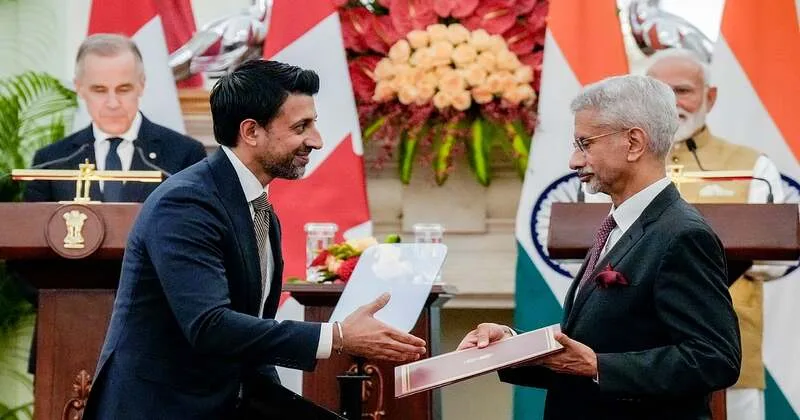
New Delhi: In a significant reset of bilateral ties, India and Canada on Monday sealed a series of landmark agreements, including a $2.6 billion long-term uranium supply deal and a pact on critical minerals, during talks between Prime Minister Narendra Modi and his Canadian counterpart, Mark Carney.
The two leaders also finalised a new framework to strengthen cooperation across key sectors and set an ambitious target of raising bilateral trade to USD 50 billion by 2030. Negotiations for a Comprehensive Economic Partnership Agreement (CEPA) were formally launched in New Delhi, signalling a renewed push to deepen economic engagement.
Uranium deal and civil nuclear cooperation
A central outcome of the visit was the signing of a 10-year uranium supply agreement valued at USD 2.6 billion, under which Canada will support India’s civil nuclear energy sector. Canada is the world’s second-largest uranium producer, accounting for around 13 to 15 per cent of global output. Approximately 80 to 85 per cent of its uranium production is exported to fuel nuclear reactors in the United States, Europe and Asia.
The agreement is expected to ensure long-term fuel security for India’s expanding nuclear power programme while strengthening strategic energy ties between the two democracies.
Addressing the media, Prime Minister Modi described the day as an “important milestone” in bilateral relations. “Since our first meeting, our relationship has been infused with new energy, mutual trust, and positivity. India and Canada share an unwavering belief in democratic values. Today, we discussed transforming this vision into a Next Level Partnership,” he said.
Prime Minister Carney termed the agreements “not merely the renewal of a relationship, but the expansion of a valued partnership with new ambition, focus, and foresight, a partnership between two confident countries charting our own course for the future.”
Critical minerals, defence and technology push
In addition to uranium cooperation, both countries signed a pact on critical minerals aimed at building resilient supply chains and enhancing technological and industrial collaboration. The agreement is expected to play a crucial role in sectors such as clean energy, advanced manufacturing and emerging technologies. The two sides also committed to expanding defence cooperation. Prime Minister Modi announced the establishment of an India–Canada Defence Dialogue to institutionalise engagement in this sector. Areas identified for deeper collaboration include maritime domain awareness, professional military exchanges and strengthening defence industries.
“We will work to enhance defence industries, maritime domain awareness, and military exchanges. To this end, we have today decided to establish the India–Canada Defence Dialogue,” Modi said, underlining the growing strategic trust between the two countries.
Beyond defence and energy, the leaders pledged to scale up cooperation in critical technologies, small and modular nuclear reactors, renewable energy and education. Modi highlighted Canada’s investment of approximately USD 100 billion in Indian markets as a strong indicator of confidence in India’s economic growth trajectory.
CEPA talks launched, trade targeted at $50 Billion
A major pillar of the renewed engagement is the formal launch of negotiations for a Comprehensive Economic Partnership Agreement. The Terms of Reference (ToR) for the CEPA were signed on March 2, 2026, by Union Commerce and Industry Minister Piyush Goyal and Canada’s Minister of International Trade Maninder Sidhu. The documents were exchanged in the presence of Prime Minister Modi and Prime Minister Carney at Hyderabad House.
The ToR outlines the format, frequency and approach for negotiations and will serve as the guiding framework for concluding an ambitious, balanced and mutually beneficial agreement. The proposed CEPA will cover trade in goods and services, along with other mutually agreed policy areas. Prime Minister Modi underlined that the goal is to raise bilateral trade to USD 50 billion by 2030, stressing the need to unlock the full potential of economic cooperation through the early conclusion of the agreement. Prime Minister Carney echoed this sentiment, describing the CEPA as an expansion of a valued partnership marked by “new ambition, focus, and foresight.”
The renewed push for CEPA follows discussions between the two leaders on the margins of the G7 meeting in Kananaskis, Canada, in October 2025, where both sides agreed to advance negotiations. Bilateral trade between India and Canada stood at USD 8.66 billion in FY 2024–25, according to data from the Directorate General of Commercial Intelligence and Statistics (DGCI&S). India exported goods worth USD 4.22 billion and imported USD 4.44 billion during the period. Key Indian exports to Canada include pharmaceuticals, iron and steel, seafood, cotton garments, electronics and chemicals. Major imports from Canada comprise pulses, coal, fertilisers and crude petroleum.
The two countries also emphasised the importance of people-to-people ties. Canada is home to more than 4.25 lakh Indian students and hosts a vibrant Indian diaspora. Officials noted that the CEPA is expected to further strengthen these connections, reinforcing the spirit of “One Family” that underpins the relationship. With strategic cooperation expanding across energy, defence, trade and technology, both leaders signalled that India–Canada ties have entered a new phase defined by renewed trust, economic ambition and long-term partnership.