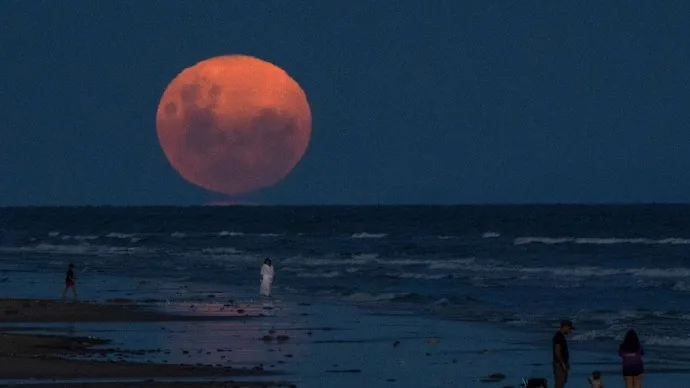
Stargazers and devotees alike are preparing for the first lunar eclipse of 2026, which will occur today, March 3. Scientifically known as a total lunar eclipse, the celestial event will turn the Moon a deep red earning it the popular name “Blood Moon.”
According to astronomical calculations, the eclipse will begin at 3:20 PM IST. However, at that time, the Moon will not yet have risen in India. As a result, Indian viewers will only witness the final phase of the eclipse shortly after moonrise in the evening, making the visible window relatively short.
The Science Behind the Blood Moon
A total lunar eclipse occurs when the Earth moves directly between the Sun and the Moon, blocking sunlight and casting its shadow called the umbra on the lunar surface. Although the Moon does not emit its own light and shines by reflecting sunlight, it does not go completely dark during an eclipse. Instead, it takes on a reddish hue due to a phenomenon called Rayleigh scattering. As sunlight passes through Earth’s atmosphere, shorter blue wavelengths scatter away, while longer red wavelengths bend and reach the Moon.
This refracted red light bathes the Moon in a coppery or crimson glow. If one were standing on the Moon during the eclipse, Earth would appear as a dark disc surrounded by a glowing red ring created by all the sunrises and sunsets happening simultaneously across the planet. The intensity of the red shade depends on atmospheric conditions; high levels of dust, smoke, or pollution can make the Moon appear darker and more crimson, while clearer skies may result in a brighter orange or copper tone.
Why it is called ‘Grastodit Chandra Grahan’
Astrologers have described today’s eclipse as a “Grastodit Chandra Grahan.” According to astrologer Dr. Gaurav Kumar Dixit, this term is used when the eclipse begins before moonrise in a particular region and only the concluding phase is visible after the Moon rises. In India’s case, although the eclipse begins at 3:20 PM IST, the Moon will rise between approximately 6:26 PM and 6:32 PM IST in most regions. By then, the eclipse will be in its final stage and is expected to conclude around 6:46-6:47 PM IST. This means the visible duration of the eclipse in India will be roughly 15 to 20 minutes, making it a brief yet significant celestial sight.
Panchang Significance
According to the Hindu Panchang, the eclipse is occurring in Simha Rashi (Leo) and Purva Phalguni Nakshatra. In Hindu tradition, a lunar eclipse is not merely an astronomical phenomenon but also a spiritually significant event believed to influence all zodiac signs and individuals. Many consider it a time for introspection, prayer and spiritual cleansing.
Sutak Kaal and Religious Observances
In Hindu belief, Sutak Kaal is considered an inauspicious period preceding an eclipse. It is observed several hours before the eclipse begins and continues until it ends. For this eclipse, Sutak Kaal began at 9:26 AM IST and will end at 6:46 PM IST, coinciding with the conclusion of the eclipse. During Sutak, devotees are advised to avoid cooking, eating or initiating auspicious activities.
Instead, many engage in mantra chanting, meditation and remembrance of God. It is also customary in some households to place Tulsi leaves in stored food items as a symbolic protective measure. After the eclipse concludes, people traditionally take a bath and may donate food or clothes as part of spiritual practice.
Regional timings
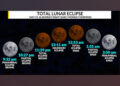
In Kanpur, the Moon will rise at 6:14 PM, and the eclipse will be visible from that time until 6:46 PM, giving a local visibility duration of approximately 32 minutes and 22 seconds. The totality phase, which will not be fully visible in India, begins at 4:35 PM, reaches its maximum at 5:04 PM, and ends at 5:33 PM. In Lucknow, the Moon will rise at 6:12 PM, with the eclipse visible from 6:12 PM to 6:46 PM, lasting about 34 minutes and 56 seconds locally. Because the main totality phase occurs before moonrise in India, viewers will only witness the concluding partial stage of the eclipse.
Safe viewing and photography
Unlike a solar eclipse, a lunar eclipse is completely safe to observe with the naked eye, and no protective glasses are required. Using binoculars or a small telescope can enhance the viewing experience by revealing lunar craters and surface textures glowing in red. Those wishing to photograph the Blood Moon are advised to use a tripod for stability, turn off the flash, manually focus on the Moon and slightly increase ISO settings to capture the dimmer light during the eclipse’s peak phase.
Total lunar eclipses do not occur every month due to the tilt of the Moon’s orbit relative to Earth’s orbit around the Sun. The precise alignment required makes this a relatively rare and captivating spectacle. For many in India, the March 3 Chandra Grahan is both a scientific marvel and a moment of spiritual reflection.
As the Moon rises already shadowed and glowing faintly red, it will offer a brief but memorable glimpse of one of nature’s most dramatic cosmic alignments.