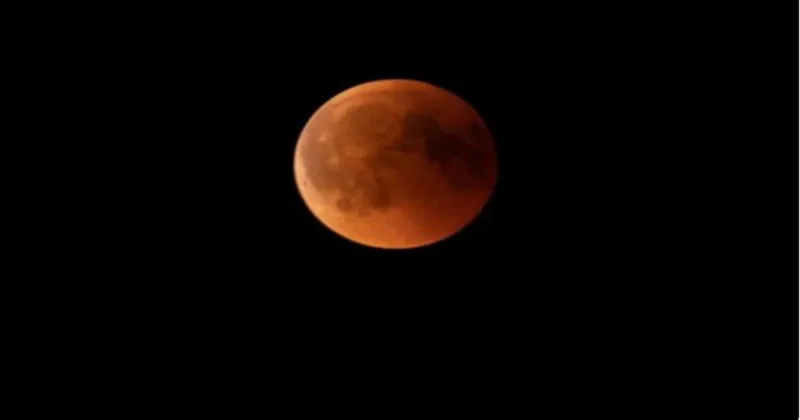
NEW DELHI: A total lunar eclipse will take place across several time zones on Tuesday, March 3, 2026. In this, the Moon moves from right to left, passing through Earth’s shadow.
According to the India Meteorological Department, a total lunar eclipse occurs when the entire Moon lies within the Earth’s umbra, and a partial lunar eclipse occurs only when a portion of the Moon lies within the Earth’s umbra.
India Meteorological Department, in a post on X, mentioned that a total lunar eclipse is set to occur on Tuesday, March 3, 2026, marking a significant astronomical event with a deep magnitude of 1.155. This phenomenon occurs when the entire Moon enters Earth’s umbral shadow, whereas a partial eclipse obscures only a portion of the Moon. This particular total eclipse will be visible to observers across India, as well as in Eastern Asia, Australia, and the Americas”.
In the Indian context, the experience will vary by region. Most places in India will observe the end of the lunar eclipse at the time of moonrise, except some places in North-East India and the Andaman and Nicobar Islands, where the end of the totality phase of the eclipse will also be visible.
According to Indian Standard Time (IST), the celestial event will follow a specific schedule throughout the afternoon and evening. The eclipse is slated to begin at 15:20 (3:20 PM), with the totality phase starting at 16:34 (4:34 PM). The Moon will remain completely within the Earth’s shadow until totality ends at 17:33 (5:33 PM), and the entire eclipse cycle will officially conclude at 18:48 (6:48 PM).
A total lunar eclipse occurs when the Sun, Earth, and Moon are precisely aligned, and the Moon passes into the shadow of the Earth. During a total lunar eclipse, the Earth comes between the Sun and the Moon and blocks any direct sunlight from reaching the Moon. (With inputs from ANI)