India–Canada relations over the past year offer a case study for how middle-power partnerships behave under geopolitical stress. The trajectory has followed a recognisable pattern. Political rupture came first. Institutional disengagement followed. Quiet security repair began thereafter. Economic re-engagement is now emerging as the most durable stabilising layer.
Viewed through media narratives, the relationship may still appear to be in recovery mode. Viewed structurally, however, a deeper recalibration is underway. The two countries are not merely attempting to restore diplomatic normalcy. They are moving towards building a more insulated, transaction-driven and institutionally buffered partnership anchored in trade flows, long-horizon capital investment, energy security cooperation, technology partnerships and structured security coordination.
The deterioration phase was not inevitable. It was accelerated by political and diplomatic choices during the tenure of Prime Minister Justin Trudeau and Foreign Minister Mélanie Joly. Public articulation of sensitive security concerns came before investigative processes matured and before diplomatic de-escalation channels were fully utilised. This triggered immediate institutional consequences. Reciprocal persona non grata declarations involving senior diplomats, including the Indian High Commissioner to Canada, marked one of the lowest operational phases in bilateral engagement in recent decades.
The more lasting damage was institutional rather than political. Diplomatic expulsions create long bureaucratic memory across foreign ministries, intelligence establishments and law enforcement systems. These institutional memories often outlast political leadership cycles. The current phase of engagement is therefore less about reconciliation and more about constructing durable institutional guardrails.
Mark Carney visit to India is a strategic renewal
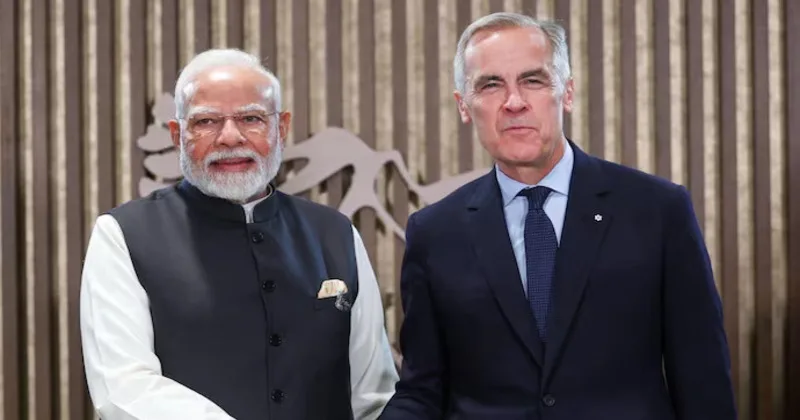
Mark Carney’s visit to India this week will offer a chance to turn a diplomatic thaw into strategic renewal. This will be Carney’s third meeting with Narendra Modi in 10 mths – extraordinary, for two countries that, until late 2024, were mired in mutual suspicion, exchanging recriminations, expelling diplomats and allowing political rhetoric to spill over into business and mobility.
The stars had begun to realign from rupture to reset when Carney and Modi met in Alberta last June. The next logical step-renewal-should now be anchored in the rapid conclusion of the long-pending Comprehensive Economic Partnership Agreement(CEPA), under negotiation since 2010, but repeatedly derailed by political turbulence.
The 2023-24 diplomatic crisis left deep institutional scars. Trust collapsed after Canada accused India of ‘transnational repression’ and electoral interference, even as India argued that Ottawa offered undue space to extremist actors. Repair began through sustained diplomatic engagement in 2025.
2024: Political shock, economic continuity
The last visit by a Canadian Prime Minister to India during the G20 Summit in 2023 took place under visible political strain. Public allegations by Canada regarding transnational criminal activity resulted in an immediate political contraction in bilateral space. However, economic fundamentals demonstrated resilience. Canadian pension and institutional capital continued to maintain deep exposure to Indian infrastructure, logistics, renewable energy and urban development sectors. Cumulative Canadian institutional exposure in India is widely assessed to be in the range of US$70–80 billion. Canadian pension funds remain among the largest foreign investors in Indian highways, logistics corridors, renewable energy platforms and commercial real estate investment structures. This continuity reflected a broader reality. Long-duration capital tends to track macroeconomic fundamentals rather than short-term political cycles.
2025: Beginning of institutional reset
The stabilisation phase began through quiet Foreign Office consultations between India’s Ministry of External Affairs and Global Affairs Canada. These engagements helped restore working-level communication channels and rebuild technical trust.
Leadership signalling continued through multilateral engagement. Prime Minister Narendra Modi’s participation in the G7 outreach meeting at Kananaskis ensured leadership-level communication did not collapse. A subsequent interaction on the margins of the G20 Summit in Johannesburg reinforced mutual signalling that controlled stabilisation was strategically desirable. Recovery then expanded across multiple layers of engagement.
Subnational diplomacy played a stabilising role. The visit of British Columbia Premier David Eby to India demonstrated that provincial trade, clean technology and digital economy partnerships remained insulated from federal political tensions. High-level political engagement resumed with the visit of Canada’s Foreign Minister Anita Anand. Discussions focused on restoring cooperation across trade, climate transition, energy security, science partnerships, agriculture supply chains and mobility frameworks.
Economic institutionalisation deepened following the visit of International Trade Minister Maninder Sidhu during the 7th Ministerial Dialogue on Trade and Investment. The dialogue reaffirmed commitment to supply chain diversification, particularly in critical minerals, clean technology and advanced manufacturing sectors. Mobility frameworks for skilled professionals and students re-emerged as a central pillar of long-term innovation partnerships.
The participation of Canada’s Artificial Intelligence Minister, Evan Solomon, at India’s recent AI Summit signalled Ottawa’s willingness to institutionalise cooperation in AI governance, standards-setting, and applied research partnerships. Societal and knowledge-sector linkages were also reactivated. Delegations of Canadian university Presidents and senior academic leadership travelled to India. Education remains one of the strongest pillars of bilateral ties. Over 300,000 Indian students study in Canada annually, contributing approximately CAD 8–10 billion to the Canadian economy.
External Affairs Minister Dr S. Jaishankar’s participation in G7 Foreign Ministers’ outreach engagements hosted by Canada reinforced India’s willingness to maintain strategic dialogue even during bilateral recalibration. The ‘Trumpian shock’ forced Ottawa to rethink its strategic anchors. Justin Trudeau’s departure and Carney’s rise brought a mandate to mitigate the existential risk of a volatile US, while diversifying Canada’s relationships. Rebuilding ties with India, therefore, became geopolitical imperative. Shared vulnerabilities in the face of tariff weaponisation helped both sides rediscover pragmatic common ground.
2026: Rebalancing Continues
By early 2026, the relationship shifted from diplomatic stabilisation to sectoral strategic convergence. Energy emerged as the central axis. Canada holds the world’s third-largest proven oil reserves, exceeding 165 billion barrels. India imports over 85 per cent of its crude oil consumption and is expected to remain among the world’s largest energy importers through 2040.
India’s LNG demand is projected to grow from roughly 65 BCM annually to potentially 110–120 BCM by the early 2030s. Canada’s west coast LNG export infrastructure is well positioned to serve Indo-Pacific demand growth. Energy cooperation, therefore, is not merely commercial; it forms the strategic ballast of the broader reset, linking trade expansion, long-term capital flows and political risk stabilisation into a single structural arc.
Uranium cooperation is likely to deepen as India expands nuclear capacity beyond its current 7.5 GW base, particularly with growing interest in Small Modular Reactor technologies to support low- carbon baseload power. Agricultural trade continues to provide stabilising ballast. Canadian pulse exports to India historically range between US$600 million and US$1 billion annually, depending on domestic production cycles.
Security cooperation was significantly strengthened through the February 2026 visit of India’s National Security Advisor Ajit Doval to Canada. Agreements included law enforcement coordination frameworks, intelligence-sharing protocols, and liaison officer deployments. Cooperation areas include fentanyl precursor supply chains, transnational organised crime, cyber threats and financial fraud networks.
The Carney doctrine
Prime Minister Mark Carney’s expected visit to India is likely to represent a transition from stabilisation towards structured expansion in bilateral engagement. Recent high-profile interactions between Carney and US President Donald Trump have provided insight into Carney’s negotiating doctrine. His calibrated willingness to disengage when discussions cross defined negotiating thresholds suggests a leadership style that is technocratic, boundary- driven and strategically contained rather than personality-driven or theatrically confrontational.
The signalling observed during these interactions reflects boundary-setting rather than disruption. It reinforces negotiating positions while preserving long-term engagement space. Transposed to India–Canada engagement, this suggests a negotiation style prioritising structured outcomes, institutional continuity and long-horizon deliverables over public optics.
During Carney’s visit, India and Canada can be expected to conclude a $2.8 billion deal for uranium supplies to India for a decade. For an India aiming to massively expand its civilian nuclear energy capacity, Canadian uranium is a timely necessity. The official reboot of the Comprehensive Economic Partnership Agreement (CEPA) negotiations is also on the cards. The CEPA has the ambitious goal of doubling bilateral trade to $60 billion by 2030.
Movement towards finalising Terms of Reference for a CEPA could represent the most consequential institutional step in bilateral economic relations. Bilateral merchandise trade currently stands at roughly US$8–9 billion annually, significantly below potential relative to economic size. A well-crafted CEPA could provide a stable framework for trade, investment and mobility and ensure a tailwind for business. It could facilitate deals in uranium supply, LNG and critical minerals, while lowering trade barriers and easing project timelines.
Even with political turbulence, Canadian institutional investors-‘Maple 8’ pension funds and firms like Brookfield and Fairfax – remained steadfast. Their investments in Indian airports, logistics, RE and urban infrastructure have crossed $100 bn. This figure could triple by 2030, with an assist from CEPA that provides predictable protections in taxation, dispute resolution and exit pathways, even as Indian IT and engineering firms are expanding strongly in Canada.
India’s economy is approaching the US$4 trillion threshold and is projected to cross US$5 trillion within this decade. Canada’s economy remains around US$2.1–2.2 trillion. Complementarities remain strong across pharmaceuticals, digital services, refined petroleum, engineering goods and speciality chemicals from India, and energy resources, potash, pulses, timber and agri-technology from Canada. A structured trade framework could potentially double bilateral trade volumes over a decade.
Technology collaboration is expected to expand across critical minerals, advanced materials, aerospace, AI-enabled manufacturing, digital public infrastructure, and clean technology ecosystems. The new agenda also focuses on Canada offering itself as an alternative to China for the sourcing of critical minerals like lithium, cobalt and copper required to boost India’s ambitious EV mobility and manufacturing plans. In return, India offers Canada a gateway to the Indo-Pacific’s booming consumer markets. This is the “Carney Effect” in action: using Canada’s natural resources not just as commodities, but as diplomatic leverage to build resilient partnerships with significant middle powers.
With the 2026 trade landscape in North America increasingly defined by protectionism and sweeping tariffs, Canada is learning a hard lesson in diversification. In continuation of the unrelenting tariff imposition on friends and foes alike (as of 30 January 2026), Trump had decertified Canadian aircraft and threatened 50 per cent tariffs on planes sold to the US by Canada. Pivoting toward India, therefore, makes ample sense.
That being said, challenges remain. Security concerns and deep-seated disagreements that triggered the 2023 crisis have not vanished; they have simply been moved to a different track. But the diplomatic channels are back at work with the high commissioners reinstated. National Security Advisor Ajit Doval’s visit to Ottawa earlier this month ensured the delicate balance: Security dialogues run parallel to economic progress, rather than impeding it. Doval and his counterpart Nathalie G. Drouin agreed to a “shared work plan” to guide cooperation. The Indian diaspora in Canada, comprising more than 1.8 million people of Indian origin, will remain a central stabilising factor across business, academia, technology entrepreneurship, and capital flows.
Strategic hedging
Canada’s expanding engagement with India must also be viewed within its broader global positioning. With Canada–United States relations entering a more volatile phase, Ottawa appears increasingly inclined to diversify strategic and economic partnerships. What will prove helpful for Canada is Carney’s economic expertise. With Canada looking for new markets to replace the business opportunities lost in the US, Carney should look at India, with its middle class numbering the entire population of the US, as an economic opportunity, replacing surface-level bilateral engagements with deep-rooted linkages.
Engagement with major growth centres such as India, reflects risk distribution rather than shifts in alignment. Carney’s Central Bank background reinforces a long-horizon, risk-distribution approach to external partnerships, particularly in capital flows, supply chain diversification, and energy security. India’s growth trajectory, energy demand profile, infrastructure absorption capacity and innovation ecosystem make deeper engagement structurally logical for Canada.
The Real test
The success of this phase will not be measured through joint statements. It will be measured through structural outcomes. Do trade negotiations move towards time-bound frameworks? Do energy engagements convert into long-term contracts? Do security dialogues become routine operational mechanisms? Do diplomatic missions regain full operational comfort? India and Canada are not bound by geography or alliance structures. They are bound by economic complementarity, capital interdependence and converging global governance interests.
If current trends continue, the next decade of India–Canada relations may be defined less by political turbulence and more by investment integration, energy interdependence, supply chain cooperation, technology collaboration and deepening people-to-people linkages. And in the longer arc of international politics, partnerships anchored in structural complementarity tend to outlast political turbulence.
An accelerated CEPA, fast-tracked in 2026, with an interim understanding by mid-year, will stand as a symbol of the new partnership. This agreement, paired with sectoral breakthrough deals in critical minerals, uranium, defence and AI, can redefine the next decade of bilateral engagement, and live up to the promise of the strategic partnership India and Canada have had on paper since 2015.