US oil politics in Iran and Venezuela deepens global tensions
September 12, 2026
  • Read Ecopy
  • Circulation
  • Advertise
  • Careers
  • About Us
  • Contact Us
Android AppiPhone AppArattai
Organiser
  • ‌
  • Bharat
    • Assam
    • Bihar
    • Chhattisgarh
    • Jharkhand
    • Maharashtra
    • View All States
  • World
    • Asia
    • Europe
    • North America
    • South America
    • Africa
    • Australia
  • Editorial
  • International
  • Opinion
  • RSS @ 100
  • More
    • World Hindu Congress 2026
    • Op Sindoor
    • Analysis
    • Sports
    • Defence
    • Politics
    • Business
    • Economy
    • Culture
    • Special Report
    • Sci & Tech
    • Entertainment
    • G20
    • Azadi Ka Amrit Mahotsav
    • Vocal4Local
    • Web Stories
    • Education
    • Employment
    • Books
    • Interviews
    • Travel
    • Law
    • Health
    • Obituary
  • Subscribe
    • Subscribe Print Edition
    • Subscribe Ecopy
    • Read Ecopy
  • ‌
  • Bharat
    • Assam
    • Bihar
    • Chhattisgarh
    • Jharkhand
    • Maharashtra
    • View All States
  • World
    • Asia
    • Europe
    • North America
    • South America
    • Africa
    • Australia
  • Editorial
  • International
  • Opinion
  • RSS @ 100
  • More
    • World Hindu Congress 2026
    • Op Sindoor
    • Analysis
    • Sports
    • Defence
    • Politics
    • Business
    • Economy
    • Culture
    • Special Report
    • Sci & Tech
    • Entertainment
    • G20
    • Azadi Ka Amrit Mahotsav
    • Vocal4Local
    • Web Stories
    • Education
    • Employment
    • Books
    • Interviews
    • Travel
    • Law
    • Health
    • Obituary
  • Subscribe
    • Subscribe Print Edition
    • Subscribe Ecopy
    • Read Ecopy
Organiser
  • Home
  • Bharat
  • World
  • Operation Sindoor
  • Editorial
  • Analysis
  • Opinion
  • Culture
  • Defence
  • International Edition
  • RSS @ 100
  • Magazine
  • Read Ecopy
Home World

US oil politics in Iran and Venezuela deepens global tensions and triggers fears of a sweeping energy crisis

The United States’ escalating oil politics involving Iran and Venezuela has pushed global energy markets into a period of deep uncertainty.With tensions rising around the Strait of Hormuz and supply chains under strain, fears are mounting over soaring crude prices and a widening global economic crisis

Dr Vishnu AravindDr Vishnu Aravind
Mar 1, 2026, 01:30 pm IST
inWorld, West Asia, Asia
Follow on Google News
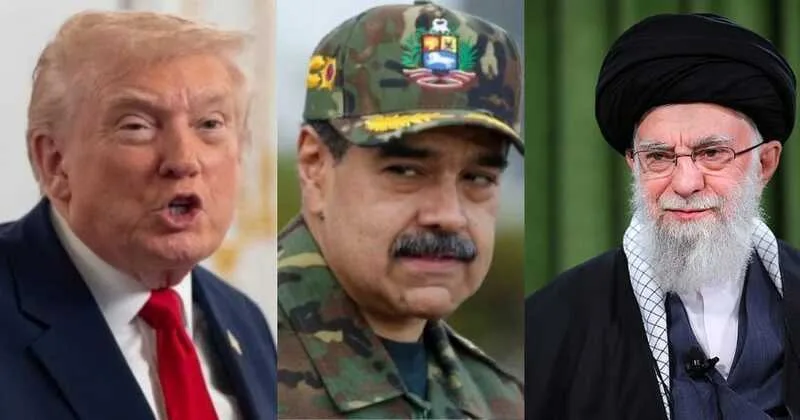
Under president Trump, the US captured Venezuela’s leader Nicholas Maduro and assassinated Iran’s supreme leader Ayatollah Khomeini, intensifying the global oil power battle

Under president Trump, the US captured Venezuela’s leader Nicholas Maduro and assassinated Iran’s supreme leader Ayatollah Khomeini, intensifying the global oil power battle

Facebook
Twitter
WhatsAppTelegramEmail

New York: With the dramatic capture of Venezuelan President Nicolas Maduro alive and the assassination of Iran’s Supreme Leader Ayatollah Ali Khamenei following joint U.S.–Israeli military strikes, the United States appears to have entered a decisive phase in its bid to control the world’s oil markets.

In recent weeks, Washington has intensified its pressure on two of the world’s most significant oil producers, Venezuela and Iran, both of which have vast petroleum reserves that have long challenged U.S. influence. The capture of Maduro and the moves by the U.S. Department of Justice to seize oil shipments and tankers off the Venezuelan coast highlight an aggressive strategy to dismantle Caracas’s oil trade and bring Venezuelan energy resources under American control. Meanwhile, the elimination of Iran’s supreme leader, a central figure in the Islamic Republic’s energy and foreign policy, signals a new and volatile stage in West Asian geopolitics.

For decades, Iran and Venezuela have been among the few producers whose oil could be exported relatively cheaply and outside the full orbit of Western corporate and financial influence. Their disruption, therefore, aligns with U.S. aims to restructure global supply chains in favour of higher-cost producers, including American shale oil, that are more tightly woven into Washington’s geopolitical strategy. In this unfolding geopolitical landscape, Russian oil remains the only major source that has so far resisted full American leverage, as Moscow continues to export crude despite Western sanctions. The global economy is now witnessing what many analysts describe as a new economic war, with Washington’s moves aimed not only at energy dominance but also at weakening geopolitical competitors, most notably China’s energy security. Beijing has reportedly been building strategic oil stockpiles amid fears of broader supply disruptions.

The Strait of Hormuz, a chokepoint only 33 kilometres wide, has emerged as the epicentre of these tensions. Approximately 20% of the world’s oil supply transits this narrow waterway from major Gulf producers including Saudi Arabia, Kuwait, the UAE, Iraq, and Iran. Iranian forces have broadcast orders claiming the strait is closed to all shipping, a declaration that, while not legally binding under international law, has already led oil majors and shipping companies to suspend crude and liquefied natural gas shipments through the passage. A prolonged disruption of traffic through the strait would send shockwaves through global energy markets. Oil prices could surge well above $150 per barrel, as supplies dwindle and market uncertainty rises. This would not only affect energy-dependent advanced economies but also emerging markets which imports lion share of its petroleum needs, mainly from West Asia.

Also Read: Protests erupt in J&K after reported killing of Iran’s supreme leader; Mehbooba Mufti and Mirwaiz condemn strikes

For oil importing states, the implications are severe. A sharp rise in international oil prices will force higher import bills, exacerbating the current account deficit and placing downward pressure on their currency . While remittances from expatriates may benefit from a weaker curency, the broader economy would face increased inflationary pressures as petrol, diesel, and essential goods become more expensive.

Economists warn that supply chain disruptions and higher energy costs could slow economic growth, strain foreign exchange reserves, and trigger volatility in many state’s stock markets. With Western restrictions on Russian oil still in place, oil importing state’s options for cheap crude imports remain limited. How much additional oil it can procure from Russia, and under what conditions, poses yet another strategic challenge for policymakers. In sum, what began as targeted geopolitical actions in Caracas and Tehran now threatens to reshape global energy flows and intensify economic stress worldwide, with emerging countries deeply exposed to the consequences.


Topics: IranIsraelOilStrait of HormuzWest AsiaConflict
Dr Vishnu Aravind
Dr Vishnu Aravind
Dr Vishnu Aravind is a researcher, political commentator and writer based in New Delhi, with a PhD from Jawaharlal Nehru University (JNU). His areas of interest include international politics, Indian foreign policy, electoral politics, election analysis, political developments, and cultural affairs. [Read more]
Share
Tweet
SendShareSend
✮ Subscribe Organiser YouTube Channel. ✮
✮ Join Organiser's WhatsApp channel for Nationalist views beyond the news. ✮
Previous News

From Srinagar to Lucknow, protests erupt after Iran confirms Khamenei’s killing

Next News

Iran witness public celebrations following Ayatollah Khamenei death; Women revive the freedom narrative

Related News

PM Modi holds series of bilateral meetings;(From Left to Right): Malaysia PM Anwar Ibrahim, Ethiopian PM Abiy Ahmed Ali and Iran President Masoud Pezeshkian

BRICS Summit: PM Modi flags maritime security, seafarers safety with Iran President; Holds series of bilateral talks

AI Generated Representative Image

West Asia Conflict: Iran eyes “exclusion zone” near Hormuz, US strikes oil tankers; War escalates as truce collapses

Iran’s deepening currency crisis is squeezing households as soaring prices erode wages, savings and access to basic necessities

Iran’s Rial crashes to record low as US sanctions bite; Iranians blame Islamic regime for deepening economic crisis

Mohammad Reza Naqdi

“Flee Quickly”: Iran’s IRGC threatens Israelis with Banu Qurayza’s fate, reviving a 7th-century tribal genocide

PM Modi held bilateral discussions with Iran President Masoud Pezeshkian on the sidelines of the SCO Summit

SCO Summit: PM Modi meets Iran President; Reaffirms regional stability & freedom of navigation for global security

AI Generated Image

West Asia: 20,000+ Pakistanis deported; Gulf countries flag illegal entry, drug trafficking & national security threat

Load More

Latest News

BRICS Summit 2026: New Delhi Declaration unanimously adopted; PM Modi pitches regional peace & Global South prosperity

BRICS Summit 2026: Troika, seafarers support network & UNSC reforms; PM Modi pitches Global South as “rule shaper”

The Quiet Part of BRICS 2026: “The Plumbing, Not the Currency” — What You Need to Know About the BRICS Currency (AI generated image)

The Quiet Part of BRICS 2026: “The Plumbing, Not the Currency” — What You Need to Know About the BRICS Currency

AI Generated Representative Image

BRICS Summit 2026 | Bajra, Ragi & Rajma: Food served to leaders reflect India’s millets, spices & culinary heritage

Andhra Pradesh: Sadiq Khan admits cyanide killing of Sowjanya’s husband; property motive eclipses Islam conversion

BRICS Summit 2026: New Delhi Declaration to be issued today; India seals diplomatic win amid West Asia crisis

Deoria Horror: Hindu Youth Manish ‘Monu’ Singh allegedly lured to death by Islamist China Ansari

PM Modi holds series of bilateral meetings;(From Left to Right): Malaysia PM Anwar Ibrahim, Ethiopian PM Abiy Ahmed Ali and Iran President Masoud Pezeshkian

BRICS Summit: PM Modi flags maritime security, seafarers safety with Iran President; Holds series of bilateral talks

The shifting economic weight of G7 and BRICS reflects the emergence of a more multipolar global order.

G7 and BRICS: How the global economic balance is shifting from western world to a rising global south

Mukul Kanitkar, senior RSS Functionary at Makhanlal Chaturvedi National University of Journalism and Communication on the occasion of a special lecture to commemorate Swami Vivekananda’s historic Chicago address

Modernity belongs to tools and technology, not culture; culture moves through continuity: Mukul Kanitkar

Load More
  • Privacy
  • Terms
  • Cookie Policy
  • Refund and Cancellation
  • Delivery and Shipping

© Bharat Prakashan (Delhi) Limited.
Tech-enabled by Ananthapuri Technologies

  • Home
  • Search Organiser
  • Bharat
    • Assam
    • Bihar
    • Chhattisgarh
    • Jharkhand
    • Maharashtra
    • View All States
  • World
    • Asia
    • Africa
    • North America
    • South America
    • Europe
    • Australia
  • Editorial
  • Operation Sindoor
  • Opinion
  • Analysis
  • Defence
  • Culture
  • Sports
  • Business
  • RSS @ 100
  • Entertainment
  • More ..
    • Sci & Tech
    • Vocal4Local
    • Special Report
    • Education
    • Employment
    • Books
    • Interviews
    • Travel
    • Health
    • Politics
    • Law
    • Economy
    • Obituary
  • Subscribe Magazine
  • Read Ecopy
  • Advertise
  • Circulation
  • Careers
  • About Us
  • Contact Us
  • Policies & Terms
    • Privacy Policy
    • Cookie Policy
    • Refund and Cancellation
    • Terms of Use

© Bharat Prakashan (Delhi) Limited.
Tech-enabled by Ananthapuri Technologies