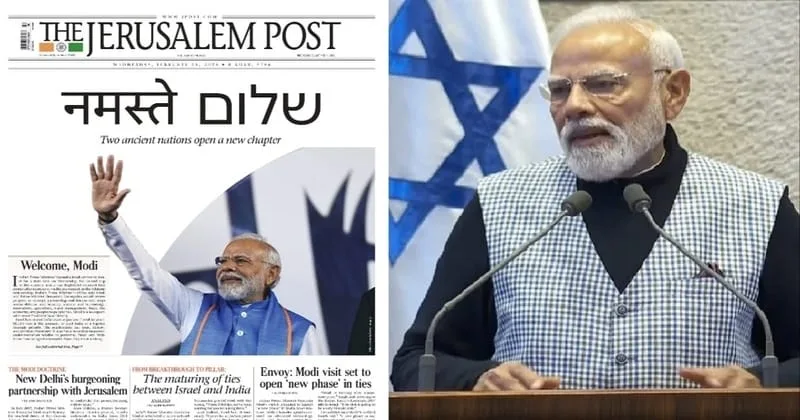
Jerusalem: Prime Minister Narendra Modi featured prominently on the front page of Israel’s leading English-language daily, The Jerusalem Post, as he began his second visit to Israel since assuming office in 2014. PM Modi departed for a two-day state visit on Wednesday morning, marking another significant chapter in the steadily expanding relationship between New Delhi and Jerusalem.
Ahead of his arrival, the newspaper carried a striking front-page tribute headlined “Welcome Modi,” accompanied by the words “Namaste” and “Shalom” written in their respective native scripts, symbolic of the warmth characterising ties between the two nations. Another prominent headline read, “New Delhi’s burgeoning partnership with Jerusalem,” underscoring the rapid growth in bilateral cooperation in recent years.
Editor-in-Chief Zvika Klein shared the front page on the social media platform X, drawing attention to the special coverage dedicated to the Indian Prime Minister. The edition also carried an interview with India’s Ambassador to Israel, JP Singh, who elaborated on the importance of the visit and its broader diplomatic implications. Singh told the Daily that a major highlight of the trip would be Prime Minister Modi’s address to the Knesset, Israel’s Parliament. “One of the most important elements will be that he will be the first prime minister from India to address the Knesset,” Singh was quoted as saying, emphasising the historic nature of the moment.
Historic address to the Knesset
Prime Minister Modi’s visit comes at the invitation of Israeli Prime Minister Benjamin Netanyahu. It marks his second trip to Israel, following his landmark 2017 visit, the first ever by an Indian Prime Minister since the establishment of diplomatic relations between the two countries in 1992.
During his current visit, Modi addressed the Knesset, receiving a standing ovation from Israeli lawmakers after delivering a 30-minute speech. In his address, he pledged “friendship, respect and partnership” with Israel, stating that the relationship between the two countries should serve as “a source of strength in an uncertain world.”
The warm reception highlighted the depth to which India–Israel ties have strengthened under Modi’s leadership. His outreach to Israel reflects a noticeable evolution in India’s foreign policy. While India did not establish full diplomatic relations with Israel until 1992, cooperation in defence, technology, agriculture and innovation has grown significantly over the past decade. At the start of the visit, Modi was welcomed at the airport with a hug from Netanyahu, a gesture that once again underscored the personal rapport between the two leaders. Introducing the Indian Prime Minister at the Knesset, Netanyahu referred to him warmly as “Narendra, my dear friend.”
Strategic partnership in a changing world
The visit is aimed at deepening collaboration across a range of sectors, including trade, defence, security and technological innovation. The growing strategic partnership has assumed greater significance amid shifting geopolitical realities and regional tensions in West Asia.
Netanyahu was effusive in his praise for Modi, describing him as “more than a friend.” In emotionally charged remarks, he thanked the Indian leader for standing firmly with Israel following the October 7, 2023, attacks carried out by Hamas, in which nearly 1,200 Israelis were killed, and around 250 were taken hostage. Modi had been among the first global leaders to condemn the attacks.
“Prime ministers and heads of state come to the Knesset and it’s always an exciting moment for all of us,” Netanyahu said. “But my dear friend Narendra, I’m especially moved by your visit. You are a great friend of Israel and a great leader on the world stage. Narendra, you are more than a friend. You are a brother.”
The Israeli Prime Minister also described Modi as “a great champion of the Israel-India alliance,” underlining the strategic importance Jerusalem attaches to its relationship with New Delhi. The Indian Prime Minister’s visit comes at a time when Israel’s international standing has been tested due to the ongoing war in Gaza. The presence of a major global leader such as Modi is seen as offering diplomatic reassurance and a measure of international support during a challenging period for Israel.
Evolving diplomatic landscape
The enthusiastic reception in the Knesset illustrated the transformation in India–Israel relations over the past decade. Under Modi, the bilateral relationship has moved into a more open and visible phase, encompassing defence procurement, joint military exercises, intelligence sharing, water management, agriculture technology and start-up collaboration.
In his address, Modi stressed the importance of ensuring that the friendship between India and Israel remains resilient amid global uncertainties. He reaffirmed India’s commitment to expanding cooperation while maintaining its independent foreign policy stance.
The visit also reflects India’s broader diplomatic recalibration in West Asia, balancing ties with Israel alongside its longstanding engagement with Arab nations. While India continues to support a two-state solution to the Israel-Palestine conflict, its deepening partnership with Israel has become an important pillar of its regional strategy.
Modi’s 2017 visit had already broken new ground by decoupling India’s Israel policy from its Palestine outreach, signalling a willingness to treat the bilateral relationship on its own merit. The current trip builds on that foundation, reinforcing economic and strategic collaboration at a time of heightened regional complexity.
As Modi concluded his address to the Knesset, lawmakers rose in applause, a symbolic gesture reflecting the growing closeness between the two democracies. The visit, marked by strong political messaging and visible camaraderie between the leaders, is expected to further consolidate ties that have steadily expanded over the past three decades.