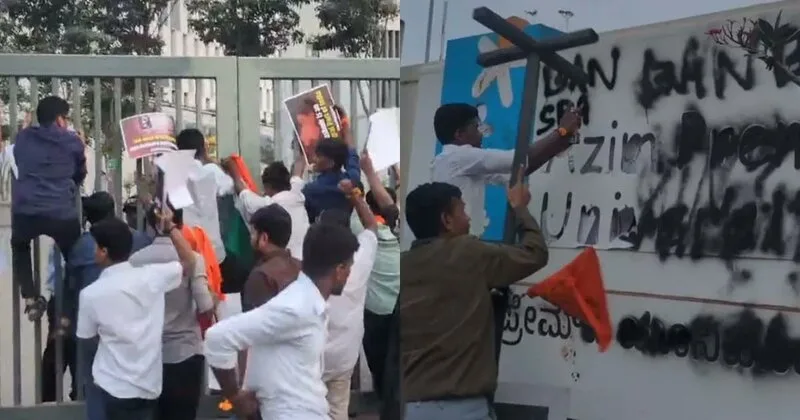
ABVP protests at Azim Premji University over anti-national event
BENGALURU: A major controversy has erupted at Azim Premji University in Sarjapur after the Akhil Bharatiya Vidyarthi Parishad (ABVP) accused student groups SPARK and All India Students’ Association (AISA) of attempting to organise “anti-national” programmes on campus. The ABVP alleged that the proposed events promote Kashmir separatism and insult members of the Indian armed forces.
According to ABVP leaders, SPARK and AISA have scheduled events on February 26, 27 and 28 within the university premises. The student organisation claimed that these programmes are designed to propagate narratives questioning Kashmir’s status as an integral part of India and to portray Indian soldiers in a derogatory light. ABVP members staged a protest outside the university campus, demanding immediate cancellation of the events and action against the organisers.
The protest intensified on Tuesday night, prompting police to step in. A total of 21 ABVP activists were detained from the protest site. An FIR was registered against them for allegedly disrupting peace and violating public order norms. However, they were later released on bail. Police officials stated that the situation remains under control and additional personnel have been deployed around the campus to prevent any escalation.
Escalating its campaign, ABVP has written to Union Home Minister Amit Shah seeking intervention. In its letter, the organisation demanded that SPARK be immediately banned and that the recognition of Azim Premji University be reviewed and, if necessary, cancelled. The letter alleges that educational institutions are increasingly becoming platforms for anti-national discourse under the guise of academic debate.
ABVP’s memorandum claims that AISA, through SPARK, has previously organised discussions and meetings that allegedly described Indian soldiers as perpetrators of violence in Kashmir and expressed support for separatist ideologies. The organisation further alleged that certain past events criticised military operations and voiced solidarity with radical left-wing movements, which, it argued, pose a threat to national unity and integrity.
Addressing the media during the protest, ABVP leader Manikanta Kalasa reiterated the allegations. “We protested in front of Azim Premji University because anti-national activities are being conducted under the banner of SPARK. Statements such as ‘Kashmir is not part of India’ and accusations against our armed forces are unacceptable. We demand strict action against those responsible,” he said.
Kalasa also alleged that during the demonstration, some university students made obscene gestures at ABVP members and attempted to provoke them. He claimed that security personnel prevented ABVP activists from staging their protest with the national flag inside the campus. As a symbolic mark of protest, ABVP members blackened a university signboard, accusing the institution of taking a “wrong step” by allowing the programmes.
So far, the university administration has not issued a detailed public response to the allegations. Sources within the institution indicated that the university upholds constitutional values and remains committed to fostering academic freedom, dialogue and critical inquiry within legal boundaries. They suggested that discussions and seminars on complex socio-political issues are part of the academic environment and do not automatically amount to anti-national activity.
The controversy has reignited the debate over the limits of free expression and dissent within university campuses. While ABVP insists that national integrity must take precedence and that no platform should be given to separatist narratives, others argue that universities are spaces meant for debate and discussion, even on contentious issues.
