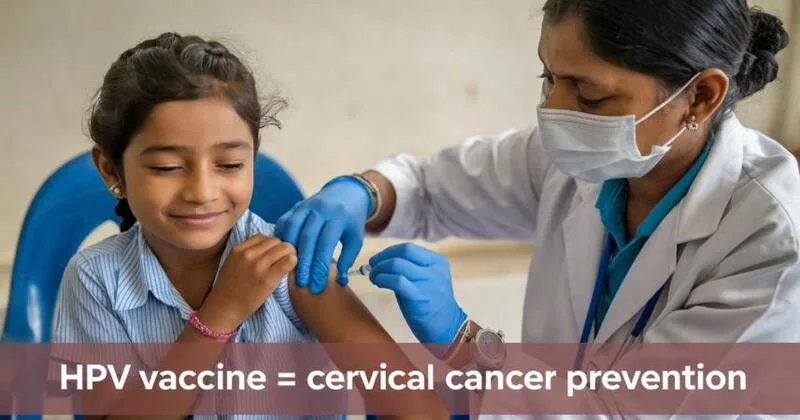
India has launched a nationwide Human Papillomavirus (HPV) vaccination programme for adolescent girls, marking a major public health intervention. Announced in February 2026, this initiative fulfils the Union Budget 2024 commitment and aligns with the World Health Organisation’s goal to eliminate cervical cancer as a public health threat by 2030. The programme will administer the Gardasil vaccine free of cost, focusing on girls in the age group of 9-14 years, with particular emphasis on 14-year-olds in the initial phase.
Behind this announcement, there lies a carefully engineered rollout by the Ministry of Health and Family Welfare. During a three-year catch-up phase, the government plans to vaccinate 1.15 crore girls annually, nearly 2.6 crore doses by 2027. To ensure supply stability, over 1 crore doses of Merck’s Gardasil are being procured through Gavi, the Vaccine Alliance. Implementation relies on India’s existing public health architecture for schools, primary health centres, district hospitals, urban health posts and Ayushman Bharat centres. The digital backbone of this programme is U-WIN, modelled on CoWIN, allowing registration, scheduling, QR-coded certificates and real-time tracking, including in remote villages
On the ground, trained vaccinators, community mobilisers and verifiers coordinate the process. Parental consent is mandatory, reinforcing voluntariness. After vaccination, observation protocols are followed, and any rare adverse events are tracked through the Adverse Events Following Immunisation (AEFI) system.
Pilot phaseswill began in Uttar Pradesh, Bihar and Maharashtra that precede national expansion under the Universal Immunisation Programme (UIP), with the broader rollout scheduled for February–March 2026.
The facts behind the urgency for vaccination
The programme responds to a growing epidemiological reality. HPV types 16 and 18 account for 70 per cent of cervical cancers globally and 85 per cent in India. India contributes one-fifth of the world’s cervical cancer cases, with 123,000 new diagnoses annually, and one-fourth of global deaths, i.e. approximately 75,000 each year
The disease results in a loss of 1.37 million Disability Adjusted Life Years. The age-standardised incidence rate stands at 17.71 per 100,000 women, second only to sub-Saharan Africa. Screening coverage remains under 5 per cent, and vaccination rates for the target group were near 0 per cent before 2022. Cervical cancer is the second leading cancer among Indian women, with peak incidence between 45 and 64 years of age. Without interventions projection indicate 1.25 lakh cases annually by 2030. If 90 per cent coverage is achieved, then up to 90 per cent of cases could be prevented
Science, storage and affordability
The vaccine in use is Gardasil 9, which protects against nine high-risk HPV strains. A single dose offers robust long-term immunity as endorsed by the WHO, and simplifying logistics compared to earlier multi-dose options.
India’s cold chain system, strengthened after Covid with 29 lakh devices, maintains the required temperature of 2–8°C nationwide. Economies of scale have reduced procurement costs to under Rs 400 per dose, compared to Rs 3,000–5,000 in the private market
Awareness campaigns led by ASHA workers, NGOs and media platforms aim to address misconceptions. Demonstration programmes in Tamil Nadu and Punjab reported that there is 80–90% acceptance, offering operational insights for the national drive
India representing its superiority over western world
More than 90 countries have implemented HPV vaccination programmes. In the United States, adolescent coverage stands at 61.4 per cent as of 2023, recovering from a post-COVID dip to 55 per cent, with 31% parental refusal cited.
The United Kingdom reports uptake between 75–80 per cent, while Europe averages 50–60%. Australia has achieved coverage above 90 per cent. The United States continues to record around 4,000 cervical cancer deaths annually despite 20 years of a vaccination programme. Indian chain supply, ASHA workers and the first line of defence i.e. healthcare facilitators during COVID, have successfully represented its supremacy.
Affordable Antiretroviral (ARV) therapy for HIV/AIDS
In the early 2000s, antiretroviral therapy (ART) in many Western countries cost more than $10,000 per patient per year. Indian pharmaceutical manufacturers began producing WHO-prequalified generic ARVs at a fraction of that price, reducing costs in several low-income countries to under $100 per patient annually. This shift dramatically expanded access to HIV treatment across Africa and parts of Asia. The impact has restructured global treatment affordability through large-scale and standards-compliant generic production.
Indigenous vaccine development: Rotavac
India’s development of Rotavac, an indigenous rotavirus vaccine, marked a significant step in modern biomedical research and translational capacity. Rotavirus is a leading cause of severe diarrhoeal disease in infants, particularly in low-resource settings. While Western vaccines were available, cost remained a barrier for widespread inclusion in national immunisation programmes. Rotavac was introduced at a significantly lower price point, enabling broader public health deployment. The programme demonstrated India’s growing competence in clinical trials, vaccine innovation and affordable biologics manufacturing at scale.
Oral Rehydration Therapy (ORT) – Clinical validation and public health scale
Oral Rehydration Therapy emerged as one of the most important public health interventions of the 20th century for treating diarrhoeal diseases. Its scientific basis evolved through global research collaboration. Indian health systems helped to demonstrate that a simple glucose-salt solution could drastically reduce mortality from dehydration caused by cholera and other diarrhoeal illnesses. The subsequent nationwide integration of ORS into primary healthcare frameworks contributed significantly to reducing child mortality and positioned India as a key implementer in global diarrhoeal disease control strategies.
These are a few incidents that suggest India will win this war on HPV by saving younger girls. If the HPV vaccination programme is implemented effectively, the programme could reduce cervical cancer incidence in vaccinated decreases by 70-90 per cent and potentially save Rs 10,000 crore in treatment costs. It will be integrated with PM-JAY screening initiatives, and the U-WIN platform adds institutional support
As the February-March 2026 rollout proceeds, the initiative will represent a national response to a preventable disease. Anchored in public financing, digital monitoring and existing health infrastructure, the HPV vaccination programme seeks to alter the trajectory of cervical cancer in India through scale, coordination and sustained coverage.