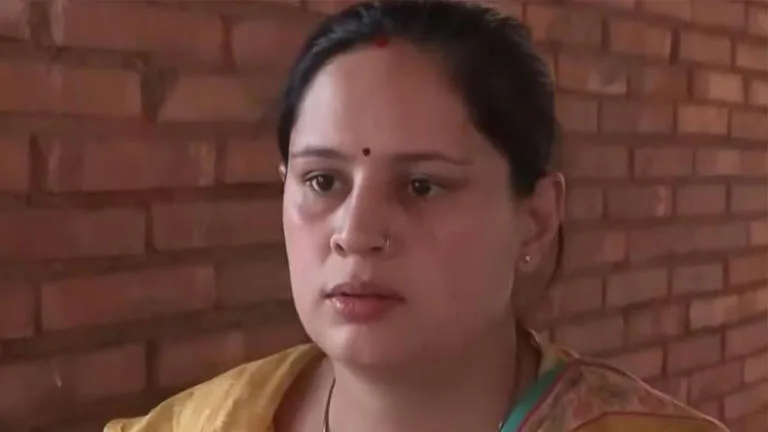
At a press conference in Delhi on Feb 23, producer Vipul Amrutlal Shah and director Kamakhya Narayan Singh unveiled their upcoming film The Kerala Story 2: Goes Beyond. At the event, the filmmakers were joined by 33 women survivors of forced religious conversions and shared their stories.
The event saw participation from victims from Bengal, Bihar, Bhilwara, Gangapur, Rajkot, Udaipur, Jammu, Maharashtra, Bhopal, Indore, Jharkhand, Faridabad, Meerut, Delhi, Noida, and Gurgaon. Vipul Shah, addressing the media at the event, stated that they had brought forward victims not only from Kerala this time but from across Bharat, showing the intensity of the crime described as “Love Jihad.”
One of the first survivors to speak was Ranchi’s national shooter Tara Shahdeo, who explained in detail how she was tricked into marrying a man who first presented himself as Ranjit Kohli and later revealed his identity as Rakibul Hasan. After escaping, Tara fought the case, and in October 2023 he was sentenced to imprisonment along with his mother.
Tara narrated her story, saying, “Before coming here, I had seen many comments of people saying all of this is fake and false and that propaganda is being deliberately pushed. My case dates back to 2014. For you this may be a story, but I have lived the worst nightmare of my life. I thank God every day because I dared to get out of that place alive; otherwise they would have killed me.”
She added, “In 2014, as a national-level shooter, my performance was at its peak. What happened to me was unreal. The man I met was from an officer-level background and met me at my shooting range. A judge brought his proposal for me. My mother had died a few months back and they knew I was vulnerable, and my father was also ill. They tracked me. I was emotionally weak and hence they targeted me. The judge told my father that the boy was very good and only had his mother, who would keep me as her daughter.”
She said people often questioned her.
“People often ask me why I did not inquire. My father and brother inquired about them very carefully. All their inquiries proved them to be a decent family. They appeared to be an established Hindu family with offices, workplaces, and everything. Their friends were officers ranked as DSPs, judges, and others. So it is not just my fault. I am a common person. You know me as Tara Shahdeo; we also knew them as Hindus, well-established families. But there are people who live with double identities.”
She said she came to know about his true identity only after marriage.
“Within a few days of the judge bringing the proposal, I got engaged to him. I got married at the Radisson Blu hotel according to Hindu rituals. It was a grand wedding. I am from Ranchi and the man I married lived in the same city, so after my vidai I was taken to his house,” she added.
“My engagement took place at his house because his mother had surgery. At that event the house looked like a traditional Hindu home. There were swastikas, Om symbols, and posters of Hindu gods and goddesses.”
“I got married on July 7, 2014. The same night I was taken to his house. I slept, and the next morning when I stepped out of the room the house looked completely different. It was not the same house anymore. There were pictures of Mecca and Medina and symbols of Allah. I felt terrified and wondered where I had come,” she said.
“I rushed to the mother of this man and questioned her. In response she pushed me away and said, ‘This is the truth and you will have to live here.’”
“I tried calling my father and my brother. I also called the judge who fixed this marriage. He managed to convince my family not to come the very next day, but he himself came. He introduced me to my husband saying, ‘Meet this Janab, he is Rakib-ul-Hasan.’ I had married this man as Ranjit Singh but now he was calling him Rakib-ul-Hasan,” she shared.
“He said if I wanted everything to go well in my life then I should do as they told me. They said they would not harm my father and brother if I cooperated.”
“I had no idea what Love Jihad was, but I clearly remember my conversation with the judge that day. He said a Qazi would come for the Nikah and ask me three times to say ‘Qubool Hai’ and I would have to repeat it.”
“I searched for my phone to call my family and tell them I did not want to do this, but they threatened me. They said they would frame my brother in a false rape case and my father under the Arms Act. It was not difficult for them because those threatening me included a judge and a DSP-rank officer.”
“I had no option. I asked them why they were doing this. They said I had to follow everything they told me. They said now I was Sara Parveen and my identity had been completely changed.”
“When I refused to change my identity they said I must do the nikah and say Qubool Hai three times. I had seen this in movies. The nikah was organised. The judge came, the Qazi arrived, and the Advocate General was also there,” she told.
“The woman posing as Ranjit’s mother kept threatening me. She said everything would be fine from the next day if I cooperated.”
“They asked me to say Qubool Hai three times and then asked me to sign papers changing my name to Sara Parveen. I refused to sign those papers. Saying Qubool Hai was one thing because I had married him the day before in front of everyone, but changing my name was not acceptable.”
“That is where the fight began. They gave me time but kept threatening me in the name of my father and brother.”
“They told me I was not the only one and many girls before me had followed this path.”
She described how her life changed drastically.
“The newspapers carried stories of my friends winning medals in national championships while I was trapped there.”
She continued, “I received a call from my father. They wanted to meet me the next day, but the family said there was a wedding and asked for time. They said they had gone out somewhere. This continued for a few days. I kept saying that I needed time because I wanted to understand how I could escape. I did not want anything to happen to my father or my brother because of me. I also kept thinking whether society would accept us if the truth came out.”
She further added, “I come from a Rajput family where honour and dignity are very important. My mother always taught me that respect matters above everything else.”
“Then that man suddenly slapped me and said that if I wanted to live I would have to do exactly what he said.”
She narrated, “That slap broke everything.”
“That very day I decided I would not spare him and would bring out the truth. At that time I did not even fully understand what I had become a victim of. I stayed with that man for 40 days, thinking every day about how I could escape alive. He beat me, had dogs bite me, and tried several times to sexually exploit me. I was taken to the house of that Muslim judge and forced to eat beef. They tried every way to break me.”
She added, “When my father and brother came looking for me they were told we had gone out somewhere. My phone had been taken away and whenever I spoke the speaker was turned on. All I wanted was for my father and brother to remain safe and for me to regain my dignity.”
She described the network she claimed to have witnessed.
“This was not a normal incident. These people were like terrorists. I saw satellite phones in the house. He had many phones and SIM cards and money came from different countries. Sometimes bags full of cash arrived. This was not a simple case of a girl falling in love. It was systematic. Many girls came to that house. Most were students who wanted admission to colleges. They lured them with promises of admission. They understood weaknesses and used them. My weakness was my father and brother,” she added.
“All I wanted was to get out alive.”
She described difficulties in escaping, “Police bodyguards stood outside the apartment. I could not escape. Where would I go? To a police station where DSP-level officers visited his house? It felt like the whole system had become a mockery. I was afraid. But I decided I would not die there.”
She credited a domestic worker, “A domestic worker helped me escape. I remain grateful to her. She encouraged me. I gave her my father’s number and told her to call when the time came.”
One day an opportunity came, “A man came to inform him his Delhi flight was confirmed. I realised I had one chance. I gave my brother’s number to the domestic worker. My father filed a complaint but police hesitated. Eventually they came.”
She described the rescue attempt.
“They arrived late. His mother said the girl had tried to escape. She called the judge. The judge told police to keep me there. The police said ‘Yes sir’. I warned my father and brother not to touch me.”
She described a confrontation.
“The DSP and judge arrived. They said I would not be allowed to leave. The police started leaving. I said I would jump. A woman officer refused to leave me. She said she would keep me in custody. That was the moment I came out of darkness.”
Then the police took her to hospital. She was referred to Rajendra Institute of Medical Sciences.
She said, “The next morning their people came. I feared poisoning. I asked doctors to change the spelling of my name. I was admitted in the trauma ward among male patients.”
Soon media coverage spread.
She shared, “My father asked if I wanted to fight. I said yes. He said I was his honour and dignity. That was the beginning.”
She described the legal battle.
“When FIR was registered in September 2014 they called it domestic violence. That was not my case. I met the Chief Minister. I said I did not trust police. A senior officer threatened my father. My father said we would fight.”
Eventually the Central Bureau of Investigation took over.
“It took a year. I had evidence but no one believed me. The accused was given four days before arrest.”
She praised media coverage, “Without media I might not have survived. He was arrested near the Delhi-Haryana border.”
She emphasised wider implications, “This is not just one girl’s story. Many girls face this.”
She spoke about social stigma.
“Hindu girls are blamed. He said I could not show my face. He forced me to wear a burqa. I refused.”
She described the outcome, “The case went on for nine years. In 2024 the judgment came. The main accused received life imprisonment. The judge received 15 years. His mother received 10 years. But the fight continues. They are applying for bail.”
She said, “Some people say this is fiction. But this is truth. I thank everyone who supported me.”
She concluded, “Without media the truth would not come out.”
“Thank you.”
Shahdeo, after the event concluded, told the media that, she first encountered the term “love jihad” through media coverage following her marriage.
“That was the first time I heard the word Love Jihad through the media. At that time I did not even know what the word meant.”
She added she initially believed justice would be swift and punishment would deter similar incidents.
The shooter described films such as The Kerala Story as “eye-opening” for society.
Speaking about stigma, Shahdeo said, “More than half of society believes the girl made mistakes. This is not just a girl’s mistake.”
She said awareness could prevent suffering.
The sequel has sparked strong reactions since its trailer launch. Opposition leaders, celebrities and social media users criticised it as propaganda. The filmmakers maintain it is based on research.
Shahdeo said public discussion is necessary.